
State Action Plans - Frequently Asked Questions
1). Why develop a State Action Plan on CO2 Emissions Reduction Activities? - The Top 10 Reasons
Based on States’ direct return on experience, ICAO has been able to identify the top 10 reasons for developing and submitting a State Action Plan:
- Develop a better understanding of the share and projections of international aviation CO2 emissions;
- enhanced cooperation between all aviation stakeholders that can positively reflect on their operational areas;
- identification of the most relevant mitigation actions;
- streamlining of policies;
- enhancing stakeholders’ support and understanding for policy decisions;
- establishment of cross-sectoral partnerships;
- promotion of capacity building;
- multiplication of the environmental effects of mitigation measures;
- facilitation of technology transfer; and
- identification of assistance needs.
2). How does a State develop or update a State Action Plan?
Below is the complete process of developing or updating a State Action Plan.
1. Nominate a State Action Plan (SAP) Focal Point
The State should nominate a Focal Point by sending their contact information to ICAO (actionplan [at] icao.int;officeenv [at] icao.int).
This Focal Point:
- Is responsible for developing the SAP;
- Is the main point of contact between the State and ICAO on questions related to the SAP;
- Will be granted access to dedicated tools and resources developed by ICAO;
- Is generally from the CAA or Ministry of Transport;
- Is responsible for submitting the State Action Plan to ICAO and keeping the document up-to-date.
2. The SAP Focal Point should contact ICAO for support (actionplan [at] icao.int)
ICAO will provide the State Action Plan Focal Point with assistance throughout the SAP development/update process. Once an official State Action Plan Focal Point nomination has been received, ICAO will be able to grant access to dedicated tools and resources developed to support Focal Points, such as the Action Plan on Emissions Reduction (APER) website. This website includes many resources free of charge for SAP Focal Points, including:
- ICAO Document 9988 - Guidance on the Development of States' Action Plans on CO2 Emissions Reduction Activities;
- The Environmental Benefits Tool (EBT);
- The Marginal Abatement Cost (MAC) Curve Tool;
- Presentations from past Seminars and Workshops.
The State Action Plan Focal Point should familiarize themself with these materials before continuing to the next step.
For more information on the ways that ICAO can support the State Action Plan development or update process, please see "State Action Plans – Frequently Asked Questions: 6. How can ICAO help in the State development of a State Action Plan on CO2 Emissions Reduction Activities?"
3.The SAP Focal Point should establish a National Action Plan Team
This team should consist of representatives from the State's aviation stakeholders, potentially including, but not limited to:
- Airlines
- Airports
- Air Navigation Service Providers
- Ministry of Environment
- Ministry of Energy
- Fuel producers
- Aircraft manufacturers
- Research institutions or Universities
For more information, please see "State Action Plans – Frequently Asked Questions: 3. Who is involved in a State Action Plan on CO2 Emissions Reduction Activities?"
4. The SAP Focal Point develops the SAP, with support from the National Action Plan Team
At minimum, a complete SAP contains five elements:
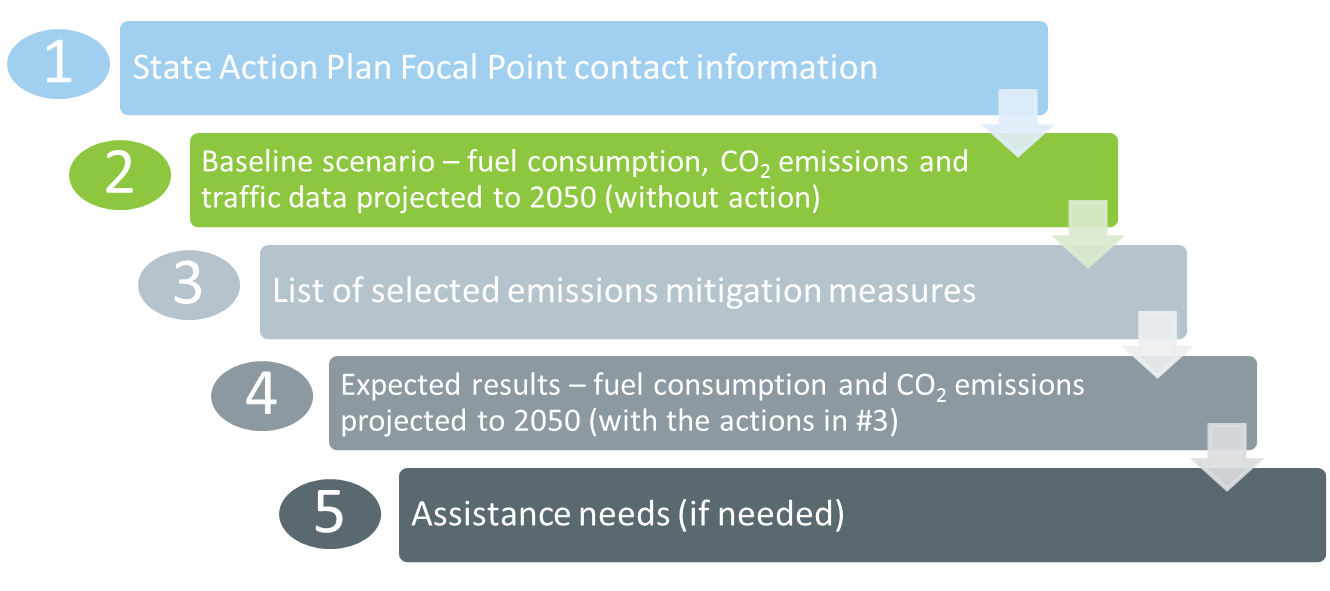
The dedicated guidance materials and tools developed to support State Action Plan Focal Points provide detailed guidance on completing this process.
ICAO is available to answer detailed questions about any of these points (actionplan [at] icao.int) and can also provide comments on draft versions of the document.
5. Submit the SAP to ICAO
An official submission can be made via the Action Plan on Emissions Reduction (APER) website, via email to actionplan [at] icao.int (actionplan[at]icao[dot]int), or via mail to ICAO Headquarters.
6. Keep the SAP up-to-date
ICAO requests that States update their State Action Plan at least every three years; however, States are also encouraged to submit updated information on an annual basis.
3). Who is involved in a State Action Plan on CO2 Emissions Reduction Activities?
First, a State nominates a State Action Plan Focal Point, usually from the DGCA. He/she will coordinate the development of the State Action Plan and interact with ICAO and all of the key aviation stakeholders. These stakeholders can include:
- aviation authorities;
- environmental authorities;
- airlines;
- airports;
- air navigation service providers;
- statistical departments;
- fuel providers; and
- any other relevant stakeholders.
The degree and nature of collaboration among these stakeholders is a key aspect of successfully developing and implementing a State Action Plan. Collecting information from these stakeholders and consolidating this input into a State Action Plan ensures that the development of the plan is based on a cooperative process and that the measures contained therein are accurate, comprehensive, and feasible to implement.
4). What does a State Action Plan on CO2 Emissions Reduction Activities contain?
At a minimum the following information is contained in a State Action Plan:
- Contact information for the officially nominated State Action Plan Focal Point;
- Baseline Scenario: Projected international aviation traffic for the State, fuel consumption and CO2 emissions for the State until 2050 (without action);
- List of selected measures proposed for mitigating CO2 emissions from international civil aviation;
- Expected Results: Estimated impact of the selected mitigation measures on the baseline scenario until 2050 (including fuel consumption and CO2 emissions); and
- Identification of any assistance needs (financial, technological, training, etc.) for the State.
5). How can a State reduce their CO2 emissions from international aviation?
ICAO has agreed to a "Basket of Measures" to address CO2 emissions, including:
- Aircraft Technology
- Operational Improvements
- Sustainable Aviation Fuels
- Market-Based Measures (Carbon Offsetting and Reduction Scheme for International Aviation (CORSIA))
Each of these measures includes a range of potential activities to reduce emissions. Click on each measure to learn more about ICAO's activities in these areas.
6). What is the relationship between State Action Plans and CORSIA?
State Action Plans are a big-picture document that captures information related to all of a State's activities related to addressing CO2 emissions from international civil aviation. CORSIA is one element of the basket of measures, so relevant actions by the State to implement CORSIA can be included in the State Action Plan, as noted in State Action Plan FAQ #5 above.
Please note that the "baseline scenario" in terms of the present and future CO2 emissions projection established by each State in their State Action Plan is different from the State's CO2 emissions in the CORSIA "baseline years" of 2019 and 2020. However, the information reported to the State through the CORSIA MRV system can serve as a basis for the fuel consumption and CO2 emissions data in the State Action Plans.
For more information on CORSIA, click here.
7). What is the ICAO State Action Plan Buddy Programme?
In line with ICAO Resolution A39-2 Para 12, the ICAO State Action Plan Buddy Programme invites States that have already submitted their State Action Plan on CO2 Emissions Reduction Activities to ICAO to partner with Member States that have not prepared their State Action Plans, in order to support those States.
For detailed information about the ICAO State Action Plan Buddy Programme, please visit the dedicated ICAO Buddy Partnerships webpage.
8). How can ICAO help in the development of a State Action Plan on CO2 Emissions Reduction Activities?
ICAO Document 9988 - Guidance on the Development of States’ Action Plans on CO2 Emissions Reduction Activities
This guidance document has been developed to specifically support the officially nominated State Action Plan Focal Point of each State with the development or update of their State’s Action Plan. It was developed with the goal of accommodating the various levels of experience among States in the development of similar national reports. This document provides step-by-step guidance on how to develop an action plan. In addition to facilitating the preparation of the State Action Plan, this guide can contribute to improving the reporting of CO2 emissions and the implementation of emissions mitigation projects for aviation.
Based on feedback received from States that developed State Action Plans using the First and Second Editions of this Document, feedback from ICAO Council, and observations from recently submitted State Action Plans, a Third Edition of this guidance document has recently been developed. This version of the document will be made available to State Action Plan Focal Points as soon as possible.
Web Interface
To facilitate the submission of State Action Plans and minimize the burden on States, ICAO has developed a dedicated web interface that can be used by State Focal Points to upload and submit action plans electronically. This interface is called the Action Plans for Emissions Reductions (APER) website.
This website includes:
- Instructions for online submission;
- Guidance Document 9988 - Guidance on the Development of States’ Action Plans on CO2 Emissions Reduction Activities;
- The Environmental Benefit Tool (EBT) - a tool that is designed for use by State Action Plan Focal Points to quantitatively estimate the benefits attributable to the implementation of various mitigation measures;
- Links to the publicly available tools (IFSET, ICAO Carbon Calculator); and
- Downloadable presentations from past training seminars.
The web interface also allows States to securely upload their State Action Plan and/or additional supporting documentation directly to ICAO as electronic documents.
Technical Transfer
Through the Technical Cooperation Bureau (TCB), ICAO can suggest a technology transfer to States. A technology transfer can refer to the transmission of skills, knowledge and technologies.
As example of a technology transfer, ICAO can provide services of international consultants and instructors and can establish and develop Civil Aviation Training Centres (CATCs).
Technical Support
ICAO Environment has developed several tools to help States calculate their carbon emissions (ICAO Carbon Emissions Calculator, ICAO Meeting Emissions Calculator) and estimate fuel saving (ICAO Fuel Savings Estimation Tool). These tools can all be accessed on the ICAO Environmental Toolkits webpage.
Furthermore, Technical Cooperation Bureau (TCB) can provide technical support to States. TCB has expertise in Air Traffic Management Systems, Airport efficiency and infrastructure (i.e. Power generation, minimizing taxiing distance, etc.), and so on. For more information on TCB fields, please visit the ICAO TCB website: http://www.icao.int/secretariat/TechnicalCooperation/
Additional Resources
The ICAO Environment public website includes a variety of additional resources for States interested in conducting additional research on mitigation measures.
For more information on technology, States are invited to visit the ICAO Environment Technologies and Standards webpage.
For more information on operations, States are invited to visit the Operational Improvements webpage.
For more information on sustainable aviation fuels, States are invited to visit the ICAO Environment Sustainable Aviation Fuel webpage, including the ICAO Global Framework for Aviation Alternative Fuels (GFAAF).
In collaboration with UNITAR, ICAO also developed an online training course "International Aviation: Intro to States' Action Plans to reduce CO2".
States are also invited to reference the ICAO 2019 Environmental Report.
Capacity Building
ICAO recently completed two capacity-building programs, which included support in regard to the development of State Action Plans. For more information about these capacity-building projects, please visit the ICAO Environment Capacity-Building and Assistance webpage.
Support Team
States with specific questions regarding State Action Plans are invited to contact the ICAO State Action Plan team directly. The State Action Plan Team can answer questions and provide detailed assistance throughout the process of developing and updating a State Action Plan.
| Office | Name | Contact details |
| ICAO Headquarters, ATB, Environment | ICAO State Action Plan Team | E-mail: actionplan [at] icao.int (actionplan[at]icao[dot]int ) |
| Asia and Pacific (APAC) | Mr. Peter Dunda | Email: PDunda [at] icao.int (PDunda[at]icao[dot]int ) Tel: +66 (0)2 537 8189 ext. 153 |
| Eastern and Southern African (ESAF) | Ms. Chingamidzai Mazhetese | Email: cmazhetese [at] icao.int (cmazhetese[at]icao[dot]int) |
| European and North Atlantic (EUR/NAT) | Ms. Blandine Ferrier | E-mail: bferrier [at] icao.int (bferrier[at]icao[dot]int ); actionplan [at] icao.int (actionplan[at]icao[dot]int ) Tel: +33 1 4641 8572 |
| Middle East (MID) | Mr. Radhouan Aissaoui | E-mail: RAissaoui [at] icao.int (RAissaoui[at]icao[dot]int) Tel: +202 2267 4840/ 41/ 45/46 |
| North American, Central American and Caribbean (NACC) | Mr. Luis Raúl Sánchez Vargas | E-mail: LSanchez [at] icao.int (LSanchez[at]icao[dot]int ) Tel: +52 55 5250 3211 |
| South American (SAM) | Mr. Jorge Armoa | E-mail: jarmoa [at] icao.int (jarmoa[at]icao[dot]int ) Tel: +51 1 611 8686 |
| Western and Central Africa (WACAF) | ICAO State Action Plan Team | E-mail:actionplan [at] icao.int ( actionplan[at]icao[dot]int ) |
9). What happens after my State submits a State Action Plan?
1. Upon submission of a State Action Plan, ICAO will include your State in the list of States and map of States that have submitted a State Action Plan on the State Action Plan homepage. If your State has provided permission to post the complete State Action Plan on the public webpage, ICAO will also include a link to download the document next to the State's name in the submission table.
2. The ICAO State Action Plan Team will review the document and provide comments for the State Action Plan Focal Point's consideration. ICAO has developed an informal standardized feedback form in order to capture the essential elements of the State Action Plans submitted by ICAO Member States and also with the view to providing constructive input for future updates.
3. States are encouraged to continue regular discussions with their stakeholders and to submit quantified updates to the State Action Plan at least every three years.
10). Seminars for State Action Plans on CO2 Emissions Reduction Activities
ICAO provides workshops and seminars around the world dedicated to the development and update of State Action Plans. States can also request special training by contacting ICAO. By knowing States' needs in terms of training, ICAO will be able to organize more specific meetings. For examples of past and upcoming ICAO Environment seminars and meetings, please visit the ICAO Environment Events webpage.
In addition to these seminars, ICAO worked with UNITAR to develop a dedicated State Action Plan training programme, available online and free-of-charge at the following link: https://unccelearn.org/course/view.php?id=26
To request specific assistance related to State Action Plans or to make suggestions for future events, please contact ICAO at actionplan [at] icao.int (actionplan[at]icao[dot]int) or officeenv [at] icao.int (officeenv[at]icao[dot]int).
SAP 10th Anniversary Celebration
The official date of the 10-year anniversary for the ICAO State Action Plan initiative is 8 October 2020. This historic event has been highlighted in multiple ways including online events in the region in order celebrate and to keep abreast on latest developments and best practices in the development and update of State Action Plans.
| Regions | Dates |
| EUR/NAT | January 14-15, 2021 |
| SAM | December 9, 2020 |
| MID | January 25, 2021 |
| APAC | April 22, 2021 |
| ESAF-WACAF | December 7, 2020 |
Virtual meetings on States Action Plan Environment Tools
During the pandemic, ICAO optimized its support to State by offering a variety of trainings to States on the use of environment tools to prepare or update State Action Plans.
| Regions | Dates |
| EUR/NAT | November 19-20, 2020 |
| EUR/NAT | October 22, 2020 |
| ESAF-WACAF | November 17, 2020 |
| ESAF-WACAF | December 1st, 2020 |
| ESAF-WACAF | June 17, 2020 |
| ESAF-WACAF | June 23, 2020 |
Regional Seminars on State Action Plans (Virtual)
During 2020, due to COVID-19 pandemic, ICAO Headquarters and Regions conducted two-day virtual training seminars for Regional Focal Points and responsible authorities. The training was given to 93 States and 209 participants.
| Regions | Dates |
| NACC-SAM | July 27-28, 2020 |
| EUR/NAT | July 29-30, 2020 |
| ESAF-WACAF | August 3-4, 2020 |
| APAC | August 5-6, 2020 |
| MID | August-25-26, 2020 |
EUR/NAT Workshops on State Action Plans development
In 2017-2019, a series of training workshops were organized in the EUR/NAT region to support States in the development and update of their State Action Plans, and use of the ICAO ENV related tools.
| Location | Dates |
| Turkey | 29-31 May 2017 |
| Cape Verde | 27-28 February 2018 |
| Azerbaijan | 3-5 December 2018 |
| Belarus | 8-10 October 2019 |
ICAO / AFCAC Joint Workshop on the Development of States' Action Plans
In 2017, 2 Workshops on the Development of States' Action Plans on CO2 emissions mitigation activities and CORSIA were organized.
| Location | Dates |
| Lagos, Nigeria | 23 to 25 August 2017 |
| Lusaka, Zambia | 28 to 30 August 2017 |
Regional Seminars on States Action Plans, with a hands-on Tutorial Session for State Action Plan Focal Points 2017
ICAO organized 5 Regional Seminars in 2017, with a view to provide officially nominated State Action Plan Focal Points and aviation industry stakeholders with practical input on the calculation of the CO2 emissions baseline and other quantification aspects.
| Region | Country | Dates |
| NACC & SAM | Rio de Janeiro, Brazil | 27 to 30 March 2017 |
| EUR/NAT | Bonn, Germany | 3 to 6 April 2017 |
| APAC | Jakarta, Indonesia | 10 to 13 April 2017 |
| ESAF & WACAF | Nairobi, Kenya | 10 to 13 April 2017 |
| MID | Cairo, Egypt | 18 to 20 April 2017 |
ICAO-EU Assistance Project, Phase 1
As part of the ICAO-EU Assistance Project Phase 1 and in order to support States in the development of their State Action Plans, a series of training workshops were organized between 2014 and 2018.
| Country | Dates |
| Santo Domingo, Dominican Republic: Kick-off Seminar (Caribbean region) | 11 to 12 December 2014 |
| Yaoundé, Cameroon: Kick-off Seminar (African region) | 3 to 6 February 2015 |
| Port of Spain, Trinidad and Tobago: Second Capacity Building Seminar (Caribbean region) | 13 to 15 October 2015 |
| Nairobi, Kenya: Second Capacity Building Seminar (African region) | 24 to 27 November 2015 |
| Libreville, Gabon: Third Capacity Building Seminar (African region) | 31 October to 4 November 2016 |
| Punta Cana, Dominican Republic: Third Capacity Building Seminar (Caribbean region) | 13 to 16 December 2016 |
| Punta Cana, Dominican Republic: Fourth Capacity Building Seminar (Caribbean region) | 12 to 13 July 2018 |
| Mombasa, Kenya: Fourth Capacity Building Seminar (African region) | 12 to 14 December 2018 |
Regional States Action Plans Seminars 2014 - 2015
With a view to supporting its member States in their efforts to take action on aviation and climate change, on 1 April 2014 ICAO launched a series of back-to-back ICAO "International Aviation and Environment" and "States' Action Plans" Seminars, conducted in each ICAO Region.
| Region | Country | Dates |
| NACC | Mexico City, Mexico | 1 to 4 April 2014 |
| SAM | Lima, Peru | 7 to 10 April 2014 |
| WACAF | Yaoundé, Cameroon | 10 to 13 June 2014 |
| ESAF | Nairobi, Kenya | 16 to 19 June 2014 |
| APAC | Kuala Lumpur, Malaysia | October 2014 |
| MID | Dubai, United Arab Emirates | February 2015 |
| EUR/NAT | Warsaw, Poland | Spring 2015 |
| ICAO HQ | Montreal, Canada | Autumn 2015 |
Regional hands-on training workshops 2011 - 2012
Between 2011 and 2012, ICAO organized several regional training workshops, during which 91 States representing 93% of global international air traffic were trained. During these workshops, focal points were trained to use the Web interface and were asked to provide feedback on ICAO Doc 9988. ICAO also worked directly with individual States and State Action Plan Focal Points to assist in the development of action plans.
| Region | Country | Dates |
| NACC & SAM | Mexico City, Mexico | 2 to 4 May 2011 |
| APAC | Bangkok, Thailand | 25 to 27 May 2011 |
| MID | Dubai, United Arab Emirates | 14 to 16 June 2011 |
| ESAF & WACAF | Nairobi, Kenya | 4 to 6 July 2011 |
| EUR/NAT | Paris, France | 11 to 13 July 2011 |
| ICAO HQ | Montréal, Canada | 21 to 23 November 2011 |
| ESAF & WACAF | Dakar, Senegal | 24 to 26 September 2012 |