
Aviation Taxation
Introduction
The ICAO Assembly, consisting of 193 ICAO Member States, has expressed an overwhelming concern about the increasing number of initiatives to collect taxes from international aviation for the mobilization of revenue for climate change and other purposes, emphasizing the need for significant financial resources to achieve aviation’s clean energy transition.
The Assembly recognized that such initiatives would represent duplicative market-based measures (MBMs), leading to double-charging for aviation CO2 emissions, and negatively impacting the implementation of Carbon Offsetting and Reduction Scheme for International Aviation (CORSIA) and ultimately the achievement of the long-term global aspirational goal for international aviation (LTAG) of net-zero carbon emissions by 2050.
ICAO Assembly Resolution A42-21, paragraph 19: "While recognizing that no effort should be spared to obtain means to support the reduction and stabilization of CO2 emissions from all sources and emphasizing the need for significant financial resources to achieve aviation’s clean energy transition and the LTAG, urges that ICAO and its Member States express a clear concern, through the UNFCCC and other relevant processes, on the use of international aviation as a potential source for the mobilization of revenue for climate finance to the other sectors, in order to ensure that international aviation would not be targeted as a source of such revenue in a disproportionate manner; "" |
ICAO Assembly Resolution A42-22, paragraph 18:
"Determines that the CORSIA is the only global market-based measure applying to CO2 emissions from international aviation so as to avoid a possible patchwork of duplicative State or regional MBMs, thus ensuring that international aviation CO2 emissions should be accounted for only once; "" |
Background
The concept of aviation taxation for environmental purposes is not new. ICAO first considered environmental levies around 1995 and early studies by the ICAO Committee on Aviation Environmental Protection (CAEP) examined various options. However, views among States differed, including concerns from developing countries about the potential economic impacts. Against this backdrop, the ICAO Assembly continued to urge against the unilateral implementation of greenhouse gas emissions charges.
The need for a harmonized global approach under ICAO’s leadership became increasingly evident as a patchwork of national and regional measures emerged in the late 2000s. ICAO, supported by expert groups and high-level groups, advanced technical and policy work on market-based measures (MBMs) and concluded that levy-based options were not effective. In 2013, ICAO Member States agreed to develop a global MBM to address international aviation emissions.
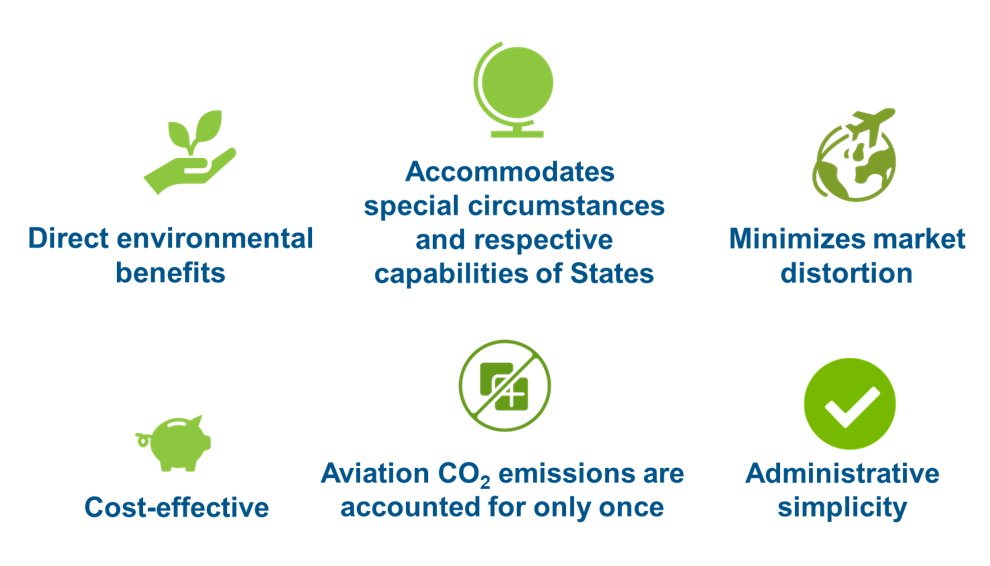
In 2014, the ICAO Council established the Environment Advisory Group (EAG) to oversee the work on the global MBM and to make recommendations to the Council. A series of ICAO Global Aviation Dialogues (GLADs) were organized across all regions in 2015 and 2016 to share information regarding the global MBM options and for ICAO to receive inputs, ensuring No Country is Left Behind. Participants provided valuable feedback on the global MBM options, emphasizing the importance of administrative simplicity, ensuring environmental integrity, and maintaining cost-effectiveness while opposing the use of aviation as a revenue source.
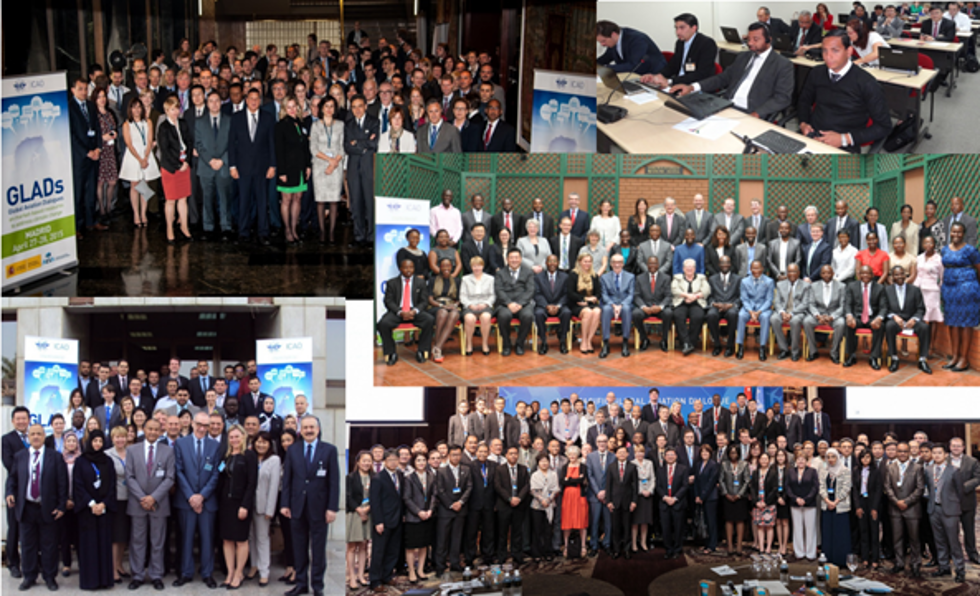
ICAO Global Aviation Dialogues (GLADs) held across all regions in 2015 and 2016
At the 39th ICAO Assembly in 2016, a landmark agreement was achieved on CORSIA, the first and only global MBM scheme adopted by any industry sector, while avoiding a fragmented system of overlapping national or regional schemes. CORSIA was designed to complement in-sector CO2 emissions mitigation measures such as technological and operational improvements as well as aviation cleaner energies, toward the achievement of the ICAO global aspirational goal of carbon neutral growth from 2020 (CNG2020).

CORSIA provides a cost-effective and administratively simple approach, requiring airlines to collectively offset emissions growth above a baseline level, with phased implementation that accommodates special circumstances and respective capabilities of States.
Issues with aviation taxation for environmental purposes
Ongoing proposals by certain UN bodies, organizations, and stakeholders regarding aviation taxes, levies, and other forms of MBMs are concerning since they risk undermining the extensive efforts and significant achievements made to develop and implement CORSIA as per the agreements under ICAO. Such proposals would hinder the efforts and progress made in advancing the implementation of measures to reduce aviation CO2 emissions, including aviation cleaner energies which requires trillions of dollars in investment.
Overlapping aviation levies and taxes will also increase air travel costs. This could have a particularly negative impact on Small Island Developing States (SIDS) and developing countries with a heavy reliance on tourism and trade by air transport. Such a shift could undermine the economic viability of airlines and tourism-related businesses, hinder socio-economic development, and delay progress towards achieving multiple UN Sustainable Development Goals (SDGs).


| Publications | Overview and links |
|---|---|---|
1 | ICAO Environmental Report 2025 | A Recap of ICAO’s Journey towards 2016 CORSIA Agreement |
2 | Statements and Submissions to UNFCCC Subsidiary Body for Scientific and Technological Advice (SBSTA)
| The biannual Statements and Submissions by ICAO to the UNFCCC Subsidiary Body for Scientific and Technological Advice (SBSTA) communicate the aviation sector’s environmental policies and progress to the UN climate process, including the topic of climate finance.
|
3 | Evolution of Market-based Measures and ICAO''s Journey to CORSIA | This publication reviews the 30-year evolution of ICAO’s MBMs discussions, explaining why Member States adopted CORSIA in 2016 instead of aviation levies or taxes or other MBMs.
Full publication link: Evolution of Market-based Measures and ICAO''s Journey to CORSIA
Uniting Aviation (summarised version) link: |
4 | ICAO Doc 10018 Report of the Assessment of Market-based Measures
| This 2013 report evaluates the feasibility, environmental benefits, and economic impacts of global MBMs for international aviation, providing the analytical foundation that ultimately supported the development of CORSIA.
Link: ICAO Doc 10018 |
5 | ICAO Doc 8632 ICAO's Policies on Taxation in the Field of International Air Transport
| This ICAO policy document contains the consolidated Council resolution on taxation of international air transport and associated commentary on the resolution.
Link: ICAO Doc 8632 |
6 | 1996 ICAO Council Resolution on Environmental Charges and Taxes | The 1996 ICAO Council resolution outlines the aviation sector's position and ICAO recommendations to States on environmental charges and taxes.
|

| Events | Overview and links |
|---|---|---|
1 | ICAO outreach at COP 31
9 to 20 November 2026 | Upcoming* |
2 | ICAO Aviation Climate Week 2026
2 to 4 June 2026
| This session discussed concerns regarding aviation taxation for climate objectives, and why CORSIA was agreed as the global MBM to address international aviation CO₂ emissions, while preserving international connectivity.
Recording link: Session 11 – Aviation Taxation for Environmental Purpose - ICAO TV
Presentation link: Aviation-Taxation-for-Environmental-Purpose.pdf |
3 | 42nd Session of the ICAO Assembly – Environment
23 September 2025 to 3 October 2025 | This webpage serves as a comprehensive source of information on environmental protection topics discussed at the 42nd ICAO Assembly.
This includes concerns expressed against levies and/or taxation on international aviation emissions which were submitted for Agenda Item 17: Environmental Protection – CORSIA in WP/295 by the Arab Civil Aviation Organization (ACAO) on behalf of 21 Arab States, WP/122 by the African Civil Aviation Commission (AFCAC) on behalf of 54 African States, and WP/322 by IATA, as well as submitted for Agenda Item 26: Economic Development of Air Transport in WP/181 by the United States and WP/267 by IATA.
Webpage link: 42nd Session of the ICAO Assembly – Environment Website |
4 | ICAO outreach at COP 30
10 to 21 November 2025 | This webpage shares various materials and information about ICAO’s participation at COP30, showcasing international aviation’s progress on climate action as well as ongoing challenges. This includes financing aviation’s cleaner energy transition and proposals for aviation taxation for environmental purposes.
Webpage link: Environmental Protection - ICAO at COP30
ICAO presentation: International Aviation and SDG7: Accelerating the Global Clean Energy Transition Skyward |
5 | ICAO virtual side event “Financing for Sustainable Aviation – challenges and opportunities in the pursuit of the Net Zero 2050 goal for international aviation” at the 4th International Conference on Financing for Development (FfD4)
3 July 2025 | This FfD4 side event organized by ICAO explored initiatives within the aviation sector to reduce emissions, the challenges in securing financing, and opportunities for enhanced international cooperation. A key focus was placed on supporting developing countries and States with specific needs, in line with ICAO’s No Country Left Behind initiative.
Recording link: 4th International Conference on Financing for Development - Environmental Protection - ICAO TV
ICAO presentation: Financing for Sustainable Aviation: Opportunities and Challenges in the Pursuit of Net Zero by 2050 |
6 | ICAO Aviation Climate Week 2025
2 to 4 June 2025
| This session discussed the needs and opportunities to finance aviation decarbonization projects, as well as the latest developments on the operationalization of the ICAO FINVEST Hub.
Recording link: Session 8.1 - High Level Panel – Unlocking Climate Finance
ICAO presentation: Scene-setting – Unlocking Climate Finance |