
42nd Session of the ICAO Assembly - Environment
A42 Resolutions
- Resolution A42-20: Consolidated statement of continuing ICAO policies and practices related to environmental protection - General provisions, noise and local air quality
- Resolution A42-21: Consolidated statement of continuing ICAO policies and practices related to environmental protection - Climate change
- Resolution A42-22: Consolidated statement of continuing ICAO policies and practices related to environmental protection - Carbon Offsetting and Reduction Scheme for International Aviation (CORSIA)
A42 Working Papers on Environmental Protection
Overview of A42 Working Papers on Environmental Protection presented by the Council of ICAO
| Submitted for adoption is a proposal for the revisions to Assembly Resolution A41-20, Consolidated statement of continuing ICAO policies and practices related to environmental protection General provisions, noise and local air quality. It reflects developments since A41 on civil aviation and the environment, including trends in aircraft noise and emissions, the development of SARPs and guidance, and relevant developments in other UN bodies and international organizations.
|
|
|
|
|
|
|
| Submitted for adoption is a proposal for the revisions to Assembly Resolution A41-22, Consolidated statement of continuing ICAO policies and practices related to environmental protection Carbon Offsetting and Reductions Scheme for International Aviation (CORSIA), which has been revised considering developments since A41 on the implementation of CORSIA. |
Long-term global aspirational goal for international aviation (LTAG)
The 41st Session of the ICAO Assembly in October 2022 adopted the LTAG for international aviation of net-zero carbon emissions by 2050 in support of the UNFCCC Paris Agreement's temperature goal. This is a historic agreement that reinforces the leadership of ICAO on issues relating to international aviation and climate change.
In November 2023, just one year after the Assembly, the Third ICAO Conference on Aviation and Alternative Fuels (CAAF/3) adopted the ICAO Global Framework for Sustainable Aviation Fuels (SAF), Lower Carbon Aviation Fuels (LCAF) and other Aviation Cleaner Energies (Appendix A of A42-WP/25). Under the ICAO Global Framework, ICAO and its Member States have agreed to strive to achieve a collective global aspirational Vision to reduce CO2 emissions in international aviation by 5 per cent by 2030, through the use of aviation cleaner energies.
Details and developments related to the implementation of the LTAG and ICAO Global Framework are provided in A42-WP/25 and A42-WP/27.
ICAO Roadmap for the implementation of the CAAF/3 outcomes and the LTAG: Four Building Blocks
In June 2024, the Council further approved the ICAO Roadmap for the implementation of the CAAF/3 outcomes and the LTAG (Appendix B of A42-WP/25). ICAO is making progress on the implementation of the ICAO Roadmap, whilst recognizing the importance of making a balanced progress between the four interdependent Building Blocks of 1) policy and planning, 2) regulatory framework, 3) implementation support, and 4) financing. Materials and developments related to the four building blocks are provided below.
 | Building Block 1 (Policy and Planning)
Details can be found in Appendix D of A42-WP/25
|
| Building Block 2 (Regulatory Framework)
Details can be found in Appendix D of A42-WP/25
|
 |
Building Block 3 (Implementation Support)Details can be found in Appendix E of A42-WP/25
|
 | Building Block 4 (Financing)
Details can be found in Appendix G of A42-WP/25
|
JOIN ACT-SAF NOW!
Participation is open to ICAO Member States, Organizations and Stakeholders interested in taking action to develop SAF initiatives. For those interested in further information, an e-mail can be sent to the Office of Environment (officeenv [at] icao.int).
Carbon Offsetting and Reduction Scheme for International Aviation (CORSIA)
The 39th Session of the ICAO Assembly in 2016 agreed on CORSIA as the first global market-based measure adopted by any industry sector to address CO2 emissions from international activity. It was designed to complement the basket of mitigation measures to reduce CO2 emissions from international aviation, including aircraft technologies, operational improvements and sustainable fuels.
CORSIA is the only global market-based measure applying to CO2 emissions from international aviation so as to avoid a possible patchwork of duplicative State or regional Market-Based Measures, thus ensuring that international aviation CO2 emissions should be accounted for only once.
Details and developments related to CORSIA are provided in A42-WP/28.

JOIN ACT-CORSIA NOW!
Participation is open to ICAO Member States to support CORSIA implementation. For States interested in further information, an e-mail can be sent to the Office of Environment (officeenv [at] icao.int (officeenv[at]icao[dot]int)).
Noise and Local Air Quality
The Thirteenth Meeting of the Committee on Aviation and Environmental Protection CAEP (CAEP/13) held in February 2025 agreed on several recommendations as a result of its technical and analytical work over the last triennium, including the integrated dual stringency Standards for noise and CO2 emissions.
Details are available in A42-WP/24 and on ICAO's website on Aircraft Noise and Local Air Quality.
Climate Change Adaptation and Science
ICAO Council's Committee on Aviation Environmental Protection (CAEP) has also undertook a number of activities on climate change adaptation and resilience. In February 2025, CAEP updated the Climate Adaptation Synthesis Report by compiling the latest information on the projected climate impacts on the aviation sector and outlining possible adaptation and resilience measures. Further Information on climate change adaptation is available on ICAO's website.
Work related to non-CO2 aviation emissions and contrails has also progressed. The ICAO Symposium on Non-CO2 Aviation Emissions was organized in 2024 to take stock of the scientific knowledge on non-CO2 aviation emissions and their impacts, and share relevant work undertaken by ICAO and relevant stakeholders. Details can be found on ICAO s website on non-CO2 aviation emissions.
A42-WP/26 also covers the recent developments in climate change adaptation and non-CO2 emissions.
Resources
 | 2025 ICAO Environmental Report To read the report, click here. |
 | A42 Skytalks will be broadcasted live on ICAO TV
|
 |
ICAO's Aviation's Cleaner Energy video Click here to watch the video. |
 | ICAO's Progress and Achievements in Environmental Protection video Click here to watch the video. |
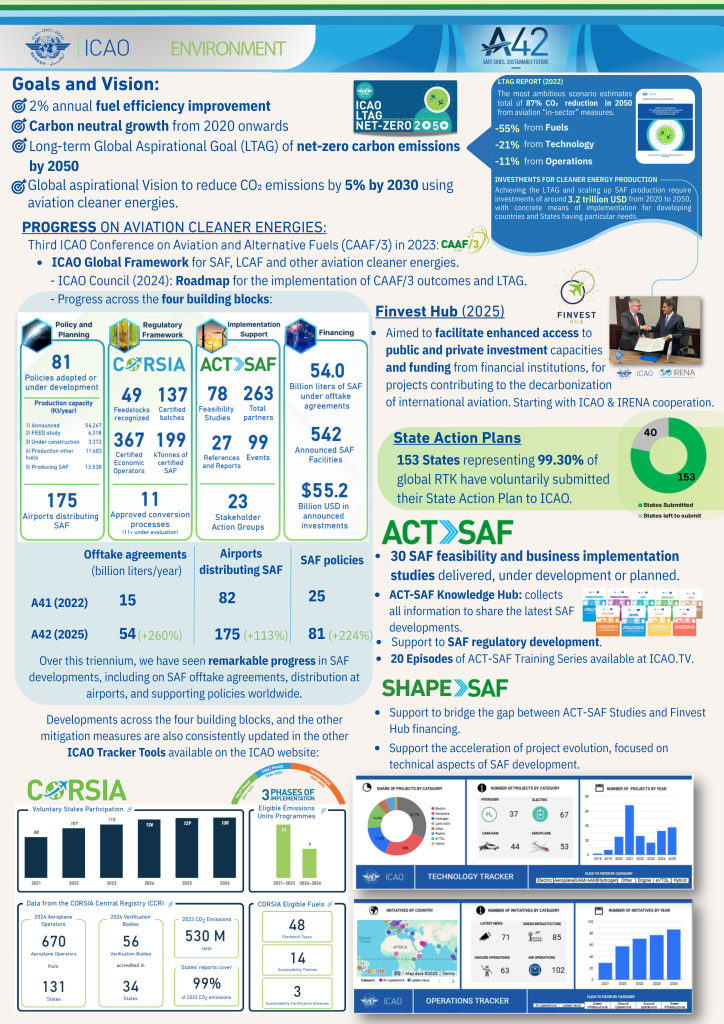 | Leaflet To read the leaflet, click here. |