
Guidance on Airport Air Quality
ICAO recognizes that airport-related sources of emissions have the ability to emit pollutants that can contribute to the degradation of air quality of their nearby communities. As such, national and international air quality programmes and standards are continually requiring airport authorities and government bodies to address air quality issues in the vicinity of airports. Similarly, attention must also be paid to other possible airport-related environmental impacts associated with noise, water quality, waste management, energy consumption and local ecology in the vicinity of airports, to help ensure both the short- and the long-term welfare of airport workers, users and surrounding communities.
One the initiatives that ICAO has undertaken to improve air quality are the creation and continued updating of the guidance Document 9889 "Airport Air Quality Manual". The manual provides guidance to assist with the assessment of airport emission sources, emission inventories and emissions allocation. Assessing the local air quality industry-specific in a broader local context is complex and comprises several aspects (Figures 1). The first step to addressing local air quality is to obtain an accurate estimate of the types and amounts of contaminants being introduced to the airshed. Then efforts to reduce these emissions can be pursued. The two main areas of an air quality assessment are: the emissions inventories; and the dispersion modelling of pollution concentrations.
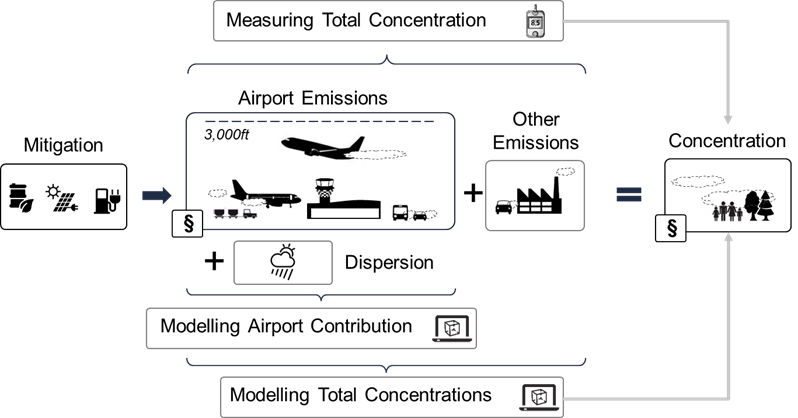
Figure 1. Airport air quality framework
An emissions inventory gives the total mass of emissions released into the environment and provides a basis for reporting, compliance, mitigation planning, and can be used as input for modelling pollution concentrations. In order to link emissions to pollution concentrations, the spatial and temporal distribution of the emissions have to be assessed as well. This combined approach of using emissions inventories and dispersion modelling enables the assessment of historical, existing and/or future pollution concentrations in the vicinities of airports or from individual emissions sources.
The emissions inventory, concentration modelling and ambient measurement elements of an air quality assessment can be used individually or in combination to aid the process of understanding, reporting, compliance and/or mitigation planning by providing information on overall conditions as well as specific source contributions. Subsequent air quality mitigation or other implemented measures (with proper consideration of the interrelationship with, primarily, noise and other airport environmental impacts) can have beneficial results for the total emissions mass, the concentration model results and measured concentrations.
In the CAEP/13 cycle, a focus has been set on the modelling of particle matter (PM) emissions, addressing not only non-volatile particle emissions, but newly the volatile particle emissions from aircraft main engines. This considerably helps to not only better understand local air quality at and around airports, but also to bridge the gap between measured PM concentration which usually contain both total particle mass and numbers with modelled values.
Additionally, during CAEP/13 the consideration of the use of sustainable aviation fuels (SAF) in the context of local air quality has been addressed. SAF will play an important role in the decarbonization of aviation with local air quality benefits alongside. Acknowledging that SAF in the more global context is assessed for their carbon benefits, particularly over their full lifetime, Doc 9889 just looks at direct emissions from the engines.