
国际民航组织期刊
The objective of the Journal is to provide a concise account of the activities of the International Civil Aviation Organization and to feature additional information of interest to Contracting States and the international aeronautical world.
 (ICAO Journal is available in English only from 2013)
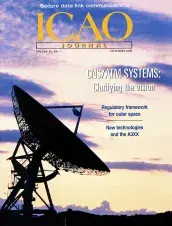
The Journal's feature articles this month focus largely on the application of advanced technologies and include an assessment of the effort to implement new communications, navigation, surveillance and air traffic management (CNS/ATM) systems that use satellites. The pace of implementation has slowed in some respects - but as part of an incremental and migratory strategy.
Recursion, stop!
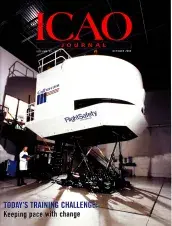
The task of training in an era of fast-paced change is not an easy undertaking. Regional solutions and global cooperation will be needed to ensure that sufficient human resources are available at the right place and time to enable air transport to grow safely and efficiently. This month's issue features several articles on today's training challenges and solutions.
Recursion, stop!
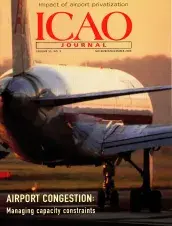
One of the more significant challenges facing congested international airports today is the process of managing limited capacity. A recent ICAO study looks at possible improvements to the existing system of slot allocation.
Recursion, stop!
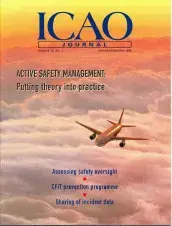
This month's edition focuses on enhancing aviation safety. As highlighted by the article beginning on page 15, one important step in bolstering safety is to assess compliance with the ICAO standards and recommended practices.
Recursion, stop!
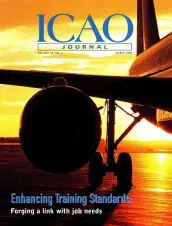
Without a direct link to the process of creating licensing standards, training programmes cannot always achieve consistent and acceptable results. As the article beginning on page 4 indicates, enhanced training standards may represent the solution.
Recursion, stop!

Aeronautical data have taken on new importance in an era of data-dependent navigation systems, and international action is required to standardize the presentation and display of such information in electronic format. An overview of future AIS-related requirements begins on page 4. Featured on this month's cover is a flight management system map display depicting the aircraft's navigation situation, weather, navaids, active flight plan and the planned route.
Recursion, stop!

Human factors is a critical aspect of aviation safety that ICAO began to address, primarily by sensitizing the industry to this new dimension of safety, almost a decade ago. Inside are several articles on human factors issues in different aviation disciplines, with particular focus on management of human error.
Recursion, stop!

Annual Report on Civil Aviation - ICAO's look back at the major developments in civil aviation in 1998 includes numerous statsitics that reflect important trends in the industry.
Recursion, stop!

Articles in this month's edition focus on environmental issues, including a report from Lufthansa that emphasizes the importance of demonstrating a commitment to environmental protection.
Recursion, stop!

Airports are under pressure to change as authorities respond to conflicting demands for more capacity and greater operational and economic efficiency without compromising safety. For an overview of the major issues facing airports, see article beginning on page 4.
Recursion, stop!

A new-generation navigation satellite system under development in Europe is expected to become operational in 2008. A report on the definition phase of the project, intended to serve all modes of transport worldwide, begins on page 4.
Recursion, stop!

The first model in Boeing's new family of 737 twin-jets, the 737-700, obtained U.S. type certification in November 1997 and has since entered airline service. Two other models in the "Next Generation" family of airliners, the -600 and -800, are expected to enter service during 1998, while development of the 737-900 is now under way.
Recursion, stop!