  • English
  • Français
User account menu
  • Log in
Accueil
International Civil Aviation Organization
Boutique OACI
User account menu
  • Log in
Seach MENU
À propos de l'OACI

À propos de l`OACI

  • Vue d’ensemble
  • Plan stratégique 2026-2050
  • Dernières nouvelles et faits saillants
  • FAQ
  • Liste – États membres de l’OACI
  • Musée de l’OACI
  • Calculateur de carbone
  • Dénoncer une faute
  • Joindre l'OACI

Corps diplomatiques

  • Assemblée de l’OACI (193 États)
  • Sessions de l’Assemblée
  • Résolutions en vigueur
  • Conseil de l’OACI (36 États)
  • Président du Conseil
  • Sessions du Conseil
  • Représentants des États au Conseil
  • Commission de navigation aérienne

Secrétariat de l’OACI

  • Secrétaire général
  • Direction de la navigation aérienne
  • Direction du transport aérien
  • Direction du renforcement des capacités et de la mise en œuvre
  • Direction des affaires juridiques et des relations extérieures
  • Direction de l’administration et des services
  • Bureaux régionaux
Priorités mondiales

Objectifs stratégiques

  • Chaque vol est sûr et sécurisé
  • L’aviation est durable sur le plan environnemental
  • • Initiative CORSIA
  • • Plans d'action des États pour la réduction des CO2 en aviation
  • • Finvest Hub
  • Une mobilité fluide, accessible et fiable
  • Aucun pays laissé de côté
  • • Renforcement des capacités et soutien à la mise en œuvre
  • Un cadre juridique exhaustif
  • Développement économique

Enablers

  • ICAO Continuous Improvement
  • Innovation dans l'aviation
  • Professionnels de l'aviation de la prochaine génération
  • Égalité des sexes et OACI
  • Programme OACI des Ambassadeurs Mondiaux
  • Formation OACI
  • Partnerships and Resource Mobilization
Événements

Événements en vedette

  • Atelier régional conjoint OACI/AWG sur la transférabilité transfrontières des aéronefs (XBT) et le respect de la Convention du Cap (CTC)
  • Symposium mondial sur le soutien à la mise en œuvre 2026
  • Quatorzième réunion du Groupe d’experts de la facilitation (FALP/14)
  • 4e Forum des conseillers juridiques en aviation civile (CALAF/4)
  • Voir la liste complète des réunions et événements passés et à venir
  • Organisez votre événement à l'OACI
Ressources

Ressources

  • Bibliothèque électronique de l'OACI
  • Publications
  • Rapports annuels du Conseil
  • Résultats des audits de sécurité - Interactif
  • Rapport sur les avantages de l'aviation
  • Faits et chiffres économiques
  • Plan mondial de sécurité aérienne
  • Rapports de sécurité
  • Plan mondial de navigation aérienne
  • Rapports de navigation aérienne
  • Programme de partenariat de l'OACI
  • Service de données API de l'OACI
  • ICAO Data+
  • ICAO iSTARS
  • Moniteur mensuel du transport aérien
  • Compendium : Politiques/pratiques de concurrence
  • Analyses économiques et prévisions
  • Bases de données et études
  • Rapports sur l'environnement
  • Publications sur l'environnement
  • Compendium de la stratégie TRIP de l'OACI
  • Aviation sans pilote
  • Données d'aviation GIS de l'OACI
Carrières
Articles en vedette
OACI TV
S'abonner
À propos de l'OACI
À Propos De L`oaci
  • Vue d’ensemble
  • Plan stratégique 2026-2050
  • Dernières nouvelles et faits saillants
  • FAQ
  • Liste – États membres de l’OACI
  • Musée de l’OACI
  • Calculateur de carbone
  • Dénoncer une faute
  • Joindre l'OACI
Corps Diplomatiques
  • Assemblée de l’OACI (193 États)
  • Sessions de l’Assemblée
  • Résolutions en vigueur
  • Conseil de l’OACI (36 États)
  • Président du Conseil
  • Sessions du Conseil
  • Représentants des États au Conseil
  • Commission de navigation aérienne
Secrétariat De L’oaci
  • Secrétaire général
  • Direction de la navigation aérienne
  • Direction du transport aérien
  • Direction du renforcement des capacités et de la mise en œuvre
  • Direction des affaires juridiques et des relations extérieures
  • Direction de l’administration et des services
  • Bureaux régionaux
Priorités mondiales
Objectifs Stratégiques
  • Chaque vol est sûr et sécurisé
  • L’aviation est durable sur le plan environnemental
  • • Initiative CORSIA
  • • Plans d'action des États pour la réduction des CO2 en aviation
  • • Finvest Hub
  • Une mobilité fluide, accessible et fiable
  • Aucun pays laissé de côté
  • • Renforcement des capacités et soutien à la mise en œuvre
  • Un cadre juridique exhaustif
  • Développement économique
Enablers
  • ICAO Continuous Improvement
  • Innovation dans l'aviation
  • Professionnels de l'aviation de la prochaine génération
  • Égalité des sexes et OACI
  • Programme OACI des Ambassadeurs Mondiaux
  • Formation OACI
  • Partnerships and Resource Mobilization
Événements
Événements En Vedette
  • Atelier régional conjoint OACI/AWG sur la transférabilité transfrontières des aéronefs (XBT) et le respect de la Convention du Cap (CTC)
  • Symposium mondial sur le soutien à la mise en œuvre 2026
  • Quatorzième réunion du Groupe d’experts de la facilitation (FALP/14)
  • 4e Forum des conseillers juridiques en aviation civile (CALAF/4)
  • Voir la liste complète des réunions et événements passés et à venir
  • Organisez votre événement à l'OACI
Ressources
Ressources
  • Bibliothèque électronique de l'OACI
  • Publications
  • Rapports annuels du Conseil
  • Résultats des audits de sécurité - Interactif
  • Rapport sur les avantages de l'aviation
  • Faits et chiffres économiques
  • Plan mondial de sécurité aérienne
  • Rapports de sécurité
  • Plan mondial de navigation aérienne
  • Rapports de navigation aérienne
  • Programme de partenariat de l'OACI
  • Service de données API de l'OACI
  • ICAO Data+
  • ICAO iSTARS
  • Moniteur mensuel du transport aérien
  • Compendium : Politiques/pratiques de concurrence
  • Analyses économiques et prévisions
  • Bases de données et études
  • Rapports sur l'environnement
  • Publications sur l'environnement
  • Compendium de la stratégie TRIP de l'OACI
  • Aviation sans pilote
  • Données d'aviation GIS de l'OACI
Carrières
Articles en vedette
OACI TV
Boutique OACI
S'abonner
  • English
  • Français

Breadcrumb

  1. Accueil
  2. Sustainable Aviation Fuels (SAF)

Sustainable Aviation Fuels (SAF)


Sustainable aviation fuels (SAF) are defined as renewable or waste-derived aviation fuels that meets sustainability criteria1. Technical analysis done at ICAO shows that SAF has the greatest potential to reduce CO2 emissions from International Aviation.
 

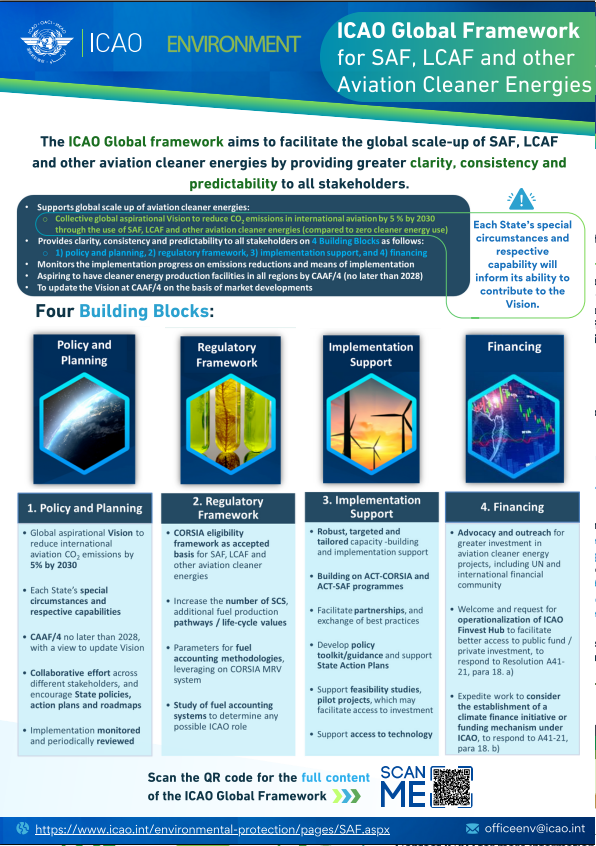
ICAO is working to facilitate SAF development and deployment through the four building blocks of the ICAO Global Framework for SAF, LCAF and other Aviation Cleaner Energies:
 

1) Policy and Planning - SAF policies and goals

​The ICAO Global Framework for Sustainable Aviation Fuels (SAF), Lower Carbon Aviation Fuels (LCAF) and other Aviation Cleaner Energies includes a collective global aspirational Vision to reduce CO2 emissions in international aviation by 5 per cent by 2030, compared to zero cleaner energy use.
 
The framework, agreed at the Third ICAO Conference on Aviation and Alternative Fuels, is built across four building blocks: policy and planning; regulatory frameworks; implementation support; and financing.
 
 
These building blocks are interconnected and need to advance and work together to achieve their intended purpose
 
​
ICAO Global Framework Leaflet
 
 
The ICAO Global Framework for Sustainable Aviation Fuels (SAF), Lower Carbon Aviation Fuels (LCAF) and other Aviation Cleaner Energies includes a collective global aspirational Vision to reduce CO2 emissions in international aviation by 5 per cent by 2030, compared to zero cleaner energy use. The framework, agreed at the Third ICAO Conference on Aviation and Alternative Fuels, inclues actions 


​Long-term global aspirational goal (LTAG)
 

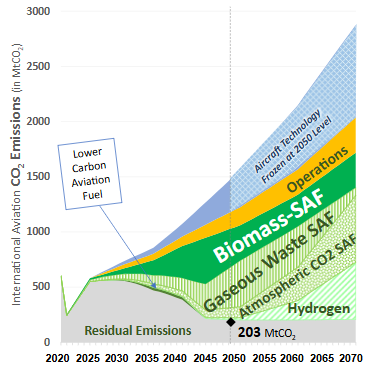
The 41st ICAO Assembly adopted a long-term global aspirational goal (LTAG) for international aviation of net-zero carbon emissions by 2050 in support of the UNFCCC Paris Agreement's temperature goal. This historic agreement reinforces the leadership of ICAO on issues relating to international aviation and climate change. The adopted Resolution A41-21 is available here. 
 
The LTAG report shows that SAF has the greatest potential to reduce CO2 emissions from International Aviation. 
 
The LTAG and fuels website details the fuels-related information contained in the LTAG analysis. 

​


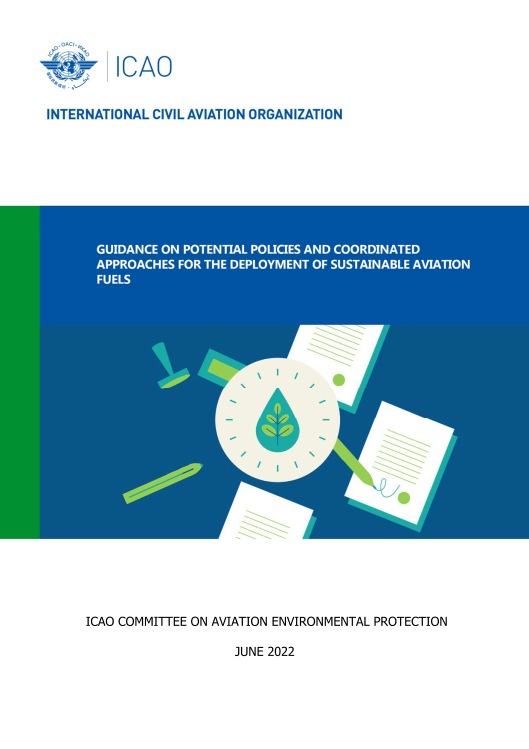
​Guidance on potential policies and coordinated approaches for the deployment of SAF (2023)

 
This guidance summarizes potential policies and coordinated approaches for the deployment of SAF, completing a toolbox of guidance material for use by ICAO Member States together with the ICAO SAF Rules of Thumb.


​SAF rules of thumb - what does it take to produce SAF?


The "SAF Rules of Thumb" can be utilized to support policy development. They provide order of magnitude estimations related to SAF costs, investment needs and production potential. These "SAF rules of thumb" complete a toolbox of guidance material for use by ICAO Member States together with the "Guidance on potential policies and coordinated approaches for the deployment of SAF"
 

SAF Trends and Short-term Projections - The possible contribution of SAF to the ICAO environmental goals is also being assessed by CAEP as part of the ICAO Global Environmental Trends and SAF short-term projections.
 

2) Regulatory framework - Globally-accepted environmental Standards for SAF
 

​

CORSIA includes methodologies that allow aircraft operators to reduce its offsetting requirements through the use of SAF and Lower Carbon Aviation Fuels (LCAF). These include globally-accepted sustainability criteria and life cycle methodologies. 


Specific details on how SAF is considered under CORSIA are provided in the ICAO Environmental Report 2019, Chapter 6 - An Overview of CORSIA Eligible Fuels (CEF). Related documents are provided in the CORSIA eligible fuels website.


information on fuel batches and economic operators that are certified under CORSIA is provided on the CORSIA certified fuels website.


​SustCriteriaCover.png
​LCAMethodologyCover.png
Sustainability criteria 
 

​Life cycle methodologies


3) Implementation Support
 
​

ACT-SAF - ICAO Assistance, Capacity-building and Training for Sustainable Aviation Fuels


The ICAO ACT-SAF Programme is supporting States to develop their full potential in SAF, through specific training activities, development of feasibility studies, and other implementation support initiatives.
 
The ICAO ACT-SAF Series of events is providing comprehensive training to ACT-SAF Partners on an array of important SAF-related topics, ranging from sustainability, to policy, economics/financing certification and logistics. All the presentations are available for download; the trainings can be visualized on ICAO.TV and YouTube.
 
​ACT-SAF.svg


SAF Feasibility Studies - Seven SAF feasibility studies were developed as part of the ICAO-EU assistance project "Capacity building for CO2 mitigation from international aviation", and many more are currently under development under the ICAO ACT-SAF programme. The concluded feasibility studies can be accessed as follows:
FSDR.PNG
FSDR.PNG
FSDR.PNG
FSTB.PNG
Cover_Kenya.JPG
​FS_BF.JPG
​Cote d'Ivoire
 
Rwanda​
 
​Zimbabwe
 
Dominican Republic​Trinidad and Tobago​
 
Kenya​
 
​Burkina Faso


​Stocktaking.PNG

​

​ICAO STOCKTAKING PROCESS
ICAO is periodically reviewing the progress on SAF development and deployment through a Stocktaking Process, including the organization of regular seminars. Information gathered on the Stocktaking is included in the "SAF tracking tools" being maintained as part of the ICAO Global Framework for Aviation and Alternative Fuels (GFAAF)  .


​
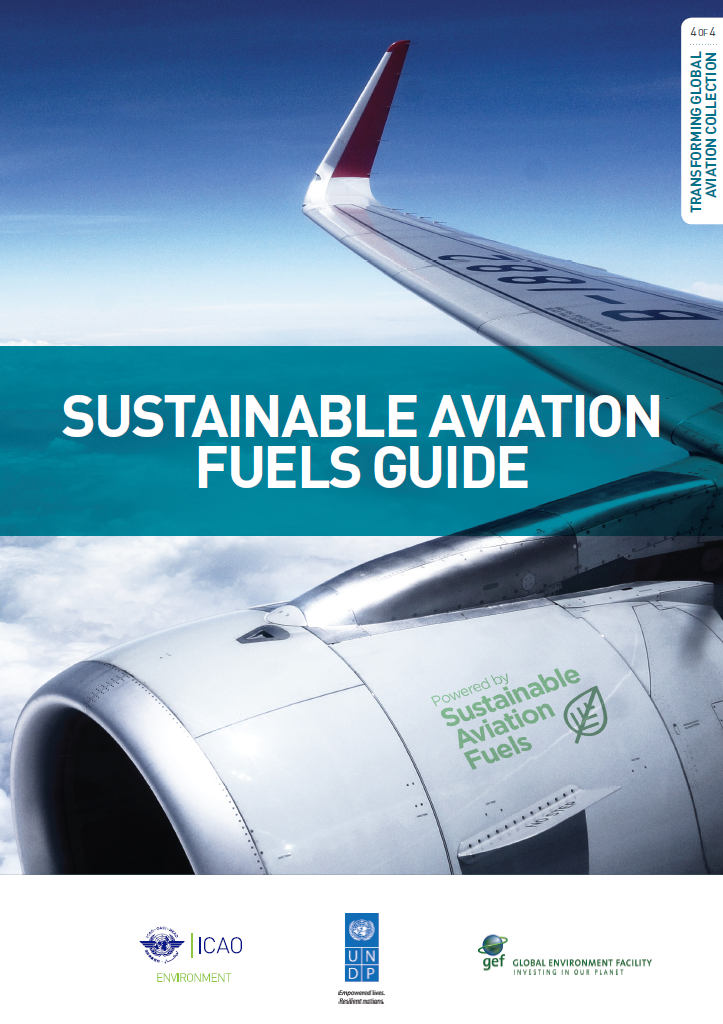
​SAF Guide (2018) 
As part of the ICAO-UNDP-GEF assistance project "Transforming the Global Aviation Sector: Emissions Reductions from International Aviation", a "Sustainable Aviation Fuels Guide" was developed to inform ICAO Member States on how sustainable aviation fuels can be deployed to reduce CO2 emissions from international aviation activities. The guide describes fuel production pathways, usage constraints, environmental and other benefits, and policy perspectives on the use and development of SAF.


SAF technical references​
 

​

Several other references on SAF are being compiled by ICAO and provided to the general public. More information can be found in the "other resouces" webpage.
 

4) Financing
 
ICAO is working on the establishment of the ICAO Finvest Hub to facilitate enhanced access to public and private investment capacities and funding from financial institutions, with a focus on developing countries and States with particular needs. 
 
The initial objective of this initiative is to support projects that contribute to the decarbonization of international aviation, by encouraging new and additional funding for this purpose.


References:
1 - Annex 16 - Environmental Protection, Volume IV, Carbon Offsetting and Reduction Scheme for International Aviation (CORSIA).


En savoir plus sur l'OACI
  • Contacter l'OACI
  • Les Nations Unies
  • Conditions générales
  • Ressources externes
  • Assistance Web
  • FAQ
Nous contacter :
  • Linked In
  • FB
  • UA
  • circle
  • insta
  • youtube

© Organisation de l'aviation civile internationale