
ICAO at RIO+20
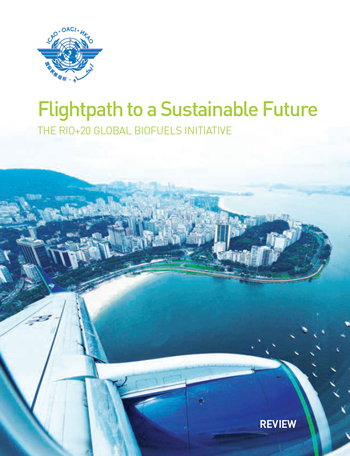
Flightpath to a Sustainable Future – The Rio+20 Global Biofuels Initiative
20 - 22 June 2012
Launch of ICAO Aviation Day at Rio+20, 19 June 2012
ICAO Secretary General, Mr. Raymond Benjamin, arrived at Santos Dumont airport in Rio de Janeiro to launch Aviation Day. A media event took place at the airport at 14:00 marking the occasion, with the participation of many of the partners involved in the global initiative.
ICAO, with the support of the Air Transport Group (ATAG), launched “Flightpath to a Sustainable Future”, an ICAO special Rio+20 global initiative consisting of the first-ever series of connecting flights powered by sustainable alternative fuels, on which the ICAO Secretary General, set out from Montréal to Rio de Janeiro for the United Nations Conference on Sustainable Development, known as Rio+20.
ICAO Rio+20 side event: Sustainable aviation for generations to come
ICAO’s official side event for the Rio+20 conference will be on “Sustainable aviation for generations to come”. This event consisted of an address by the ICAO Secretary General, followed by presentations from States and aviation stakeholders providing perspectives on sustainable alternative fuels for aviation and experiences with developing sustainable alternative fuels initiatives.
ICAO Rio+20 Video

ICAO Briefing for Rio+20 Decision Makers
Flightpath to a sustainable future: The ICAO Rio+20 global initiative
As part of a global initiative to promote the sustainability of air transport, the International Civil Aviation Organization (ICAO), in cooperation with the aviation industry, has arranged for the first time ever a series of connecting flights powered by sustainable alternative fuels which will bring ICAO Secretary General, Mr. Raymond Benjamin, from Montréal to Rio de Janeiro for the United Nations Conference on Sustainable Development, known as Rio+20.
Read the document here.
Launch of Flightpath to a Sustainable Future: the ICAO Rio+20 Global Initiative, at Montreal airport
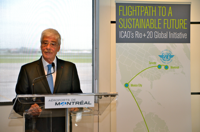
Mr. Raymond Benjamin
ICAO Secretary General
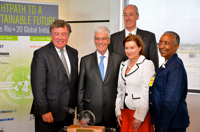
(left to right): Mr. James C. Cherry, President and Chief Executive Officer, Aéroports de Montréal, Mr. Raymond Benjamin, ICAO Secretary General, Mrs. Hélène Gagnon, Vice-president, Public Affairs, Bombardier, Mr. Robert Deluce, President and Chief executive Officer, Porter Airlines, Ms. Angela Gittens, General Director, ACI.
Civil aviation plays a key role in society as it affects social, cultural, economic, commercial, political and environmental aspects of life, and therefore it has a primary role to play when we look at opportunities and solutions for sustainable development across its social, economic and environmental pillars.
Aviation is a major contributor to the social and cultural pillars of sustainable development. Aviation offers the safest, most efficient means of public transportation. Since 1970, the real cost of air travel has been reduced by over 60% through deregulation of the aviation market in the 1980s and the introduction of low cost carriers. This translates into freedom to travel and the exchange of cultural and educational experiences.
With regard to the economic pillar of sustainable development, aviation provides access to regional and global markets and it is a key driver of business, travel and tourism. The air transport industry directly employs more than 8 million people and supports more than 56 million jobs worldwide. Around 2.7 billion passengers travel by air each year. Aviation’s global economic impact, estimated at $2.2 trillion, raises the standards of living and thus makes communities more sustainable.
Demand for air traffic is projected to grow substantially in the foreseeable future and the consequences of this rate of growth are increasingly called into question. While fulfilling its role as a catalyst for social and economic development, the future of air transport needs to be environmentally sustainable.
ICAO expects Rio+20 to focus on a number of important subjects, including energy access, sustainable transport, poverty eradication, finance and sustainable development goals – all of which international aviation has a central role to play in. Additionally, other issues including international governance and cooperation are areas where ICAO, as the UN specialized agency with the responsibility to deal with all aspects of international air transport, including environment ones, is committed to continue to act, exercising its leadership to create a sustainable air transport future.
Related documents
- Input and Contributions of ICAO to the UNCSD (26 October 2011)
This submission provides the input and contribution of ICAO for inclusion in the compilation document serving as the basis for the preparation of the zero draft of the Outcome document of the United Nations Conference on Sustainable Development (UNCSD) – also known as Rio+20, to be held in June 2012 in Rio de Janeiro.
- ICAO Review: Sustainable Alternative Fuels for Aviation Workshop
The Workshop was an important milestone in preparation for the UNCSD Conference.
- ICAO’s Interventions during the UNCSD meeting (7 Jul 2011)
Ms. Jane Hupe, Chief, Environment Branch
Agenda Item: Discussions on expected outcomes of the Conference
- ICAO’s Interventions during EC-ESA plus Principals meeting (6 Jul 2011)
Ms. Jane Hupe, Chief, Environment Branch
Agenda Item: Briefing on the study on Institutional Framework for Sustainable Development (IFSD)