
  • English
User account menu
  • Log in
Home
International Civil Aviation Organization
ICAO store
User account menu
  • Log in
Seach MENU
About ICAO

About ICAO

  • Overview
  • Strategic Plan 2026-2050
  • Latest News and Highlights
  • FAQs
  • List - ICAO Member States
  • ICAO Museum
  • ICAO Carbon Calculator
  • Report Misconduct
  • Contact ICAO

Diplomatic Bodies

  • ICAO Assembly (193 States)
  • Sessions of the Assembly
  • Resolutions in Force
  • ICAO Council (36 States)
  • President of the Council
  • Sessions of the Council
  • Council State Representatives
  • Air Navigation Commission

ICAO Secretariat

  • Secretary General
  • Air Navigation Bureau
  • Air Transport Bureau
  • Capacity Development and Implementation Bureau
  • Legal Affairs and External Relations Bureau
  • Administration Bureau
  • Regional Offices
Global Priorities

Strategic goals

  • Every Flight is Safe and Secure
  • Aviation is Environmentally Sustainable
  • • CORSIA
  • • State Action Plans for Aviation CO2 Reduction
  • • Finvest Hub
  • Seamless, Accessible, and Reliable Mobility
  • No Country Left Behind
  • • Capacity Development and Implementation Support
  • Comprehensive Legal Framework
  • Economic Development

Enablers

  • ICAO Continuous Improvement
  • Innovation in Aviation
  • Next Generation Aviation Professionals
  • Gender Equality
  • ICAO Global Ambassadors Programme
  • ICAO Training
  • Partnerships and Resource Mobilization
Events

Featured Events

  • ICAO/AWG Joint Regional Workshop on Cross-Border Transferability of Aircraft (XBT) and Compliance with the Cape Town Convention (CTC)
  • ICAO Global Implementation Support Symposium 2026
  • Fourteenth Meeting of the Facilitation Panel (FALP/14)
  • 4th Civil Aviation Legal Advisers Forum (CALAF/4)
  • View the Full List of Coming and Past meetings and Events
  • Host your event at ICAO
Resources

Resources

  • ICAO E-Library
  • Publications
  • Annual Reports of the Council
  • Safety Audit Results - Interactive
  • Aviation Benefits Report
  • Economic Facts and Figures
  • Global Aviation Safety Plan
  • Safety Reports
  • Global Air Navigation Plan
  • Air Navigation Reports
  • ICAO Partnership Programme
  • ICAO API Data Service
  • ICAO Data+
  • ICAO iSTARS
  • Air Transport Monthly Monitor
  • Compendium: Competition Policies/Practices
  • Economic Analyses and Forecasting
  • Databases and Studies
  • Environment Reports
  • Environment Publications
  • ICAO TRIP Strategy Compendium
  • Unmanned Aviation
  • ICAO GIS Aviation Data
Careers
Featured Articles
ICAO TV
Subscribe
About ICAO
About ICAO
  • Overview
  • Strategic Plan 2026-2050
  • Latest News and Highlights
  • FAQs
  • List - ICAO Member States
  • ICAO Museum
  • ICAO Carbon Calculator
  • Report Misconduct
  • Contact ICAO
Diplomatic Bodies
  • ICAO Assembly (193 States)
  • Sessions of the Assembly
  • Resolutions in Force
  • ICAO Council (36 States)
  • President of the Council
  • Sessions of the Council
  • Council State Representatives
  • Air Navigation Commission
ICAO Secretariat
  • Secretary General
  • Air Navigation Bureau
  • Air Transport Bureau
  • Capacity Development and Implementation Bureau
  • Legal Affairs and External Relations Bureau
  • Administration Bureau
  • Regional Offices
Global Priorities
Strategic Goals
  • Every Flight is Safe and Secure
  • Aviation is Environmentally Sustainable
  • • CORSIA
  • • State Action Plans for Aviation CO2 Reduction
  • • Finvest Hub
  • Seamless, Accessible, and Reliable Mobility
  • No Country Left Behind
  • • Capacity Development and Implementation Support
  • Comprehensive Legal Framework
  • Economic Development
Enablers
  • ICAO Continuous Improvement
  • Innovation in Aviation
  • Next Generation Aviation Professionals
  • Gender Equality
  • ICAO Global Ambassadors Programme
  • ICAO Training
  • Partnerships and Resource Mobilization
Events
Featured Events
  • ICAO/AWG Joint Regional Workshop on Cross-Border Transferability of Aircraft (XBT) and Compliance with the Cape Town Convention (CTC)
  • ICAO Global Implementation Support Symposium 2026
  • Fourteenth Meeting of the Facilitation Panel (FALP/14)
  • 4th Civil Aviation Legal Advisers Forum (CALAF/4)
  • View the Full List of Coming and Past meetings and Events
  • Host your event at ICAO
Resources
Resources
  • ICAO E-Library
  • Publications
  • Annual Reports of the Council
  • Safety Audit Results - Interactive
  • Aviation Benefits Report
  • Economic Facts and Figures
  • Global Aviation Safety Plan
  • Safety Reports
  • Global Air Navigation Plan
  • Air Navigation Reports
  • ICAO Partnership Programme
  • ICAO API Data Service
  • ICAO Data+
  • ICAO iSTARS
  • Air Transport Monthly Monitor
  • Compendium: Competition Policies/Practices
  • Economic Analyses and Forecasting
  • Databases and Studies
  • Environment Reports
  • Environment Publications
  • ICAO TRIP Strategy Compendium
  • Unmanned Aviation
  • ICAO GIS Aviation Data
Careers
Featured Articles
ICAO TV
ICAO store
Subscribe
  • English

Breadcrumb

  1. Homepage
  2. Environmental Protection
  3. Committee On Aviation Environmental Protection
  • Home
  • Scientific Understanding
  • Environmental Trends
  • Technology Goals & Standards
Aircraft Noise
  • Trends
  • Technology Goals
  • Technology Standards (Reduction of noise at source)
  • Land Use Planning and Management
  • Noise Abatement Procedures
  • Operating Restrictions
  • Noise from Emerging Technology Aircraft
Local Air Quality
  • Trends
  • Technology Goals
  • Technology Standards
  • Guidance on Airport Air Quality
Climate Change
  • LTAG - Long-term global aspirational goal
  • Trends
  • Technology Goals
  • Technology Standards
  • Operational Measures
  • Sustainable Aviation Fuels
  • Lower Carbon Aviation Fuels
  • CORSIA
  • Adaptation
  • Financing
  • Climate Neutral Initiative
  • non CO2 emissions
State Action Plans
  • Frequently Asked Questions
  • Facts and Figures
  • E-learning Course
Capacity Building and Assistance
  • ACT-SAF
  • ACT-CORSIA
  • Buddy Partnerships
  • ICAO-EU Project -Phase II
  • ICAO-EU Project -Phase I
  • ICAO-UNDP Project
Airports
  • ATM Environmental Assessment
  • Community Engagement
  • Eco-Airport Toolkit e-collection
  • CAEP
E-Tools and Models
  • ICAO E-Tools
  • Models and Databases
Innovation
  • Innovative Fuels
  • Electric Aircraft (E-HAPI)
  • Circular Economy
  • Publications
  • Statements
  • Events
  • Contact Us

Committee on Aviation Environmental Protection (CAEP)

Click here to see the calendar of upcoming CAEP events

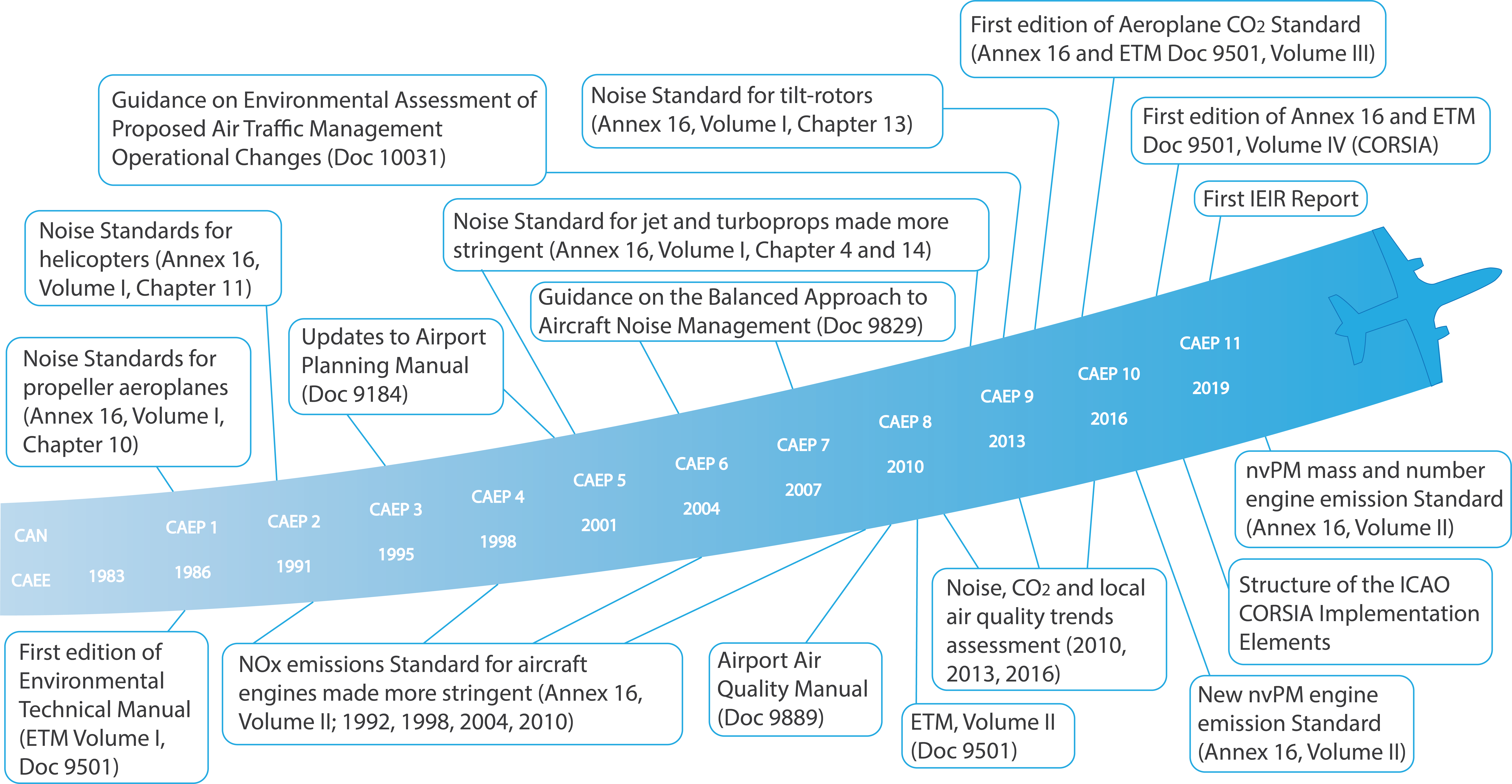
​​The Committee on Aviation Environmental Protection (CAEP) is a technical committee of the ICAO Council established in 1983.

CAEP assists the Council in formulating new policies and adopting new Standards and Recommended Practices (SARPs) related to aircraft noise and emissions, and more generally to aviation environmental impact. 

DescriptionTerms of ReferenceStructureMilestonesMilestones


CAEP Description

The Committee on Aviation Environmental Protection (CAEP) is a technical committee of the ICAO Council established in 1983. CAEP assists the Council in formulating new policies and adopting new Standards and Recommended Practices (SARPs) related to aircraft noise and emissions, and more generally to aviation environmental impact.

CAEP undertakes specific studies, as requested by the Council. Its scope of activities encompasses noise, local air quality (LAQ) and the basket of measures for reducing international aviation CO2 emissions, including aircraft technology, operational improvement, sustainable aviation fuels and market-based measures (CORSIA).

CAEP informs the Council's and Assembly's decision making with the ICAO Global Environmental Trends, which assess the present and future impact of aircraft noise and aircraft engine emissions. The Global Environmental Trends is crucial to the work of ICAO as it provides a robust single reference for sound discussion and decision-making.

The Council reviews and adopts CAEP recommendations, including amendments to the SARPs, and in turn reports to the ICAO Assembly where the main policies on environmental protection are ultimately defined.
 

CAEP Terms of Reference

CAEP's assessments and proposals are pursued taking into account: 

  1. effectiveness and reliability of certification schemes from the viewpoint of technical feasibility, economic reasonableness and environmental benefit to be achieved;
  2. developments in other associated fields, e.g. land use planning, noise abatement operating procedures, emission control through operational practices, etc.;
  3. international and national programmes of research into control of aircraft noise and emissions from aircraft engines;
  4. the potential interdependence of measures taken to control noise and to control engine emissions;

With regards to CORSIA, the Committee addresses technical issues relating to the implementation of CORSIA.
 

Milestones
 

CAEP Members and Observers 

As of September 2025, CAEP is composed of 34 Members from all regions of the world and 20 Observers. More than 1200 internationally-renowned experts are involved in CAEP activities and working groups.  
 

Members (34 States)​ ​ ​

ArgentinaAustraliaBrazil
 
CanadaChileChina
Côte d'IvoireDominican RepublicEgypt
France
 
Greece
 
Ghana
 
Germany 
 
​India
 
​Indonesia
 
Italy​
 
​Japan
 
​Kenya
 
Netherlands​
 
​Nigeria
 
​Oman
 
Poland​
 
Qatar
 
Russian Federation
 
Saudi Arabia
 
Singapore
 
South Africa​
 
​Spain
 
Sweden
 
Switzerland
 
Ukraine
 
United Arab Emirates​​
 
United Kingdom​
 
​United States


Observers (5 States and 15​ Organizations) ​

States
Austria​
 
Malaysia
 
Norway
 
Portugal
 
Türkiye
 
​
 
International Non-Governmental Organizations​ ​
Advanced Biofuels Association (ABFA)​​​
 
Airports Council International (ACI)
 
Civil Air Navigation Services Organization (​CANSO)
 
International Air Transport Organization (IATA)
 
International Business Aviation Council (IBAC)​​​
 
International Coordinating Council of Aerospace Industries Associations (ICCAIA)​​
 
International Coalition for Sustainable Aviation (ICSA)​​​
 
International Federation of Air Line Pilots' Associations (IFALPA)
 
International Petroleum Industry Environmental Conservation Association (IPIECA)
 
United Nations Bodies​
United Nations Environment Programme (UNEP)
 
United Nations Climate Change (UNFCCC)​
 
World Meteorological Organization (WMO)
 
​Regional State Organizations
​European Union (EU)
 
Arab Civil Aviation Organization (ACAO​) 
 
African Civil Aviation Commission (AFCAC)​
 

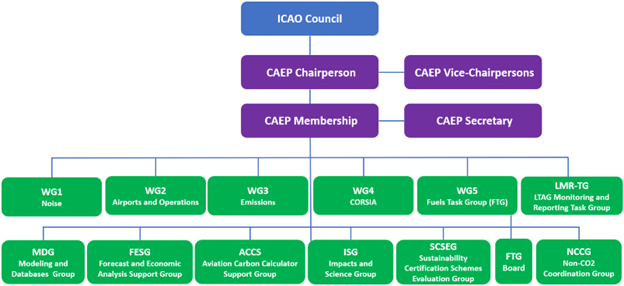
CAEP Structure (Leading up to CAEP/14 in 2028)


CAEP Activities 

Working group 1 (WG1): Aircraft Noise Technical Issues
The main aim of WG1 is to keep international aircraft noise certification Standards (Annex 16, Volume I) up-to-date and effective, while ensuring that the certification procedures are as simple and inexpensive as possible.

Working group 2 (WG2): Airports and Operations
WG2 addresses aircraft noise and emissions issues linked to airports and operations.

Working group 3 (WG3):  Emissions Technical Issues
WG3 deals with aircraft performance and emission technical matters, including the updating of Annex 16 - Volume II and the development of the new aircraft CO2 Standard, Annex 16 – Volume III. 

Working group 4 (WG4):  CORSIA

WG4 deals with CORSIA, including the maintenance of Annex 16 - Volume IV.

 Working Group 5 (WG5): Aviation Fuels

The Working Group 5 addresses technical issues related to aviation fuels, including the methodologies for considering CORSIA Sustainable Aviation Fuels and CORSIA Lower Carbon Aviation Fuels under Annex 16, Vol IV.

Modelling and Databases Group (MDG) 

The MDG group carries out modelling efforts in support to the activities of the other CAEP groups and maintains various databases such as the movements, fleet, and population databases.

Forecasting and Economic Analysis Support Group (FESG)

The main role of the FESG is to develop and maintain the databases necessary to provide the framework for performing economic analysis and forecasting fleet growth. It provides support to the other working groups within CAEP and works with them on data issues that concern more than one working group. 

Aviation Carbon Calculator Support Group (ACCS)
The ACCS group is focused on the development and update of the ICAO Carbon Calculator, which is based on an impartial and transparent methodology for computing the CO2 emissions from passenger air travel. More information on the ICAO Carbon Calculator can be found here.

Impacts and Science Group (ISG)
ISG role is to provide the best possible consensus information from the science community to CAEP on aviation's impacts on climate, air quality and noise issues.

Sustainability Certification Schemes Evaluation Group (SCSEG)
The SCSEG undertakes the evaluation of Sustainability Certification Schemes (SCS) in the context of their recognition under CORSIA. More information on this evaluation process can be found here.

Long-term Global Aspirational Goal Task Group (LTAGTG) – this task group provides technical support in the exploration of the feasibility of a long-term global aspirational goal for international civil aviation CO2 emissions reductions, including options and roadmaps for their realization.


Learn more about ICAO
  • Contact ICAO
  • The United Nations
  • Terms & Conditions
  • External Resources
  • web [at] icao.int (Web Support)
  • FAQ
Connect with us :
  • linkedIn
  • Facebook
  • Unitingaviation
  • ICAO-TV
  • Instagram
  • Youtube

© 2025 International Civil Aviation Organization