Civil and Military ATM Cooperation (CMAC) and Flexible Use of Airspace (FUA)
What is FUA ? Why we need to enhance Civil/Military ATM Cooperation
Flexible use of airspace (FUA) is an airspace management concept based on the principle that airspace should not be designated as purely civil or military, but rather as a continuum in which all user requirements are accommodated to the greatest possible extent.
Airspace is recognized as a finite resource to both Civilian and Military. With rapid growth of air traffic flow, States are faced with the challenge of managing their limited airspace in a way that accommodate both Civil and Military requirements on use of airspace. A closed Civil/Military ATM Cooperation is an enabler to Flexible Use of Airspace which provides a resolution on sharing the limited resource.
Benefits of FUA
- Increase flight economy by enabling direct flight or more efficient flight level across reserved/segregated airspace;
- Increase airspace capacity by providing more ATS routes during a specific time period;
- Reduce ATC workload by enhancing ATS route network and associated sectorisation;
- Provide more flexible and closely airspace reservation in line with military operational requirements.
CMAC/FUA Activities of APAC RSO
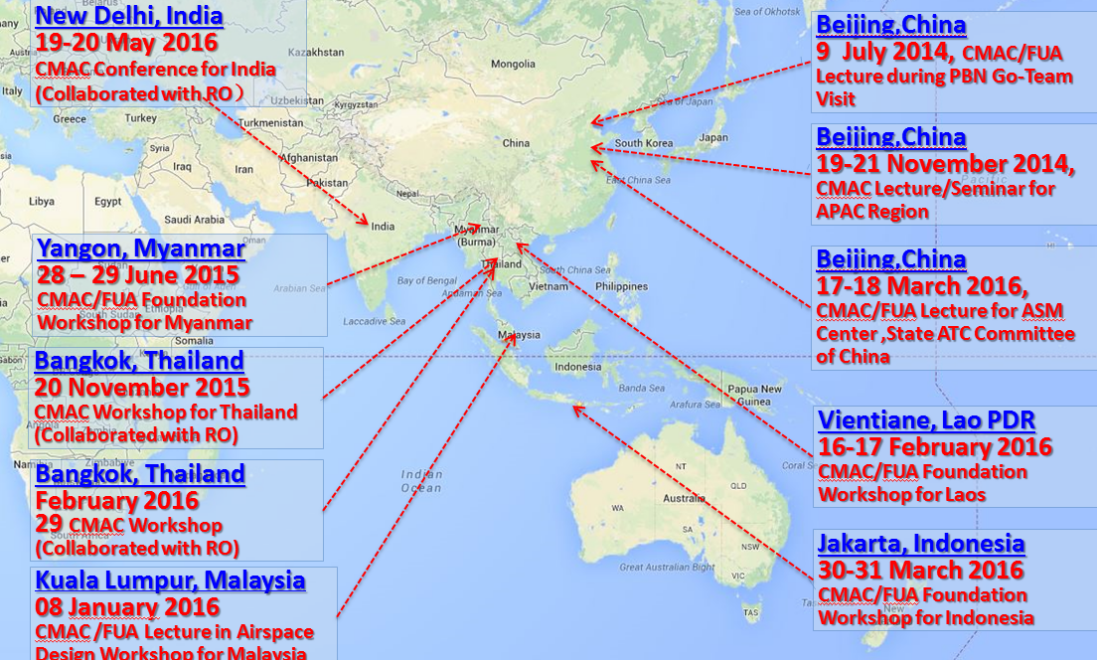
APAC RSO has supported States on enhancing Civil and Military ATM Cooperation and implementing Flexible Use of Airspace through delivering various CMAC/FUA Workshops, organizing CMAC/FUA Seminar and working together with States on specific CMAC/FUA projects.
What can APAC RSO offer to States?
1. FOUNDATION CMAC/FUA WORKSHOP
OVERVIEW-What’s the Foundation CMAC/FUA Workshop?
The Foundation CMAC/FUA Workshop aims to provide States with concepts and applications of CMAC/FUA based on ICAO’s provisions. The CMAC/FUA best practices and lessons learned are also shared with the expectation on providing practical reference for implementation.
The Foundation CMAC/FUA Workshop aims to provide States with concepts and applications of CMAC/FUA based on ICAO’s provisions. The CMAC/FUA best practices and lessons learned are also shared with the expectation on providing practical reference for implementation.
CONTENT -What can we learn from the Workshop?
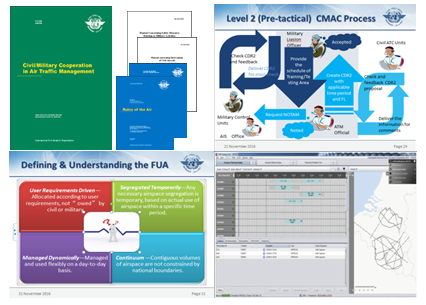
The typical duration of the Workshop is two days , consisting of the following training modules:
- Module-1 Airspace Management and Flexible Use of Airspace Concept
- Module-2 Civil Military Coordination at Three Levels of Airspace Management
- Module-3 Flexible and Adaptable Airspace Structure
- Module-4 Conditional Route Categories and Coordination Process
- Module-5 Civil and Military Cooperation in Air Traffic Management and Institutional and Regulatory Framework
- Module-6 Civil and Military Cooperation Elements in APAC Seamless ATM Plan and Global Air Navigation Plan
- Module-7 Global Challenge and Best Practices
Upon the request of host State, some Modules of the Workshop could be tailored to be State specific and based on real cases of host State.
BENEFIT -Why we need the Workshop?
- Broaden the awareness of ICAO’s policy and provision on CMAC/FUA;
- Achieve practical guidance on enhancing CMAC and implementing FUA ;
- Be aware of best practices and lessons learned for improvement of ASM;
- Facilitate the implementation of high priority CMAC/FUA tasks in line with APAC Seamless ATM Plan.
Audience-Who are expected to participate?
The Workshop is open for Individual States/Sub-Regional Groups, and the trainees could be personnel of Civil and Military Authorities, Regulators, Airspace Designers and Managers, Air Traffic Controllers.
Contact-How to request for ICAO to deliver the Workshop?
Depending on States’ readiness and status, States may wish to host and request for ICAO to conduct the Workshop. Please approach Mr. LIU Song, Regional Officer ATM(AOM-FUA), ICAO APAC RSO for further information through APAC-RSO [at] icao.int (APAC-RSO[at]icao[dot]int).
The Workshop or seleted module Delivered
CMAC Workshop
1.1 APAC RSO conducted and participated in the Inter Regional Workshop on Enhanced Civil-Military Cooperation in ATM and Flexible Use of Airspace 2026 during 19 – 23 January.
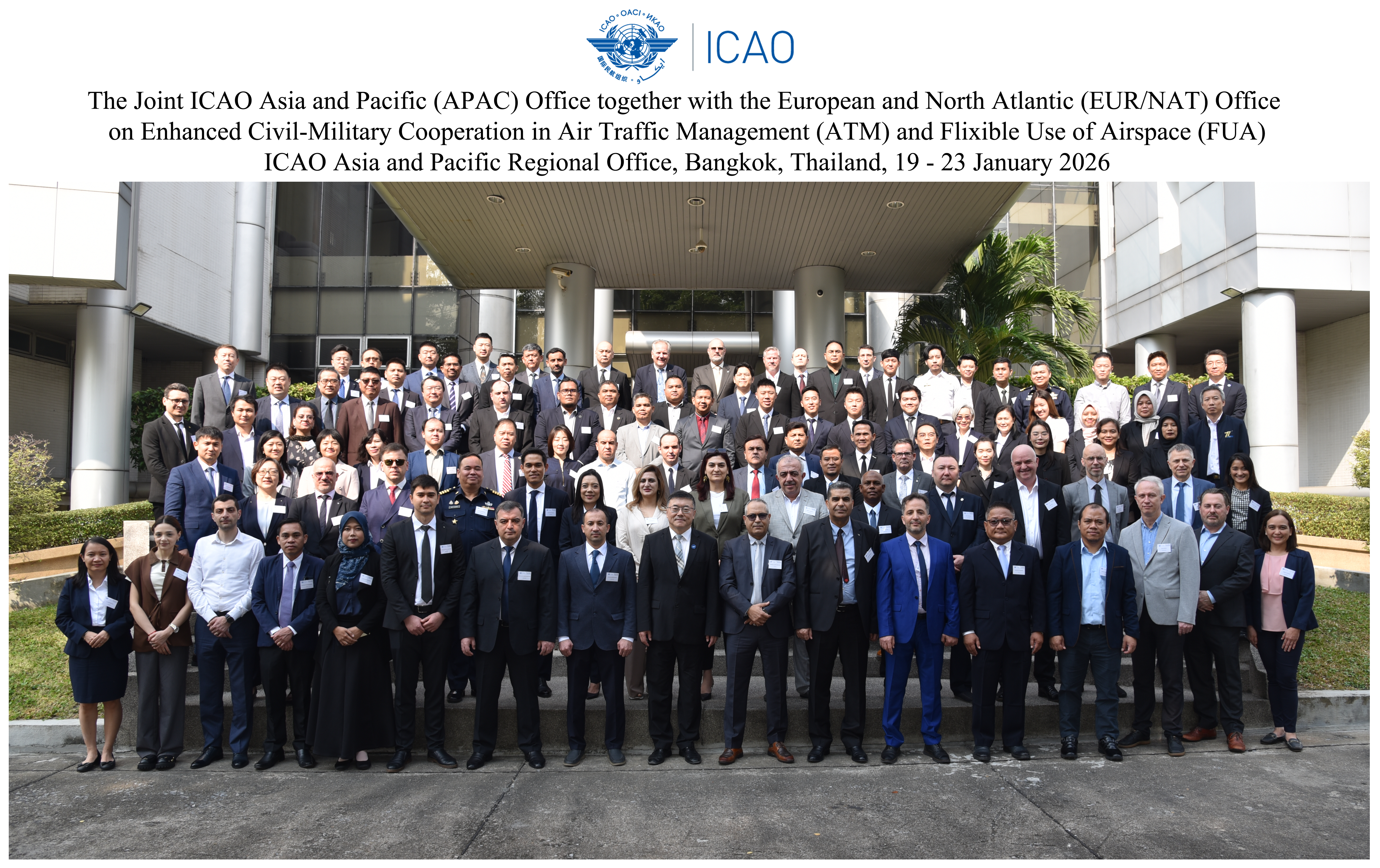
This interactive Workshop is planned to provide States and Administrations with practical guidance on Civil-Military ATM Cooperation (CMAC) and FUA within ICAO framework, including Doc 10088, assist the States/Administrations to advance “one-step forward” regarding the application of FUA concept at strategic, pre-tactical and tactical phases through case study, on-site visit and group exercises, and share good practices, discuss challenges and explore further development of CMAC/FUA with the integration of relevant key ICAO Global Air Navigation Plan ASBU elements. A total of 110 participants from 21 States— including military representatives from 10 States— and 5 international organizations from the APAC and EUR/NAT regions attended. For more details, please visit Meeting Documents.
1.2 The Webinar on Civil Military Cooperation in ATM
The Webinar on Civil Military Cooperation in ATM was conducted by DC/RS0 from 20-21 November 2024.The objectives are to assist States with updated information and provide practical guidance on CMAC and FUA implementation in accordance with the ICAO document 10088; share latest progress, experiences, challenges and solutions on the implementation of CMAC and FUA among APAC States; help the States learn from the sophisticated experiences of FUA implementation at European level through case study, and conduct thorough discussions on how to enhance CMAC by key stakeholders focusing on the constructing and improving the 3-level airspace management framework with system supports; exchange details at the operational level about FUA implementation from the perspective of aircraft operators. The Webinar attracted over 200 on-line participants from 22 States including CAAs, ANSPs, Airport Authorities, Joint C/M ASM Office, ATC etc., 5 International Organizations (CANSO, IFATCA, EU, EUROCONTROL, IATA) and 3 Airlines. Among them, over 30 are from military of relevant States, including DoD, DoT, Air Force, Navy and so on.
2. Advanced CMAC/FUA Modules
OVERVIEW-What’s the Advanced CMAC/FUA Modules
The Advanced CMAC/FUA Modules aim to provide States with the knowledge and experiences of the next step implementation on CMAC/FUA. State who has implemented the basic FUA and/or has the basic functionality of ATFM might need relevant Module to further improve the performance of their airspace management. These Modules can also be selected and cooperated into the Foundation CMAC/FUA Workshop.
CONTENT -What can we learn from the Advanced CMAC/FUA Modules?
- Module-8* Traffic Management/Flexible Use of Airspace Integration and CDM Process ( Advanced Module): Help participants understand the interaction process of ASM and ATFM, the CDM process of FUA among different Stake holders
- Module-9* Flexible Use of Airspace Manual Template of Asia and Pacific Region(Advanced Module, upcoming): Help participants understand the FUA Manual template, and assistant States to build their own FUA Manual.
- Module-10* Enhancement of Pre-tactical and tactical CMAC/FUA with supporting of Airspace Management Tool (Advanced Module, upcoming): Using LARA demonstrator to help participant understand the whole process of Pre-tactical and tactical CMAC/FUA ; show participants with the study case in Europe; envisage the improved CMAC/FUA process based on local cases
BENEFIT -Why we need the Advanced CMAC/FUA Modules?
- To further improve the quality of Civil and Military ATM Cooperation; further improve the performance of per-tactical and tactical Airspace Management.