
ANS Implementation
What is AOM/ASM?
- Airspace Organization Management (AOM)
AOM focuses on designing a well-organized airspace structure that supports various types of air activities, different traffic volumes, and varying service levels and regulations, all aimed at improving the efficiency and safety of air travel. It is a vital part of Air Traffic Management (ATM) that involves the dynamic and integrated management of both air traffic and airspace. AOM ensures the safe, economical, and efficient flow of air traffic by providing necessary facilities and seamless services in coordination with all involved parties, including both airborne and ground-based operations.
The main objective of AOM is to optimize the use of available airspace by dynamically sharing time and, when needed, separating airspace among different categories of users based on short-term needs. This process, known as Airspace Management (ASM), involves selecting and implementing airspace options to meet the needs of airspace users. The ultimate goal is to make the most efficient use of airspace based on actual needs and to avoid permanent airspace segregation whenever possible.
- Main principles of ASM include:
▶ Flexible Use of Airspace (FUA): This concept allows airspace to be managed dynamically and temporarily segregated as needed, rather than being exclusively controlled by either civil or military entities.
▶ Communication, Cooperation, and Coordination: These are critical elements for implementing FUA, ensuring that all parties collaborate effectively to manage airspace.
▶ National, High-Level Civil/Military Coordination: This is essential for a consistent and collaborative national airspace planning process.
- Airspace Management (ASM)
ASM is a method used to choose and implement airspace options to satisfy the needs of the Air Traffic Management (ATM) community. It is a planning activity aimed at maximizing the use of available airspace through dynamic time-sharing and sometimes segregating airspace among different categories of users based on short-term requirements.
The main goal of ASM is to ensure the most efficient use of the airspace according to actual needs and, if possible, to avoid permanent airspace segregation. When it becomes necessary to separate different types of traffic by organizing the airspace (for instance, aircraft conducting military exercises), the size, shape, and time regulations of these areas are designed to minimize the impact on overall operations.
The Regional Sub-Office AOM/ASM team collaborates closely with ICAO APAC Regional Office, and, where necessary, supports Headquarters' staff for all air navigation matters, and particularly with respect to the implementation of Airspace Management in accordance with the Global Air Navigation Plan, the Asia/Pacific Seamless ANS Plan, the Aviation System Block Upgrades (ASBUs) framework and other related plans and policies, achieving results such as:
Participate in the definition of the Regional Sub-Office work programme in the fields of Airspace Management.
Identify challenges faced by States and propose action list to support the States.
Planning, organizing and managing assigned resources to ensure that they are being used efficiently to meet ICAO Strategic Objectives in a timely and efficient manner in accordance with agreed performance objectives.
Contribute to the APAC Regional Office’s policy development related to Airspace Management, by coordination with the ATM Section of the Regional Office.
Assess the implementation status of airspace management in APAC States.
Support States in the development and implementation of airspace management.
Organize seminars/workshops to promote international practices on airspace management implementation and airspace simulation.
Organize other activities aimed at achieving the most efficient use of airspace or addressing specific implementation challenges.
Free route airspace (FRA)
Free route airspace (FRA) is a specified airspace within which users may freely plan a route between a defined entry point and a defined exit point, with the possibility to route via intermediate (published or unpublished) significant points, without reference to the ATS route network, subject to airspace availability. Within this airspace, flights remain subject to air traffic control.
FRA is a way of overcoming the aviation sector's efficiency, capacity and environmental problems by helping to reduce fuel consumption and emissions, while improving flight efficiency. At the same time, it paves the way for further enhanced airspace design and ATM operational concepts.
For airspace users, the move from routes to free route airspace availability offers significant opportunities to airspace users. Free route airspace offers airspace users the ability to fly directly according to their filed flight plan route while ensuring efficiencies in fuel planning, consumption and costs.
For air navigation service providers, operating an FRA environment offers improved traffic predictability thanks to more stable trajectories. At the same time, it enhances the use of conflict detection tools. The FRA concept can lead to a better spread of conflicts compared with the concentration of conflicts generated by the former fixed ATS route network.
Studies show a slight decrease in controllers' workload as a result of free route airspace implementation, mainly coming from a decrease in radio transmissions, monitoring and coordination tasks.
In the Asia/Pacific region, ICAO’s regional plans encourage free-routing adoption. The Asia/Pacific Seamless ATM Plan and recent ICAO guidance promote FRA implementation (block-wide or cross-border) over the next decade. ICAO meetings have urged member states to implement FRA in upper airspace by approximately 2030.
Several initiatives are underway for FRA implementation in Asia: In India, the Civil Aviation Authority has introduced Free Route ATC sectors above FL245 on select north-south routes. A Free Route Operations (FRTO) trial was identified to capitalize on existing and emerging User Preferred Route (UPR) programs in the region by the States of Singapore, Indonesia, Australia and New Zealand with collaboration with IATA. Some states such as Singapore has conducted some kind of a form of FRA like Direct-routing in a phased approach, some states like Indonesia has implemented a trial operation of FRA within JKT FIR and UPG FIR.
While technical requirements such as RNP accuracy and airborne capability are still being finalized, the trend is clear: ANSPs across Asia are preparing for Free Routing Airspace as RNAV equipage and airborne capability expands.
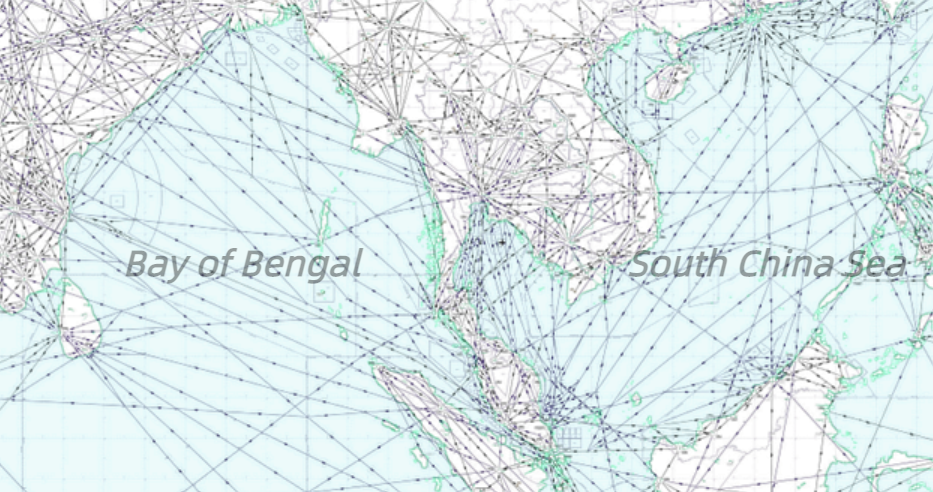
- SAIOSEACG: South Asia, Indian Ocean and Southeast Asia ATM Coordination Group
SAIOSEACG/4-https://www.icao.int/APAC/meetingdocs?fid=551#block-icao-page-title
SAIOSEACG/5-https://www.icao.int/APAC/meetingdocs?fid=24799
SCSTFRG: South China Sea Traffic Flow Review Group
SCSTFRG/13-https://www.icao.int/APAC/meetingdocs?fid=574#block-icao-page-title
- BOBTFRG: Bay of Bengal Traffic Flow Review Group
BOBTFRG/7-https://www.icao.int/APAC/meetingdocs?fid=3069#block-icao-page-title
Route development/Route Catalogue
The Fourteenth Meeting of the Asia/Pacific Air Navigation Planning and Implementation Regional Group (APANPIRG/14, August 2004) under Conclusion 14/5 established the ATS Route Network Review Task Force (ARNR/TF) to review the Asia and Pacific ATS route network to determine present and future route requirements. It’s been an ongoing project ever since.
To facilitate the amendment process and keep track of route implementation and future requirements, and with the objective of providing more up to date information on route developments, the ICAO Asia and Pacific (APAC) Regional Sub-Office has updated the Asia/Pacific Region ATS Route Catalogue based on the information provided by States/Administrations and airspace users through email correspondences and meetings.
The Asia/Pacific Region ATS Route Catalogue records the current status of route proposals, which may not have reached the stage of the formal proposal through the Regional Air Navigation Plan Proposal for Amendment (PfA) process.
The most recent Version 23.2 of the Catalogue is available at the ICAO Asia/Pacific website https://www.icao.int/APAC/Pages/eDocs.aspx#tabs-3 under the ‘ATM’ category.