

Chapter 6: Safety Analysis
6.1 Introduction
The process to analyse the safety data and safety information is called safety analysis. At the State level, the objective is the identification of hazards that might not otherwise be identified by the analysis of service providers and operators. In a safety analysis, statistical and analytical techniques are used to check, examine, describe, transform, condense, evaluate and visualize safety data and safety information.
6.2 Types of analysis
Common types of safety data and safety information analysis include descriptive analysis, inferential analysis and predictive analysis. Descriptive statistics are used to summarize data in ways that are meaningful and useful. Inferential statistics use data to learn about the larger population. Predictive statistics extract information from historical and current data to predict trends and behaviour patterns.
1. Web portal used in Brazil for the Analysis of Accident and Incident Data
Web portal for analysis of accidents and incidents data supporting decision making by authorities and service providers. Accessible through
Click here to access.
Click to download:
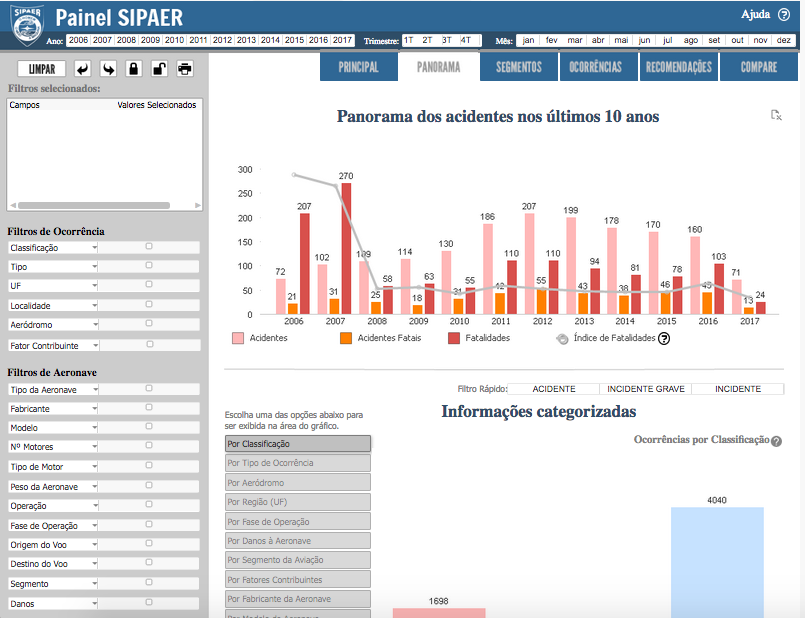
Source: National Civil Aviation Agency (ANAC)
_________________________________________________________________________________________________
2. The Operational Learning Review
This presentation is about how the Operational Learning Review process has enabled the Cathay Pacific Safety Team to capture safety-related data in a far more contextualized way to give improved decision-making support to the operational management of the airline. Particularly, how this approach has been used for hazard identification as part of their SMS process, for updating training and reviewing policies, and most importantly, how this has been embraced by the authority for audit and monitoring purposes.
Click here to watch
Source: Cathay Pacific Airways
_________________________________________________________________________________________________
3. Assessment & Analysis of Civil Aviation Risks in the 2020 low activity period
The purpose of this study is to carry out an assessment and prioritisation of safety issues on the basis of safety data collected in real time, i.e. incidents and oversight data. These data are supplemented by feedback from the operators themselves collected during exchanges with DSAC inspectors. This study aims in particular to:
• Assess the safety risks generated directly or indirectly by the safety issues arising from the current health crisis,
• Ensure that operators have taken into account all the safety issues that relate to them within the framework of their Safety Management System (SMS), or in their safety policies for operators who do not implement a SMS,
• Make recommendations as a means of reducing risks.
This study is part of a coordinated approach to continuous risk management, which is at the heart of the State Safety Programme (SSP).
Click link to download:
Assessment & Analysis of Civil Aviation Risks in the 2020 low activity period.pdf
Source: Direction Générale de l’aviation civile/Direction de la sécurité de l'aviation civile (DGAC/DSAC)
_________________________________________________________________________________________________
4. Copenhagen Airport Survey regarding appropriate resources for Safety
Survey to assess and monitor allocation of appropriate resources to achieve established safety performance.
Click link to download:
Survey regarding appropriate resources for safety.docx
Source: Airport Council International - ACI World
6.3 Reporting of analysis results
The results of safety analysis need to be made available in meaningful ways to organisational decision makers, external service providers, State aviation authorities and States. Imminent safety alerts, safety analysis reports, and safety conferences are some ways in which this can be accomplished.
1. EASA Aviation Safety Review
The Annual Safety Review provides both a statistical summary of aviation safety in the EASA Member States (MS) and identifies the most important safety challenges faced by European aviation today.
Click link to access:
Source: European Union Aviation Safety Agency (EASA)
Please check example 7. Annual Safety Review (EASA) under section 8.6 Component 4: State safety promotion.
_________________________________________________________________________________________________
2. Safety Events Report Quarter April-June 2018
Quarterly reports of the collection and analysis of safety information by service providers, Airports etc.
Click link to download:
Informe de Análisis de Eventos de Seguridad Operacional .pdf
Informe Eventos Trimest
Source: Dominican Civil Aviation Institute (IDAC)
_________________________________________________________________________________________________
3. General Aviation Accident Dashboard
Interactive report that shows a summary of statistics for general aviation accidents occurring from 2012 through 2021
Click to access:
General Aviation Accident Dashboard: 2012-2021 (ntsb.gov)
Source: National Transportation Safety Board (NTSB)
6.4 Safety information sharing and exchange
Sharing and exchanging safety information can improve safety. States should promote safety information sharing or exchange among the aviation system, and share safety information with other States. Moreover, States should agree on the level of protection and conditions on which safety information will be shared prior to sharing this information.
1. Code of Conduct on the Sharing and Use of Safety Information
This code of conduct is an ICAO policy that States are encouraged to follow without prejudice to matters already covered under international law and/or provisions. It includes principles and standards applicable to the sharing and use of aviation safety-related information, which was developed based on the Recommendation of the High Level Safety Conference (HLSC) 2010 and a set of principles included in the ICAO Assembly Resolution A37-1. The ICAO Council endorsed this code of conduct on 17 June 2011 (C-DEC 193/3). It is global in scope and is directed toward ICAO Member States, RSOOs and RASGs, the aviation industry and other international and regional aviation organizations.
Click to download:
Code of Conduct on the Sharing and Use of Safety Information .pdf
Source: International Civil Aviation Organization (ICAO)
_________________________________________________________________________________________________
2. Sample Regional aviation safety group (RASG)
This example provides guidance on the purpose for States encouraging to share safety information within their RASG. At the regional level, the RASGs coordinate the planning process. This example provides mature structuring document for establishment of the Regional Aviation Safety Group – Pan America (RASG-PA).
RASG-PA was established in November 2008 to use the framework provided by the ICAO Global Aviation Safety Plan (GASP) and the Global Aviation Safety Roadmap (GASR) to support the establishment and operation of a performance-based aviation safety system in the Pan American Region.
Click to download:
ICAO Regional aviation safety group-Pan America (RASG-PA) procedural handbook .pdf
Source: Regional Aviation Safety Group – Pan America (RASG-PA)
_________________________________________________________________________________________________
3. Sample Aviation Safety Team
This is a real-life example for National Civil Aviation Agency of Brazil (ANAC) establishing the procedures for the Brazilian Aviation Safety Team (BAST), a collaborative environment for the exchange of safety information and best-practices among aviation authorities and industry. It is divided in four groups dealing with specific aspects of aviation safety: commercial operations, general aviation, helicopter operations and infrastructure. The creation of a non-punitive environment for the exchange of information and best practices among regulators and industry has contributed to a more proactive approach in addressing safety concerns. Other countries in the region have reached to Brazil for support in implementing similar initiatives.
This example provides guidance on the purpose to exchange safety information and best-practices among aviation authorities and industry at national level.
Click to download:
Source: National Civil Aviation Agency of Brazil
6.5 Data-driven decision making
The main purpose of safety analysis and safety reporting is making safety data available to decision makers who are empowered to make decisions based on the presented data. Effective safety management depends on decisions that are made to be transparent, accountable, fair and objective, justifiable and defensible, reproducible, executable and pragmatic.
1. Business Intelligence Infrastructure (BII)
The Business Intelligence Infrastructure (BII), developed in house for Transport Canada, has been established to provide the tools required for Transport Canada to produce and deliver comprehensive analysis and reports in a more effective, efficient and accessible manner. It can be configured to automatically pull data from multiple databases simultaneously. BII is only accessible internally to Transport Canada employees. The Civil Aviation Daily Occurrences Reporting System (CADORS) is one such databases that the BII acquires data from. Attached are 8 examples of reports that can be generated from the BII.
Click link to download:
Annual Aviation Occurrences and Casualties by Type of Operation .pdf
Quarterly Accident Report .pdf
Annual Aircraft Accident Rates .pdf
Aircraft Operator Detail Report .pdf
Aerodrome Detail report 2017 .pdf
Aerodrome Detail Report 2015 to 2017 .pdf
Report Occurrence Details .pdf
Source: Transport Canada