

ICAO Handbook for CAAs on the Management of Aviation Safety Risks related to COVID-19 (Doc 10144)
Notice to users
This content was developed by ICAO with support of the aviation experts from the Safety Management Panel. Updates will be published to reflect new developments as we continue to learn from the challenges presented by the COVID-19 pandemic.
Click here to download the Handbook.
Please forward any comments to safetymanagement [at] icao.int
1. Introduction
1.1 This high-level guidance is intended to support civil aviation authorities (CAAs) with the management of aviation safety risks, which fall under their responsibility, during the coronavirus disease (COVID-19) pandemic.
1.2 The terms and definitions used in this guidance are consistent with the ICAO Safety Management Manual (Doc 9859) and can be applied by States at different levels of State safety programme (SSP) implementation.
1.3 The guidance outlines aspects for CAAs to consider at different stages of the pandemic and focuses on:
a) assessment and prioritization of risks based on collection and analysis of data;
b) application of safety management principles to support risk-based decision-making; and
c) management and monitoring of CAA approvals in light of the flexibility needed across the aviation system to continue safe operations.
1.4 The successful management of the COVID-19 pandemic requires the assessment and management of risks that extend beyond the boundaries of managing aviation safety risks as defined in Annex 19 — Safety Management. The CAA should keep in mind how their decisions may impact the risks being managed by other State authorities and that efforts by other State authorities to manage the risks that fall under their responsibility will have an impact on aviation.
1.5 The need to explore more powerful methods of risk management and establish a framework for integrated risk management was supported by the aviation community during the Thirteenth Air Navigation Conference (AN-Conf/13) held from 9 to 19 October 2018. Subsequently, the Air Navigation Commission tasked the Safety Management Panel (SMP), in coordination with other relevant expert groups, to take the lead in addressing Recommendation 6.2/1, Supporting effective safety management implementation which instructed that ICAO:
“g) in collaboration with States, RSOOs and industry explore more powerful methods of identifying hazards and managing risk, suitable for complex socio-technical systems such as aviation and adaptable, regardless of the type of risk;
h) in collaboration with States, RSOOs and industry explore the benefits of a unified framework for integrated risk management (safety, security, environment, etc.) taking into account the evolution of ISO management standards;”
1.6 Further guidance will be developed to support CAAs in the restart of the aviation system. Practical examples are being collected and developed to be shared on the Safety Management Implementation Website.
2. Cooperation, Collaboration and Communication
2.1 The means to cooperate, collaborate and communicate (3Cs) are vital functions exercised by many States in tackling global crises. Together, the “3Cs” are key to address the pandemic and achieve the best outcomes for the entire aviation community and society as a whole. CAAs should recognize that these existing functions also
continuously contribute to the effective implementation of an SSP, which is important in managing aviation safety risks, including the impact of COVID-19 to the aviation system. Dr. Michael Ryan, Executive Director, World Health Organization (WHO) was quoted “Perfection is the enemy of the good when it comes to emergency management” during a press conference in March 2020.
2.2 COVID-19 has highlighted the complex interfaces within States, and externally, demonstrating the challenges of collaborative decision-making. Decision-making may need to be made based on limited information, taking into account broader risks than just aviation safety. CAAs are encouraged to adopt a safety risk management approach to decision-making.
2.3 Identifying interfaces and establishing channels for communication provides access to expert opinion, which is valuable in understanding the available information in a dynamic situation. Responding under a crisis situation may require qualitative decision-making using a risk management approach and asking practical questions. (e.g. What supporting evidence is available?, What are the consequences of alternative options?, How will delays in decisions impact?, What is the risk tolerability for the specific situation?, What are the available resources?).
National efforts
2.4 CAAs should share and exchange safety information and take into consideration lessons learned to ensure they can best manage the disruption. CAAs should make active efforts in recognizing and breaking down information silos which would otherwise reduce the effectiveness of coordinated actions taken to manage risks at the national, regional and international level. This approach is particularly important in coordinating groups and committees, which contain the essential knowledge and experience to support and maintain a safe, secure civil aviation environment in which services are delivered in a reliable and efficient manner.
2.5 Depending on the size, nature and capacity of the State, coordination groups and committees may exist in different forms or may need to be established. States should coordinate between aviation and public health authorities and establish national facilitation committees comprising all relevant groups, taking into account that cross-sector collaboration at the national level is essential (State letter EC 6/3-20/46 refers). States who have implemented an SSP should have an SSP coordination group or similar cross-sector committee to facilitate the identification and management of interfaces. States that have not yet established such a group are recommended to put in place an ad-hoc coordination group or committee, or to join an existing group addressing similar objectives.
Regional efforts
2.6 At the regional level, regional safety oversight organizations (RSOOs), including cooperative development of operational safety and continuing airworthiness programmes (COSCAPs), play a key role in supporting and harmonizing the actions taken by its Member States to manage the aviation safety risks related to the pandemic. In addition, RSOOs can fulfil a valuable role in assessing the operational impact on the region and coordinating the restart of operations. ICAO regional offices, regional aviation safety groups (RASGs) and planning and implementation regional groups (PIRGs) also provide an opportunity for collaborating and sharing lessons learned.
2.7 International organizations also play an important role in coordinating industry stakeholder efforts, which will be particularly important when restarting the aviation system. An understanding of the role played by other national non-aviation organizations such as public health authorities, military authorities, and customs and immigration authorities as well as establishing coordination is crucial for ensuring that strategies are implemented effectively and seamlessly.
International efforts
2.8 At the international level, as noted in ICAO Assembly Resolution A40-14, Mitigation of the spread of disease through, inter alia, aircraft disinfection and vector control methods, and the importance of CAPSCA (Collaborative Arrangement for the Prevention and Management of Public Health Events in Civil Aviation) for implementation, States are encouraged to become members of the CAPSCA. Through the CAPSCA, aviation authorities, public health authorities and international organizations combine efforts to improve preparedness planning and response to public health events that affect the aviation sector, further information can be accessed here.
2.9 CAAs should be addressing communication needs at all levels, including: other States; service providers; international organizations; non-aviation stakeholders; and the public. It is vital CAAs build a well-rounded picture and disseminate relevant information as part of their role in supporting the needs of the aviation community, fostering trust and transparency. CAAs need to ensure clear distinctions are made between facts, theories and speculation when doing so. Care should be taken though to avoid wrong or misleading information being published or circulated by non-authorized sources.
2.10 Effective communication practices include the use of existing digital platforms already in place to urgently communicate information with other States, industry stakeholders and the public. This includes traditional and less common means such as e-mails, video conferences, social media and websites. The use of digital platforms also enable and enhance the speed of issuing and approving content with the added benefit of easily updating and withdrawing information as required, in real time. Useful areas to include are:
a) advice to industry;
b) status on exemptions granted and risk mitigation in place by sector;
c) provision of safety and regulatory services (i.e. surveillance activities); and
d) key announcements and contact information.
3. Challenges Faced at Different Pandemic Stages
3.1 Given the very different degrees of preparedness by States and the value of being better prepared for potential future crises (including new waves of COVID-19), it is vital to extract, communicate and apply lessons learned as the aviation sector progresses through the pandemic. In particular, this applies to managing different stages of the pandemic including future outbreaks.
3.2 States and CAAs will also be at different levels of maturity in their understanding and application of safety risk management. Managing the safety risks as a result of the pandemic provides an opportunity to test existing or develop new capabilities. Examples of potential new capabilities include conducting surveillance activities remotely, operating effectively with reduced resources and using digital platforms to communicate more tactically.
3.3 To this end, throughout all the stages CAAs will need to cooperate, collaborate and communicate with its industry. The aviation community recognizes “we are all in this together” to safeguard the viability and the stability of the aviation sector.
3.4 The pandemic will have a significant impact on the CAAs ability to function effectively. CAAs will need to monitor their resources and continuously assess their capacity to fulfil their safety oversight obligations as this will vary throughout the different stages of the pandemic. CAA senior management need to consider human factors when assessing such impacts. There may also be funding issues as some CAAs rely on funding from industry, and with operators parking or retiring aircraft or even ceasing to exist, this may impact their financial resources. This may also have a long-term impact on staffing levels and resources for the oversight of the restart and future infrastructure changes and safety improvements.
Different pandemic stages that a State may progress through.
Click link to download:
Different stages of a pandemic.png
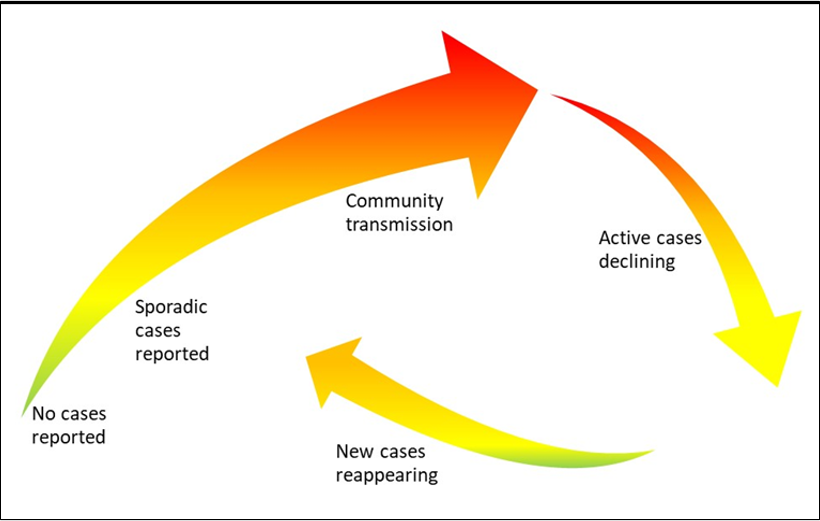
No Reported cases
3.5 Even if a State does not have any reported cases of infection, there is a likelihood of potential cases in the future. Close coordination with the State and public health authorities will be important even at this early stage. CAAs can use the opportunity to proactively manage and reduce the risks to the aviation community. Initiatives include:
a) developing guidance material for operators flying to and from States with active cases;
b) becoming familiar with emergency response plans: and
c) communicating aviation efforts in combating the pandemic.
Note. Initiatives to apply restrictions to airspaces and airports should be carefully considered, as this may also stop the supply of important resources such as health personnel and medical equipment.
Sporadic cases reported - one or more cases, imported or locally detected
3.6 Where cases have been confirmed, States may introduce travel and working restrictions to reduce transmission of infection. This would be an opportunity for the CAAs senior management or the SSP Coordination Group to establish a task force to oversee the situation.
3.7 It is also important at this stage that CAAs consider their own staff’s health and well-being. Even without State restrictions, CAAs should be looking at moving towards reducing non-essential movements and encouraging remote working. This may also require staff to work from home, impacting the ability to conduct the same level of on-site oversight activities.
3.8 This will require a review of surveillance programmes and some flexibility around scheduled audits. Consideration should be given to carrying out desktop reviews and video conferencing to supplement planned on-site surveillance activities. This will also reduce inspector exposure to people and organizations especially as airline and airport staff are at a high risk of becoming infected due to their close contact with passengers travelling internationally.
3.9 CAAs should facilitate safe and expeditious movement of essential supplies, and movement of personnel performing travel to perform essential tasks.
Community transmission
Note. Community transmission consists of larger outbreaks of local transmission defined through an assessment of factors including, but not limited to:
a) large numbers of cases not linkable to transmission chains;
b) large numbers of cases from sentinel lab surveillance; and
c) multiple unrelated clusters in several areas of the country/territory/area.
3.10 It is likely that at this stage there will be government restrictions on travel movements. This will impact CAAs and the aviation industry. CAAs should be reviewing and amending its surveillance plans to minimize movement and physical contact with staff in aviation organizations.
3.11 This may have a significant impact on training of crew and air traffic controllers, and checking currency of experience (with flight simulation training devices becoming unavailable for a longer time) or medical certificates (with medical centres being closed). Due to possible restrictions at the destination, operators may not be able to provide adequate suitable rest facilities, forcing them to reduce rest. As a consequence, there could be pressure on duty time limitations and fatigue. This is likely to lead to exemptions being requested against existing regulations.
3.12 There may be added challenges related to CAA staff becoming infected or having to self-isolate. This will reduce the CAA capabilities to fulfil its role and may require temporary restructuring to allow staff to fill any gaps.
3.13 Challenges related to the level of oversight that can be provided should consider a safety risk management approach to decide what must be done and what can be postponed. As some service providers start to operate at a reduced capacity, this may result in increase of monitoring of risks.
Active cases declining
3.14 It is likely that the State authorities will make decisions on when to remove or reduce any travel restrictions. Even if those travel restrictions are lifted, there will be challenges for the industry to ramp up operations and restart. This may require active involvement of the CAAs to prioritize and adjust oversight activities to ensure that the restart is done safely and that any risks identified are being managed appropriately by service providers. There is likely to be a high demand for CAA services once the aviation system restarts, which may impact the available capacity. This may require further flexibility in surveillance programmes even when restarting the aviation system.
New cases reappearing
3.15 There is always the risk that cases could reappear once all the travel restrictions have been lifted. The key to properly addressing this is continuous vigilance. With all the experience gained from dealing with the initial outbreak there would be more experience in how to handle the situation. This would require reviewing and possibly reactivating some of the activities in the earlier stages. It is very important to document and review the lessons learned from the earlier stages and make improvements, where appropriate. Likewise, it is also important to share and consider those lessons learned by other States from dealing with the situation, which can be used to better prepare for similar scenarios in the future.
4. Identification, Collection and Analysis of Relevant and Available Data and Information
4.1 CAAs may have access to safety data sources of varying quality depending on the level of implementation of the SSP. Different CAAs will have varying amounts of data available but it should try to gather as much as possible even if it is limited. Collecting available data will enable analysis and the development of information to support the data-driven decision-making process. Benchmarking the current situation will help model scenarios to support the management of safety risks and a better understanding of the impacts that any decision will have on aviation.
4.2 To collect the relevant data and information, CAAs are encouraged to establish an open and continuous dialogue with all aviation domains and other stakeholders involved in tackling the pandemic, and as described in the 3Cs.
4.3 CAAs are encouraged to establish mechanisms so that the collected data and information can be updated frequently to cope with the dynamic nature of the pandemic, in order to better understand how the service providers are coping with the situation. The data collected should be used to inform the application of a risk management approach for the CAA’s activities and support the development of plans to restart operations, which will need to be a collaborative decision.
Table 4-1. Suggested data and information to collect and analyse to support safety risk management
| Categories | Data to be Collected and Analysed |
|---|---|
| Data on the current COVID-19 including absolute and relative rates | • number of cases, considering active and recovered • services (considering those with underlying health conditions or are self- |
| Status and volume of traffic during the pandemic | • expected volume and rate of flights over time including restarting normal • general aviation flights • humanitarian flights for evacuation and repatriation • medical flights • cargo flights performed with aircraft certified for transportation of passengers • transportation of dangerous goods or medical equipment • State aircraft operations (military, customs, police, etc.) |
| Impacted operational personnel according to ICAO Annex 1 — Personnel Licensing (air traffic controllers, pilots and cabin crew, aircraft maintenance engineers, flight dispatch, aeronautical meteorology personnel, etc.) | • number and due date of expiring licenses • due date for medical certificates for crew members • impact on crew training and checking (i.e recency of experience, license proficiency check, operator proficiency check) • recurrent mandatory training related to special operations • years of experience of professionals |
| Continuity of flight operations | • number of organizations that are closed or in a difficult financial situation • number and due date of approvals and certificates • maintenance issues such as storage and de-storage of aircraft, due maintenance, fuel system management, lack of spare parts, expiring airworthiness certificates • surveillance activities required to maintain validity of certificates (i.e. due audits) and exemptions in place • availability of resources (in-house or contracted) to support activities such as preparation of aircraft to flight, reconfiguration and affecting mass and balance of the aircraft, maintenance, disinfection of aircraft • exceptional operational considerations related to flight time limitations, flight duty periods and fatigue, accommodation facilities and transportation for crew, human factor aspects, etc. |
| Operational status of the air navigation services (ANS) provision and limitations | • availability of communications, navigation, and surveillance (CNS) services • availability of air traffic control (ATC) services and management • connectivity with global systems, supporting centres and meteorological offices • contingency planning affecting operations (airspace limitations, capacity • status of ATC unit/facilities (availability, limited time of operations, |
| Aerodromes and infrastructure availability | • current movements by airport • aircraft parking positions available including the use of other paved surfaces • due maintenance of navigation or airport equipment • location of parked aircrafts where maintenance or storage procedures could • availability of critical services (handling, catering, fuelling, medical, |
| Impact on CAA’s oversight activities | • capabilities to process certification, registration/deregistration, authorization • number of audits and inspections postponed during the pandemic, or • number and type of exemptions granted in all the domains (i.e flight time • conditions under which differences would be acceptable to the destination States |
5. Application of Safety Management Principles
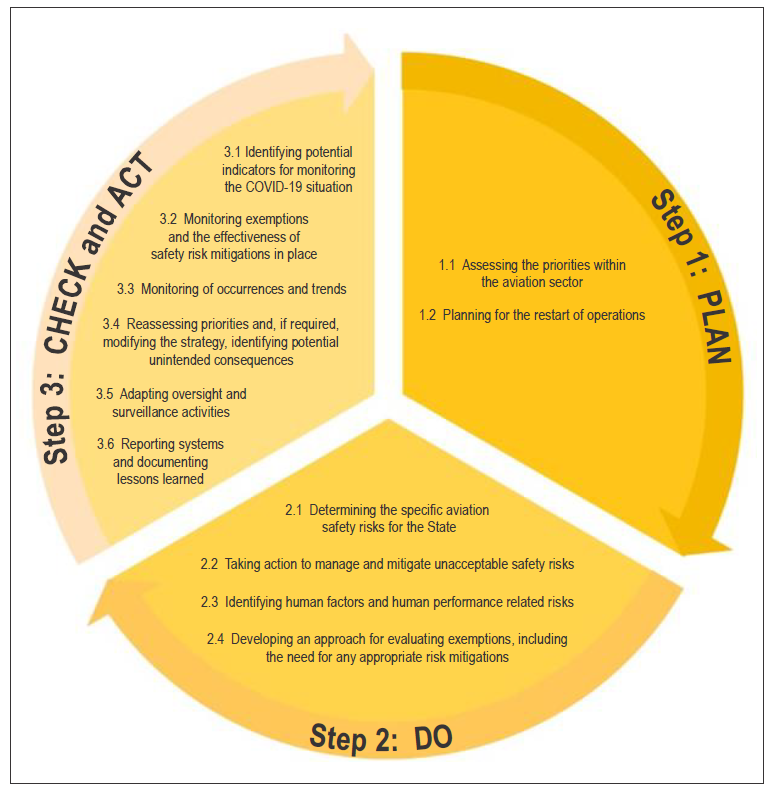
The decision-making process involves assessing the COVID-19 situation and the collection and analysis of available data within the State. The following provides a safety risk management approach using the plan–do–check–act (PDCA) cycle for managing aviation safety risks during the pandemic. The safety management principles as described in this Chapter, can be applied by States at different levels of SSP implementation.
Click link to download:
PDCA cycle for managing aviation safety risks during COVID-19.png
Practical Examples and Tools
Application of Safety Management Principles
To complement the Handbook, practical examples and tools are being collected to support CAA in managing aviation safety risks related to COVID-19.
Click on Examples and Tools tabs for more information. They are divided into three steps: Plan, Do, Check and Act.
Adding to the current COVID-19 SMI Website, ICAO is continuously developing initiatives to support the implementation of Doc 10144 and the restart of operations:
- Webinar Management of aviation safety risks related to COVID-19 for CAAs;
- Implementation Package (iPACK) - Aviation Safety Risk Management related to COVID-19 for CAAs;
- Virtual Classroom - Aviation safety risk management related to COVID-19 for CAAs;
- COVID-19 Safety Operational Measures - Decision aid for CAAs to review alleviations.
More information can be found through the COVID-19 Safety Risk Management Webpage: icao.int/safety-management/covid-19-safety-risk-management
Step 1. Plan
Assessing the priorities within the aviation sector (Step 1, 1.1)
1.1.1 Service providers will encounter different challenges and will need different strategies when dealing with the situation. The maturity of the service providers safety management system (SMS) should be taken into consideration as this will affect their ability to identify, prioritize and manage their safety risks more effectively. Some operations may change due to travel restrictions, the increased demand for the transport of cargo, etc. As a result, service providers will have to shift their operations to respond (e.g. maintenance organizations will focus on storage and maintenance of parked aircraft).
1.1.2 The existing surveillance plans should also be reviewed as many organizational and operational aspects of the service provider may have changed. The pandemic will also impact many aspects that should also be considered, such as safety culture, people behaviours, the reporting system, budgets for training, SMS effectiveness, etc.
1.1.3 This will require coordination with industry and a plan to prioritize activities as well as CAA resources. The analysis of data collected, as outlined in Table 4-1, should be used to support the management of resources. CAAs and service providers should establish a strategic plan with a timeline that supports the management of the next steps.
Planning for the restart of operations (Step 1, 1.2)
1.2.1 Even at an early stage, planning for the restart of operations will help to plan resources and manage the limited capacity of CAAs. This will require coordination and communication with public health authorities based on forecasts and projections. It would also be important to work closely with industry on their intentions for limiting and restarting operations so that it is planned and managed effectively. This would include determining what is expected of service providers for when restarting operations, which could include requesting a restart plan that would be agreed by the CAA.
1.2.2 Guidance should be provided on what documentation the CAA would want to review. It is expected that service providers could use a combination of their emergency response plan (ERP) and their management of change procedures to restart operations.
EXAMPLES
1. Preparation of Aerodromes to Resume Operations
EASA issued a Safety Information Bulletin containing recommendations to support the return to safe operations at the aerodrome. It focuses on establishing a plan that should be implemented prior to the start of operations including the management of human performance, outdated information, training, aerodrome infrastructure and equipment as well as financial impact.
Click link to download:
EASA Safety Information Bulletin SIB No. 2020-07 (4 May 2020).pdf
Source: European Aviation Safety Agency (EASA)
_________________________________________________________________________________
2. Strategic Framework in response to COVID-19 in SAM Region
The ICAO South American Regional Office organized a series of activities as part of the regional coordination efforts to confront together as a Region in a harmonized and organized manner, this outbreak. This document reflects the efforts of the working groups of the Member States, Industry, and International Organizations intending to promote an orderly, harmonized, progressive, and safe response. It is important to emphasize that this document is presented as a strategic framework, compilation of best practices, and experiences of this continually changing situation. It does not represent a regional plan nor compulsory activities or mandatory compliance. However, being a document of common consensus, it is also recognized the importance of these differences being duly communicated, to measure their impact on the Region's complete response.
Click link to download:
Revision 1 – June 2020.pdf and Communication Plan.pdf
Source: ICAO South American (SAM) Office
_________________________________________________________________________________
3. Industry Recovery from the COVID-19 Crisis – Key Safety Areas to Watch
As the world is on the verge to recover from the profound impacts of the new coronavirus pandemic (COVID-19), the Regional Aviation Safety Group — Pan America (RASG-PA) has evaluated several key safety areas to closely monitor during the increase in traffic that is expected in the coming months. Therefore, as data and information are being collected to monitor such areas, the Group has devised this document to call the attention of all stakeholders in the region to monitor carefully those areas which will be further challenged during this period. This way our aviation community can implement additional safety measures as needed to ensure the level of safety we have achieved.
Click link to download:
RASG-PA Safety Advisory-6 - English, Spanish, Portuguese
Source: Regional Aviation Safety Group – Pan America (RASG-PA)
_________________________________________________________________________________
4. Dossier COVID-19
The purpose of this document is to assist the National Civil Aviation Authorities in the resumption of activities by recalling the regulatory references that may have been impacted by the COVID-19 crisis. The goal of this document is to highlight the regulatory provisions contained in ICAO Annex 1, 6, 8 and 18 that may be affected by this period of inactivity and for which the NAA and organizations should have a thorough review to accompany a return to normal operation. The continuous compliance with regulations should be combined with a safety decision-making process conducted by the NAA together with the SMS of approved organizations. The document covers at this stage the areas covered by ICAO Annexes 1, 6, 8, 14, 18 and 19. It is composed of 3 parts: Air operations, Airports, Air Navigation Service Provider (ANSP).
Click link to download:
Source: France Aviation Civile Services
_________________________________________________________________________________
5. Dossier COVID-19 – Aerodromes
In order to approach the restart, the document addresses the risks induced by the period of inactivity. The assessment should be carried out jointly by the aerodrome operator, the civil aviation authorities and the air navigation services. Infrastructure and ground aids verification will be carried out by the operator with the aim of "recertifying" its infrastructure. The actions related to the operating procedures and the operation of the operator's management system listed in this document are essential to the restart.
Click link to download:
Source: France Aviation Civile Services
_________________________________________________________________________________
6. Non-Medical Operational Safety Aspects
This guidance represents a road map of sensible, practical actions that can supplement company procedures and lead to a safe, harmonized and sustainable return to global air transportation. We deliberately do not discuss specific coronavirus advice, which is properly the preserve of national governments. Specific aviation advice on detailed medical procedures associated with personnel protection, equipment cleaning, protective clothing and individual and group behaviour is well described elsewhere.
Click link to download:
Roadmap.pdf and Safety punch checklists
Source: Flight Safety Foundation (FSF)
_________________________________________________________________________________
7. The Effect On Aviation Mental Health From the Covid-19 Pandemic and Return to Re-defined ‘Normal’ Flight Operations
This is the Safety Notice (SN) issued by the Civil Aviation Authority of the United Kingdom on 28 July 2020. This notice contains recommendations regarding operational safety. The purpose of this SN is to enable the industry, under the banner of total system safety, to understand the impact of the Covid-19 pandemic on the health and wellbeing of all aviation safety sensitive personnel involved in flight operations and the resulting potential human performance risks they should be aware of and should be managing.
Click link to download:
Source: UK Civil Aviation Authority
_________________________________
TOOLS
1. Sample Checklist – Aerodrome Operations
Resuming operations after a full or partial aerodrome closure involves extensive preparatory checks to ensure safe and efficient aircraft operations. To this end, States were provided with a sample checklist to facilitate a quick recovery for aerodromes by checking key elements in areas such as aerodrome infrastructure, aerodrome Operations, certification and compliance, coordination and collaboration, and Human Resource, Competency and Training.
Click link to download:
Checklist – Aerodrome Operations.docx
Source: International Civil Aviation Organization (ICAO)
Step 2. Do
Determining the specific aviation safety risks for the State (Step 2, 2.1)
2.1.1 CAAs should apply a safety risk management approach, through the analysis of available data collected (see Chapter 4 or Table 4-1) to understand the context, and specific hazards and risks caused by the pandemic on the aviation system. Some CAAs may have to rely on subject matter expert opinion from both within the CAA and industry if there is only limited data available.
2.1.2 This should include analysing the hazards and safety risks related to the CAAs capabilities and resources as well as those more specific to industry. It is important to consider the hazards and safety risks at the different stages of the pandemic as they will vary at each stage, as described in Chapter 3.
2.1.3 Where possible CAAs should carry out safety risk assessments to identify the more significant safety risks, identify when State action is needed and to prioritize those actions. The level of detail of safety risk assessments conducted may vary from a formal quantitative to a qualitative safety risk assessment supported by subject matter experts. When carrying out any safety risk assessment CAAs should ensure that all the relevant departments and experts are involved as some safety risks will overlap different regulatory domains.
Taking action to manage and mitigate unacceptable safety risks (Step 2, 2.2)
2.2.1 Once an understanding of the safety risks have been identified, CAAs should decide on any actions it should take to manage those risks during the pandemic. This would not necessarily mean the use of exemptions. These actions could be to enable the acceleration of processes and prioritizing CAA work and resources (e.g. humanitarian and repatriation flights). It should also consider the risks of taking no action as this may have longer term impact during the restart activities.
2.2.2 Having a better understanding of the safety risks will make it easier to prioritize surveillance activities and determine what can be postponed. CAAs may also take action to restrict or stop certain aviation activities during the pandemic (such as sports and recreational flying) to reduce the workload on ATC services that may be running on reduced resources.
2.2.3 To expedite many of these actions, the normal regulatory change mechanisms may need to be adapted or delivered through “supplementary” directives. It may be useful to initially encourage action on a voluntary basis while developing the formal directives or regulatory changes.
Identifying human factors and human performance related risks (Step 2, 2.3)
2.3.1 It is important to recognize that there will be a significant impact on the people working within the aviation community. This is likely to continue and possibly change once operations are restarted. CAAs should address this risk with the senior management of service providers to determine how they are managing the impact on its people and the safety culture of the organization. This includes the risk of errors due to distractions, stress, fatigue, staff or relatives who are sick, unfamiliarity with changing tasks, extended working hours, competing priorities, etc.
Developing an approach for evaluating exemptions, including the need for any appropriate risk mitigations (Step 2, 2.4)
2.4.1 If the health measures put in place to address the spread of COVID-19 impacts the renewal of medical certificates, licenses and approvals, service providers may request exemptions to keep operating. Requests for exemptions should be reviewed on a case-by-case basis and accompanied by a safety risk assessment and proposals for additional risk mitigation to be applied to reduce the safety risk. CAAs may take into consideration practices being implemented by other States, keeping in mind operational considerations that may vary between States and between service providers.
2.4.2 CAAs should establish a process for the review and acceptance of exemption requests, which should be based on safety risk management approach. Sector-wide exemptions could also be issued. This would need careful consideration as service providers will have unique activities and different safety risks. However, this may be beneficial for CAAs as it may be useful for managing resources and movement restrictions.
Note: ICAO is supporting discussions on alleviations applicable to different operational domains through the publication of Quick Reference Guides (QRG).
2.4.3 CAAs will also need to consider the magnitude, nature and aggregated risk of accepting multiple exemptions from the same service provider or an organization that holds multiple certificates.
2.4.4 The responsibilities for risk acceptance, related to exemptions with accompanying mitigations accepted during this period, need to be clearly documented by service providers and CAAs (e.g. to support any requests for extensions and for the restart of the aviation system).
2.4.5 If CAAs choose not to allow exemptions this may result in the lapse of licenses and approvals delaying the restart of operations by service providers, as training and recency requirements will need to be addressed.
2.4.6 CAAs will have to decide whether to accept exemptions issued by other States that constitute differences from ICAO Standards and Recommended Practices (SARPs). In exercising its sovereignty under the Chicago Convention, CAAs should determine if the exemptions granted consider safety risk management approach and are suitable for its own State aviation system.
Note: As defined in Article 38 of the Convention on International Civil Aviation (Doc 7300, Chicago Convention), to notify ICAO of any differences that may arise, temporary differences resulting from COVID-19 shall be notified as requested in State letter AN 11/55-20/50, dated 3 April 2020. These differences can result from changes in regulations or as exemptions granted during this period. ICAO has facilitated such procedures by developing the COVID-19 Contingency-related Differences (CCRD).
EXAMPLES
1. Business Aviation Risk Management Measures during COVID-19
Collection of real-world approaches how business aviation ground handling companies, air operators, and catering providers manage front line risks in a COVID-19 environment.
Click link to download:
IBAC.COVID19 Industry Risk Management Measures .pdf
Source: International Business Aviation Council (IBAC)
_________________________________________________________________________________
2. Guidance for the transport of cargo and mail on aircraft configured for the carriage of passengers
IATA, in cooperation with various stakeholders, has developed guidance for aircraft operators for the transport of cargo in passenger aircraft, including considerations for a safety risk assessment and recommended operational procedures.
Click link to download:
Guidance Ed 3 (4 May 2020) .pdf
Source: International Air Transport Association (IATA)
Note: There are many considerations to be made when loading cargo into the passenger cabin, such as fire protection and suppression, weight and balance, securing of loads and loading limitations, and many more. Refer to the regulatory documentation available and guidance from your State. Also, note that passenger compartments on passenger aircraft may or may not support the transport of dangerous goods in response to shipper needs.
_________________________________________________________________________________
3. Coronavirus ‘SARS-CoV-2’ Infections – Operational Recommendations
EASA issued a Safety Information Bulletin providing operational recommendations regarding necessary coordination and communication between aircraft operators, aerodrome operators and crew members in managing cases with acute respiratory infection onboard aircraft and minimizing the risk of contamination of the crew. It is complemented by Annex 1 - Enhanced aircraft disinfection for mitigating risks of transmission of the COVID-19 infection and the COVID-19 Aviation Health Safety Protocol.
Click link to download:
EASA Safety Information Bulletin SIB No. 020-02R4 (7 April 2020)
Annex 1 to EASA Safety Directive 2020-01 & 2020-02 (Issue 15, 03 June 2020) .pdf
COVID-19 Aviation Health Safety Protocol (Issue 1.1, 21 May 2020) .pdf
Source: European Aviation Safety Agency (EASA)
Note: Annex 1, developed in coordination with EASA Member States and based on the information from WHO, ECDC and other reputable public health institutes, contains a list of countries for enhanced aircraft disinfection. It is intended to ensure an additional layer of protection for passengers and aircrew, as specified in by EASA SD 2020-01 and SD 2020-02. The list is not intended to suggest travel restrictions or other public health measures (such as quarantine) at State level.
_________________________________________________________________________________
4. Occupational Health and Safety Guidance for Air Carriers and Crews
The Centers for Disease Control and Prevention (CDC) and FAA are providing additional occupational health and safety guidance for air carriers and their crews to reduce crewmembers’ risk of exposure to COVID-19 and decrease the risk of transmission of COVID-19 on board aircraft and through air travel. The guidance integrates the expertise in both the public health/occupational safety and aviation safety domains.
Click to download:
Safety Alert for Operators (SAFO) 20009 - 11/05/2020
Source: US Federal Aviation Administration (FAA)
Note: Please refer to CAPSCA for updated information related to health measures in aviation as some directives in this document may differ from the current international recommendations.
_________________________________________________________________________________
5. Dealing with COVID-19 in Air Navigation Facilities
IFATCA has developed this guidance material to help air traffic controller associations to respond to the COVID-19 crisis surrounding the responses of their employers and the aviation industry in general. It aims to support the IFATCA Member Associations to assist where possible their employers (Governments, National Agencies, Air Navigation Services Providers). The document provides information and examples about COVID-19 and the impact on air traffic service, ongoing operations in a reduced traffic environment, and recovery phase. It contains information related to the various phases of pandemic response, and information on the identification and treatment of risk factors.
Click link to download:
IFATCA COVID-19 guidance material - Version 2.0 - May 2020 .pdf
Source: International Federation of Air Traffic Controllers' Associations (IFATCA)
Note: The document aims to support air navigation service providers and associations, but it also provides background information that can be applied in sectors beyond the current targeted audience.
_________________________________________________________________________________
6. Guidance for continued helicopter operations
In this guidance, EASA provides details regarding measures recommended for helicopter operators and competent authorities (CAs), including the frontline operations of managing the COVID-19 outbreak.
This guide should be considered in synergy with the recommendations from international and national health authorities.
Click link to download:
Source: European Aviation Safety Agency (EASA)
_________________________________________________________________________________
7. Guidance to Wellbeing
Safety performance is directly related to the manner in which people from front line staff to CEOs perform their various roles, and overall performance relies on individual and collective states of wellbeing.
Today, the scenarios of continued operations, cessation of operations and re-establishing operations are generating some unusual challenges, many of which are related to how we all feel about the current crisis situation. This document describes the idea of wellbeing and offers some simple tools based on some fundamental psychological concepts that will help each one of us to make decisions and take actions that will maintain or improve our state of wellbeing.
Click link to download :
Guidance in English, French, Spanish
Source: Flight Safety Foundation (FSF)
_________________________________________________________________________________
8. ICAO Handbook for Cabin Crew Recurrent Training during COVID-19 (Doc 10148)
The ICAO Handbook for Cabin Crew Recurrent Training during COVID-19 (Doc 10148) was developed to provide guidance to States on interim measures that can be taken by operators to modify their approved training programmes due to restrictions that have been put in place to mitigate the spread of infection during the COVID-19 pandemic. It provides guidance on the establishment of an online recurrent training programme, which can reduce the severity of operational training disruptions.
Click link to download:
ICAO Handbook for Cabin Crew Recurrent Training during COVID-19 (Doc 10148) .pdf
Source: International Civil Aviation Organization (ICAO)
_________________________________________________________________________________
9. Transporting Cargo on Transport-Category Airplanes Configured to Carry Passengers
This SAFO provides information and recommendations to operators that hold certificates to conduct operations under Title 14 Code of Federal Regulation (14 CFR) part 121. The information and recommendations address considerations when performing safety risk assessments prior to moving cargo in airplanes configured with passenger cabins, in lower cargo compartments, and in the passenger cabin (without passengers onboard). The contents of this document do not have the force and effect of law and are not meant to bind the public in any way. This document is intended only to provide clarity to the public regarding existing requirements under the law or agency policies.
Click link to download:
Transporting cargo on transport-category airplanes.pdf
Source: US Federal Aviation Administration (FAA)
___________
TOOLS
1. Decision aid for CAAs to review alleviations
This decision aid has been developed in collaboration with SSP coordinators in the region to help CAAs in applying a safety-risk management approach in reviewing alleviations, and in supporting the latest ICAO guidance to facilitate decision-making on the issuance of alleviations.
Click link to download:
Decision aid for CAAs to review alleviations v1.0 .pdf
Source: International Civil Aviation Organization (ICAO)
_________________________________________________________________________________
2. Review of Aviation Safety Issues Arising from the COVID-19 Pandemic
EASA has been working closely with Member States regulators and industry partners to identify the new or emerging safety issues. This took the form of a survey and follow-up virtual meetings with the different stakeholder groups. As a result of the first step in the SRM process a description of the Safety Issues identified is provided and have been categorised. The issues are ordered from high to low risk within each heading from an EASA perspective. Organisations and Member States should evaluate the applicability of the listed safety issues to their own situation and, where applicable, capture them in their SMS.
EASA is now addressing those safety issues to identify appropriate mitigating actions and to support their implementation across the industry.
Click link to download:
Aviation Safety Issues Arising from the COVID-19 Pandemic .pdf
Template supporting the survey: Safety Issue Fact Sheet .pdf
Source: European Safety Aviation Agency (EASA)
_________________________________________________________________________________
3. The role of operators’ management systems in the COVID-19 recovery phase
This guidance is intended to support the operators’ management systems in identifying the hazards stemming from return to normal operations and in establishing mitigations to reduce the associated risks to an acceptable level. Two practical scenarios were developed to support the document:
1 – commercial air transport operators that re-engage their aircraft after a long period of storage or/and with crew with limited or no-recent experience to an aerodrome that was recently re-opened to traffic.
2 – air operators restarting their usual types of operations with the need to review its business model during the return to normal operations.
Click link to download:
Issue 2, 17.07.2020, Practical scenario 1, Practical scenario 2
Source: European Aviation Safety Agency (EASA)
_________________________________________________________________________________
4. Exemption templates
This document provides guidelines for national competent authorities (NCAs) when granting Flight Time Limitation (FTL) exemptions under Art. 71(1) of Regulation (EU) 2018/1139 (hereinafter, the Basic Regulation), during the current COVID-19 outbreak.
Click link to download :
Source: European Aviation Safety Agency (EASA)
Step 3: Check and Act
Identifying potential indicators for monitoring the COVID-19 situation (Step 3, 3.1)
3.1.1 CAAs should monitor the progress of the pandemic and the impact of mitigations taken by other State authorities on the aviation system. In addition, indicators should be established that are specific to managing the safety risks resulting from COVID-19 and the associated long-term impacts to the aviation system. As mentioned in Chapter 4, data to monitor indicators need to be collected and should include existing occurrence reporting systems.
3.1.2 Existing State safety performance indicators (SPIs) should continue to be monitored but there should be recognition that any trends, targets and alert levels may not be statistically valid as a result in the reduction of operations.
Monitoring exemptions and the effectiveness of safety risk mitigations in place (Step 3, 3.2)
3.2.1 This will require communication and coordination with industry stakeholders, as mentioned in the 3Cs in Chapter 2. This may include regular meetings to discuss proposals, and to share challenges and lessons learned. This should also include the agreement of proposed actions to measure and monitor the effectiveness of safety risk mitigations in place. This will support potential future extensions and eventual termination (upon restart of the aviation system).
3.2.2 SPIs should consider the impact and effectiveness of any exemption(s) granted, including deadlines and extensions. There should also be means to monitor exemptions to check that the expiry dates have not been exceeded and if the required safety risk mitigations are in place. This includes follow-up actions once operations have been restarted.
Monitoring of occurrences and trends (Step 3, 3.3)
3.3.1 This process will have a significant impact on how CAAs manage occurrences and monitors them for trends, which may require a more detailed review of individual occurrences as trends may be misleading due to the change of operations. This may also delay the speed at which occurrences are reported to CAAs and closed by the service provider.
Reassessing priorities and, if required, modifying the strategy, identifying potential unintended consequences (Step 3, 3.4)
3.4.1 Throughout this period the activities will need to be continuously monitored as situations can change rapidly. CAAs should review and update their understanding of their top safety risks, as needed. This would benefit from a management team that will monitor the situation and can make decisions if a change in strategy is needed. The SSP coordination group or an ad-hoc group that reports directly to the SSP coordination group could do this.
Adapting oversight and surveillance activities (Step 3, 3.5)
3.5.1 During restrictions on movement routine on-site surveillance may not be possible. Surveillance should be based on a safety risk management approach as described previously. Remote and desktop surveillance activities may be performed to carry out a review of documents, procedures and evidence of activities, such as operational and audit records, risk registers and SPIs.
3.5.2 Checklists could be distributed to service providers, with evidence of compliance provided by the organization itself. Audits can be conducted via teleconference and adjusted to the operations of the service providers. This will likely be the only method of direct communication with a service provider. Time should be prioritised in discussing changes, safety risks and hazards to ensure that the service provider is carrying out effective hazard identification.
Reporting systems and documenting lessons learned (Step 3, 3.6)
3.6.1 It is important that lessons learned are documented and shared. Service providers should be encouraged to share lessons learned, even though they are going through challenging times. It is important that the reporting systems remain in place and in use, helping CAAs collect data that may be of value to review as the aviation system restarts. There may even be a need to reenergize reporting systems through a safety promotion campaign. CAAs should also document lessons learned from State perspective and are encouraged to share these with other States, RSOOs, RASGs and PIRGs.
3.6.2 It is important that CAAs record key meetings and decisions taken when applying the safety management principles described in this guidance. Once the pandemic is over, CAAs should capitalize on their efforts to apply lessons learned during the COVID-19 pandemic to continue building on their SSP implementation, making further progress towards addressing contingency planning and improving the effectiveness of their safety management functions.
EXAMPLES
1. IOSA Guidance for Safety Monitoring under COVID-19
The document provides information related to monitoring of internal operations and maintenance functions addressing risk assessment, evaluation, auditing, and other acceptable methods to ensure compliance with regulatory requirements and IOSA Standards and Recommended Practices.
It contains recommendations for the monitoring of the operations conducted under COVID-19 measures, if the operations become limited or inactive or if the operations are suspended, and also monitoring of external service providers and other airlines.
Click link to download:
Edition 3 -03 August 2020 .pdf
Source: International Air Transport Association (IATA)
_________________________________________________________________________________
2. Performance-Based Oversight (PBO): Guidance During Covid-19
To combat challenges associated with the Covid-19 outbreak, changes in business modelling and activity may be made by the aviation industry. It is critical to recognize the safety impact that may be residual from any such change. The purpose of this document is to provide guidance on how to utilize the Performance-Based Regulation (PBR) system during a time when we could be faced with resources, time, and travel restrictions. This document offers advice in the following areas: Oversight, Activity (desktop audits, extraordinary IRM), Data available, Recording of Data, Risk and Hazard ID, Future Oversight. The file contains a workflow to support the decision-making process (page 7).
Click link to download:
PBO Guidance - COVID-19 .pdf
Source: UK Civil aviation Authority
_________________________________________________________________________________
3. Aviation Surveillance and Targeted Inspection during COVID-19
State-level bulletin (IPB 2020-04) provides internal guidance related to implementation of national oversight plan. It is the notification of changes to surveillance planning methodology and conduct of surveillance.
State-level bulletin (IPB-005) discusses how TCCA will assess certificate holders for current levels of risk given the changing landscape of aviation operations, and prioritize surveillance for certificate holders who demonstrate increased levels of risk.
The Bulletin is supported by Targeted Inspection Worksheet and Risk Matrix.
Click link to download:
IPB 2020-04 .pdf, IPB 2020-05.pdf, and COVID 19 Targeted Inspection .docx
Source: Transport Canada
Note: This example was designed for an internal audience. Users should aim to use the information as a starting point and tailor the guidance for their specific State.
_________________________________________________________________________________
4. Conducting Onsite Activities during the COVID-19 Pandemic
Procedures to reduce the risk of exposure to COVID-19 by personnel while conducting inspection, surveillance, enforcement, investigation or other on-site activities on behalf of Transport Canada Civil Aviation (TCCA).
Click link to download:
IPB 2020-09 - Internal Process Bulletin .pdf and SI SUR-033 - Staff Instruction .pdf
Source: Transport Canada Civil Aviation (TCCA)
Note: This example was designed for an internal audience. Users should aim to use the information as a starting point and tailor the guidance for their specific State.
___________
TOOLS
1. Monitoring and Planning Tool – MPT
This tool provides support for States and organizations in monitoring alleviations related to the extension of validity of certificates, examinations, or recurrent training activities. It also supports their planning on addressing the aftermath of COVID-19 alleviation measures, the deferred certificate renewals stacking up ("bow wave").
The tool will also help States to establish a dialogue with industry to better anticipate demand of services. ICAO developed this tool with the support of subject matter experts made available from States and industry. A webinar was released to support the implementation and regional workshops are under development.
Click link to view
Source: International Civil Aviation Organization – ICAO
_________________________________________________________________________________
2. Guidance for Managing Aircraft Airworthiness for Operations During and Post Pandemic
This guidance aims to provide a tool for airlines working to ensure the airworthiness of their aircraft fleet and manage the associated safety risks while facing the operational challenges introduced and restrictions caused by the COVID-19 worldwide crisis.
This document provides information on the considerations for a safety risk assessment and formulates recommendations on mitigations to such risks associated with extended grounding of aircraft and subsequent restart of operations.
Click link to download:
Managing Airworthiness during and post pandemic.pdf
Source: International Air Transport Association (IATA)
Repeat PDCA Cycle
Safety risk management is a continuous activity, making the PDCA cycle useful throughout an infectious disease outbreak. During the evolution of this pandemic, risks will change and the initial plans and actions will need to be monitored to ensure that they remain current and appropriate. This may be as a result of new safety data and information becoming available. This could lead to adapting what is being monitored and result in different actions being taken. This also enables the lessons learned to be fed back into the safety risk management processes and activities.