
Journal OACI
The objective of the Journal is to provide a concise account of the activities of the International Civil Aviation Organization and to feature additional information of interest to Contracting States and the international aeronautical world.
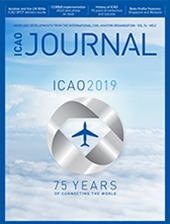 (ICAO Journal is available in English only from 2013)

Implementation of space-based communications, navigation, surveillance and air traffic management (CNS/ATM) systems, a concept endorsed by ICAO in 1991, is well under way. Numerous planning, research and development activities have been initiated. In the months and years ahead, the ICAO Journal will keep readers informed on efforts to implement the new CNS/ATM systems worldwide. Our first article comes from Singapore, where a new ATC system with ADS capability is scheduled to enter service next year. A new radar simulator functionally identical to the future operational system is already in operation.
Recursion, stop!

In the fight against terrorism the aviation community has turned to sophisticated tools to detect a wide range of weapons and explosives, and has updated programmes and strategies to address the ever-changing threat.
Recursion, stop!

The philosophy of airline-tailored ab initio pilot training, while not new, is increasingly attractive to both major and regional international airlines as the preferred method of recruiting transport aircrews.
Recursion, stop!

Two earth stations at a location near Toulouse have entered service linking ground communications with satellites of the International Maritime Satellite Organization. For more details on new-technology developments in France and Europe.
Recursion, stop!

Russian Federation flag carrier Aeroflot took delivery of five Airbus A310-300s in 1992. Representing the first Western-built aircraft to join the Aeroflot fleet and featuring a bright new livery, the arrival of the A310s in Moscow heralded a new era in the carrier's long history, enabling it to offer new levels of comfort and service on its international route network. The start of A310 operations with Aerflot also marked the first entry into commercial passenger service of a Western-built airliner holding a Russian type certificate.
Recursion, stop!

Human factors play a critical role in every aviation activity, from flight training to airline management. Statistics attribute about 75 per cent of aircraft accidents to lapses in human performance, and ICAO has given the highest priority to increasing awareness of the human factors considerations in all aviation disciplines.
Recursion, stop!

Undetected wind shear is deadly to aviation and has been the cause of numerous accidents resulting in loss of life and aircraft. As outlined in the article beginning on page 7, in recent years important steps have been taken to address this formidable hazard.
Recursion, stop!

Extended-range twin-engine operations (ETOPS) depend on the performance and high reliability offered by modern turbofans such as the Rolls-Royce Trent. Several Trent powerplants, with take-off thrust ranging from 300 to 385 kilonewtons, are being designed to power the Airbus A330 and Boeing 777.
Recursion, stop!

Development of satellite-based technologies for use by civil aviation has entered the transition and implementation phase, and elements of the new air navigation system will be operationally available in some regions in the immediate or near future.
Recursion, stop!

The Airbus Industrie A340 long-range transport, which made its first flight in October 1991, is the largest aeroplane to be manufactured by the European consortium. The four-engined aircraft will log about 2,000 flight hours before it enters service in 1993.
Recursion, stop!

The airline industry encountered both higher costs and declining traffic in 1991. A review of developments and industry performance begins on page 11. According to an ICAO study, the medium term outlook for the industry looks more promising.
Recursion, stop!

Amsterdam's Schiphol Airport is in the midst of a major expansion. The terminal building is being extended stage-by-stage, and a new 10I-metre air traffic control tower, under construction since 1988, entered operation last year. The development of airports and route facilities is a key to economic growth. As explained in the article beginning on page 6, the development of such infrastructure is supported by various ICAO activities.
Recursion, stop!