
国际民航组织期刊
The objective of the Journal is to provide a concise account of the activities of the International Civil Aviation Organization and to feature additional information of interest to Contracting States and the international aeronautical world.
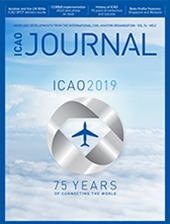 (ICAO Journal is available in English only from 2013)

René Magritte's L'Oiseau de Ciel (1966) was commissioned by SABENA Belgian World Airlines. The great surrealist Belgian master was one of the foremost artists of this century who looked to the sky for inspiration. For a special report on art and aviation in this issue, turn to page 79.
Recursion, stop!
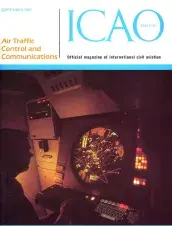
Four-colour plan-view display for air traffic control providing very high resolution is driven by a minicomputer. Developed by Raytheon as a Direct Access Radar Channel, it has been dubbed RAYDARC. It employs a patented method for rapid colour switching. Colours can be adjusted to match an individual operator's colour perception and preference.
Recursion, stop!
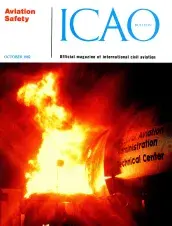
This wide-body test article, actually a section of an old Douglas C-133 Cargomaster aircraft, is being used by the U.S. Federal Aviation Administration to study post-crash cabin-fire hazards at its Technical Centre at Atlantic City Airport in New Jersey.
Recursion, stop!

American Airlines has contracted with two firms to provide it with L-100-30 Super Hercules cargo services to feed a number of hubs, at which American B-747 freighters pick up the payloads for delivery to major cities within the United States. The Hercules is a good companion for the larger cargo aircraft since it can accommodate the M-I cargo container shown.
Recursion, stop!
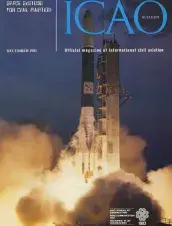
World Communications Year — 1983. Future uses of space technology in aeronautical communications and navigation as well as current applications in search and rescue covered in this issue arc part of ICAO's interest in WCY 83, proclaimed by the United Nations under the auspices of the International Telecommunications Union. In a state letter, ICAO's Secretary General Yves Lambert noted that WCY 83 represents a unique opportunity for furthering the improvement of aeronautical telecommunications and invited civil aviation authorities to actively participatc in national efforts to develop communications infrastructures, including aeronautical telecommunications.
Recursion, stop!
This air traffic control simulator is now operational at the Ministry of Transport Aeronautical College in New Zealand. It was developed and installed by Solartron, a division of Schlumberger Electronics (UK) Ltd. Site of the training facility is Christchurch International Airport.
Recursion, stop!
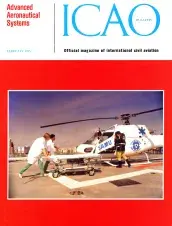
More and more, helicopters are proving their worth in the field of medical evacuation and patient transportation. They are fast, flexible and minimize patient discomfort. Shown is an Aerospatiale Ecureuil I (AS-350B) single-turbine rotorcraft adapted as an air ambulance.
Recursion, stop!
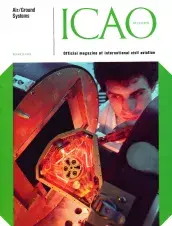
A key part of the SAGEM air data/inertial reference system (ADIRS), planned for first use in the new Airbus A320, is this Kearfott ring laser gyroscope. Three of these, used in a strap-down configuration, will comprise the principal inertial sensors of the system.
Recursion, stop!
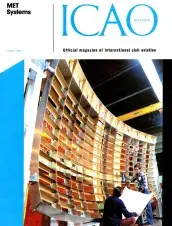
Moving from design to production, technicians put the finishing touches on the first ASR-9 airport surveillance radar being developed by Westinghouse for the U.S. Federal Aviation Administration. The prototype antenna was moved to a test range near Baltimore, Maryland, last January; first delivery of a completed ASR-9 is scheduled for 1986. This advanced system simultaneously tracks and presents aircraft and weather to air traffic controllers without interfering clutter. Westinghouse is under contract to deliver 137 systems to the U.S. Government. (Details on this new system were published in the September 1983 issue of the ICAO Bulletin.)
Recursion, stop!
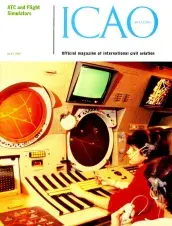
The student controller's position in any of the training facilities co-located in seven ATC centres throughout France duplicates operational systems. All of these remote training stations are connected to the country's National Civil Aviation School located at Toulouse.
Recursion, stop!
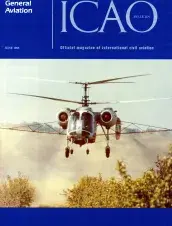
Agricultural aircraft usage in Eastern Europe has been steadily expanding since the Second World War. The Soviet Ka-26 helicopter (shown) came into use in the Region in the early 1970s for coverage in low mountain ranges and fruit and vegetable centres. This aircraft is spraying insecticide for pest control in fruit orchards.
Recursion, stop!
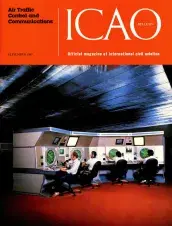
This is a portion of the air traffic control consoles at the Geneva area control centre. The ACC currently handles from 800-1,200 movements a day. As part of an overall systems update, a new flight-plan processing concept has been introduced at Geneva-Cointrin Airport -- for details, see story beginning on page 36.
Recursion, stop!