

ICAO Resources on Trafficking in Persons
Standards • Assembly Resolution • Guidance • Training Resources
Trafficking in Persons
Trafficking in persons is the recruitment, transportation, transfer, harbouring or receipt of persons, by means of the threat or use of force or other forms of coercion, of abduction, of fraud, of deception, of the abuse of power or of a position of vulnerability or of the giving or receiving of payments or benefits to achieve the consent of a person having control over another person, for the purpose of exploitation [Protocol to Prevent, Suppress and Punish Trafficking in Persons, Especially Women and Children, supplementing the United Nations Convention against Transnational Organized Crime].
Air travel is one of the modes of transportation utilized by traffickers. All stakeholders in the aviation ecosystem, particularly aviation personnel in direct contact with the travelling public can play an important role in combatting trafficking in persons when properly equipped to recognize indicators of trafficking in persons and information on how to report suspected instances of human trafficking to the relevant authorities, to ensure that traffickers do not misuse the civil aviation sector to deny the freedom of others.
The International Civil Aviation Organization (ICAO) is a Specialized Agency of the United Nations and contributes to the achievement of the United Nations Global Plan of Action to Combat Trafficking in Persons (Global Plan). ICAO Annex 9 - Facilitation to the Convention on International Civil Aviation (the Chicago Convention) contains international Standards on combatting trafficking in persons, obliging ICAO’s Member States to comply. These Standards are augmented by ICAO Assembly Resolution A42-16 Development and Implementation of Facilitation Provisions – Combatting Human Trafficking and complemented by guidance and training material to assist States in their implementation of the relevant Annex 9 Standards.
Annex 9 – Facilitation to the Convention on International Civil Aviation
Standard 8.45 establishes that Contracting States shall take measures to ensure that procedures in place to combat trafficking in persons are based on a Comprehensive Strategy and include clear reporting systems and relevant competent authorities’ points of contact for airport and aircraft operators. Note: Key elements to incorporate into a Comprehensive Strategy to combat trafficking in persons include:
|  |
laws; leadership; policies; reporting protocols and response mechanisms; partnerships; training; public awareness; data collection; information-sharing; and victim and survivor support. These key elements should be based, to the extent possible, on a victim-centred and trauma-informed approach. Further guidance on developing a Comprehensive Strategy, including examples, can be found in Doc 10171, A Comprehensive Strategy for Combating Human Trafficking in the Aviation Sector.
Standard 8.46 establishes that Contracting States shall take measures to ensure that airport and aircraft operators’ personnel in direct contact with the travelling public are provided with awareness training on trafficking in persons.
ICAO Assembly Resolution A42-16 ICAO Assembly Resolution A42-16 - Development and Implementation of Facilitation Provisions – Combatting Human Trafficking - calls on States to to give attention to adopting and promptly implementing Amendment 30 to Standards 8.45 and 8.46 in Annex 9; and to give due regard to Doc 10171, A Comprehensive Strategy for Combatting Human Trafficking in the Aviation Sector, Circular 352, Guidelines for Training Cabin Crew on Identifying and Responding to Trafficking in Persons, and Circular 362, Guidelines for Combatting Trafficking in persons in the Air Operator Supply Chain, in their implementation of the relevant provisions of Annex 9. Guidance Material and Tools
Guidance Material and Tools
Circular 352: Guidelines for Training Cabin Crew on Identifying and Responding to Trafficking in Persons (2018)Recognizing its potential to initiate global action in the context of air transport, the ICAO collaborated with the Office of the United Nations (UN) High Commissioner for Human Rights (OHCHR) to develop guidance material, which can serve as a foundation for cabin crew training. The joint ICAO-OHCHR Guidelines for Training Cabin Crew on Identifying and Responding to Trafficking in Persons (Cir 352) are the result of this collaboration, which underscores the important role of international aviation in combatting human trafficking. |  |
This Circular provides States and operators with the framework and topics that should be included in training packages on identifying and responding to trafficking in persons, aimed particularly at cabin crew members. Although the content of this Circular is applicable to cabin crew members, the issue of trafficking and combating this issue involves several stakeholders, not just cabin crew. Flight crew members play a vital role in reporting suspected cases of trafficking on board. It is imperative that they also receive training on this subject as part of a team approach to the issue. All personnel at airports should also be trained to recognize trafficking in persons and how to report any suspected case to the appropriate authorities. Therefore, the content of this circular may be adapted and used to create training packages for different transportation stakeholders (i.e. trains, buses or cruise lines).
Download a copy of the (ICAO-OHCHR) Guidelines for Training Cabin Crew on Identifying and Responding to Trafficking in Persons
| Circular 352: Guidelines for Training Cabin Crew on Identifying and Responding to Trafficking in Persons |  |  |  |  |  |  |
ICAO online tool for capacity building of cabin crew, on identifying and responding to trafficking in persons (2020).The tool for capacity building of cabin crew on identifying and responding to trafficking in persons was developed by ICAO in collaboration UNOHCHR. This is a free-of-charge eLearning tool, for use by States and operators enables trainees to understand the issue of trafficking in persons; identify potential cases of trafficking in persons; and respond to suspected trafficking in persons, including producing a report of the occurrence. This eLearning tool is intended to supplement each operator's specific training on its policies and procedures related to handling suspected cases of trafficking in persons.
| 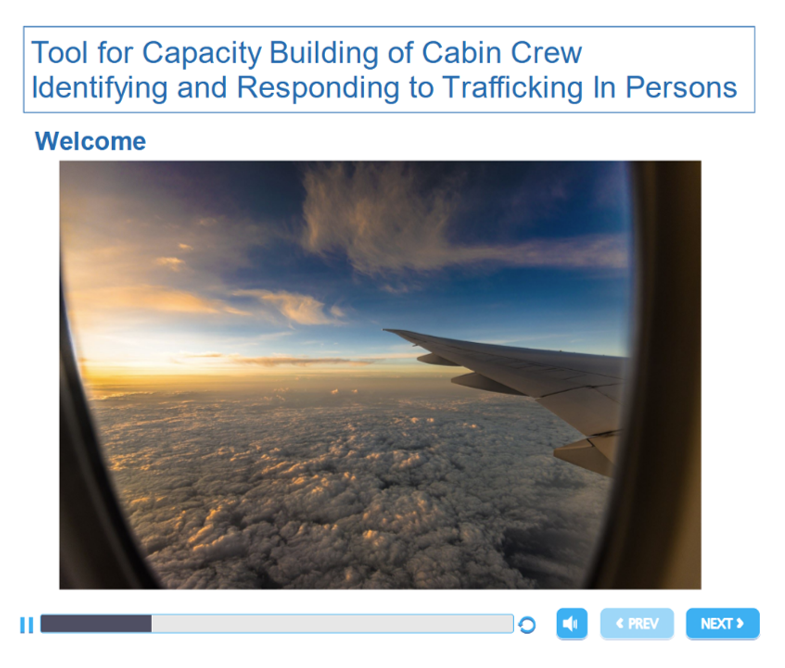 |
The tool for capacity building of cabin crew on identifying and responding to trafficking in persons was developed by ICAO in collaboration UNOHCHR. This is a free-of-charge eLearning tool, for use by States and operators enables trainees to understand the issue of trafficking in persons; identify potential cases of trafficking in persons; and respond to suspected trafficking in persons, including producing a report of the occurrence. This eLearning tool is intended to supplement each operator's specific training on its policies and procedures related to handling suspected cases of trafficking in persons. It is important to note that this eLearning tool must be supplemented with the operator's specific training on its policies and procedures related to handling suspected cases of trafficking.
Website: Digital Learning on Trafficking in Persons for Cabin Crew 4
Circular 357: Guidelines for Reporting Trafficking in Persons by Flight and Cabin Crew (2021)These joint ICAO-OHCHR guidelines are intended to assist States, their relevant authorities, and operators in managing crew reports of suspected cases of trafficking in persons in aviation, and to be used in conjunction with Circular 352. This circular emphasizes the need for appropriate reporting by cabin crew of suspected cases of trafficking in persons. The gathering and analysis of crew reports help law enforcement authorities and operators gather intelligence on trafficking in persons. |  |
Cabin crew members and other personnel should be encouraged to take appropriate action to help stop this crime, by reporting any suspicious situation. To encourage continued reporting, States, their law enforcement authorities and operators should reassure personnel that their efforts to identify and report suspected cases of trafficking in persons will be reviewed and taken seriously, even if the person submitting the report is not aware of what actions, if any, are ultimately taken. A joint effort on the part of the State and the operator is needed to maintain open communication and to allow for statistical analysis and other intelligence to emerge periodically, in relation to trafficking in persons in aviation.
Download a copy of (ICAO-OHCHR) Guidelines for Reporting Trafficking in Persons by Flight and Cabin Crew.
| Circular 357: Guidelines for Reporting Trafficking in Persons by Flight and Cabin Crew | | | | | | |
Doc 10171: A Comprehensive Strategy for Combating Human Trafficking in the Aviation Sector (2023).Developed by the ICAO Facilitation Panel’s Working Group on Human Trafficking, this Comprehensive Strategy For Combating Human Trafficking in the Aviation Sector seeks to provide an overview of the intersection of human trafficking and the aviation sector, and to equip States, civil aviation authorities (CAAs) and organizations, aircraft operators and airports with guidance and recommendations to inform the development of comprehensive trafficking strategies.
|  |
It covers key components of a comprehensive strategy, including human trafficking laws, leadership, policies (including social responsibility and employee responsibilities), reporting protocols, partnerships (including law enforcement and non-governmental organizations (NGOs)), training, public awareness, data collection and information-sharing and victim and survivor support. Additional resources in the appendices offer counter-trafficking tools for CAAs and organizations, aircraft operators and airports to adapt and tailor, including a model comprehensive strategy to combat trafficking. While this strategy focuses on civil aviation entities, the guidance should be implemented within the context of broader multimodal transportation initiatives, and States should share it broadly across government agencies.
Download a copy of Comprehensive Strategy For Combating Human Trafficking in the Aviation Sector
| Doc 10171: Manual on a Comprehensive Strategy for Combating Human Trafficking in the Aviation Sector | | | | | | |
Circular 362: Guidelines for Combatting Trafficking in Persons in the Air Operator’s Supply Chain (2025).Circular 362 developed in collaboration with the UNOHCHR is intended to assist States and air operators in preventing trafficking in persons in air operator’s supply chains, by providing clear steps to ensure due diligence and transparency in supply chain management. This Circular emphasizes the need for supply chain due diligence, voluntary commitments to fair labour practices, including responsible recruitment and adherence to existing laws by aviation sector organizations as important measures to prevent trafficking in persons.
|  |
This circular emphasizes the need for supply chain due diligence and voluntary commitments to fair labour practices, including responsible recruitment and adherence to existing laws by aviation sector organizations, as important measures to prevent trafficking in persons. Trafficking in persons has been found in supply chains in virtually every sector, worldwide. Addressing this issue requires internal government coordination and raising awareness among air operators regarding their responsibilities, the financial and reputational impact of engaging in such practices and legal obligations. To foster supply chain management and prevent trafficking, air operators should implement policies and procedures, as well as awareness campaigns and training programmes, related to this issue. Joint State and air operator efforts facilitate open communication and allow for analysis as well as for other information to emerge periodically.
Download a copy of (ICAO-OHCHR) Guidelines for Combatting Trafficking in Persons in the Air Operator’s Supply Chain.
| Circular 362: Guidelines for Combatting Trafficking in Persons in the Air Operator’s Supply Chain | | | | | | |
States are obliged to comply with ICAO Annex 9 - Facilitation Standards on Trafficking in Persons, to ensure that procedures in place to combat trafficking in persons are based on a Comprehensive Strategy and include clear reporting systems and relevant competent authorities’ points of contact for airport and aircraft operators. States are also obliged to take measures to ensure that airport and aircraft operators’ personnel in direct contact with the travelling public are provided with awareness training. Appropriate Authorities for Civil Aviation should require that operators develop policies, procedures, training and guidance for their employees, specifically to raise awareness on trafficking in persons and appropriate responses to such events.
The aviation industry is one of the modes of transportation utilized by traffickers, making it likely for frontline airline personnel to come face-to-face with victims or perpetrators. ICAO recommends that each operator develops a set of dedicated policies, procedures and reporting protocols for when such encounters occur.
For any further information please address your inquiries to:
Facilitation Section (FAL) e-mail: FAL [at] icao.int (FAL[at]icao[dot]int)