Projects
Initiative Towards sustAinable Kerosene for Aviation (ITAKA)
ObjectiveITAKA is an EC funded research project that intends to support the development of aviation biofuels in Europe, in an economically, socially and environmentally sustainable manner, improving the readiness of existing technologies and infrastructures. The objective is to develop a full value-chain in Europe to produce sustainable Synthetic Paraffinic Kerosene (SPK) at a large enough scale to allow testing in existing logistic infrastructures and in normal flight operations in Europe. In addition, according to the objectives set by the European Advanced Biofuels Flight Path and the SWAFEA study recommendations, it also represents an instrument to coordinate efforts and use complementarities between European Initiatives on sustainable aviation fuels. DescriptionITAKA is a collaborative project framed in the implementation of the European Union (EU) policies. In particular, it supports the implementation of the European Industrial Bioenergy Initiative (EIBI) of the European Strategic Energy Technology Plan (SET-Plan). It specifically aims to contribute to the fulfilment of some of the short-term objectives (2015) of the EU Advanced Biofuels Flight Path initiative, the goal of which is to reach a target of 2 million tons of biofuels used in European civil aviation by 2020. As the first-of-its-kind project in the European Union, ITAKA will link supply and demand by establishing commercial relationships under guaranteed conditions among feedstock growers, biofuel producers, distributors and end-users. ITAKA targets camelina oil as the best sustainable feedstock that can be produced timely at enough quantity within Europe to produce biojet fuel. The oil is converted into drop-in aviation fuel through the HEFA (Hydro-processed esters and fatty acids) pathway. On the other hand, used cooking oil (UCO) is also being assessed for its use as biojet fuel feedstock. | Category Deployment Value-chain step Full value-chain Type of pathway Oleaginous / Hydroprocessing Starting time and duration November 2012 - October 2016 Stakeholders Ministries, national agencies, industry, fuel producers, airlines, NGO Regional scope Regional Involved countries Europe Status On-going |
ITAKA addresses challenges in two main areas:
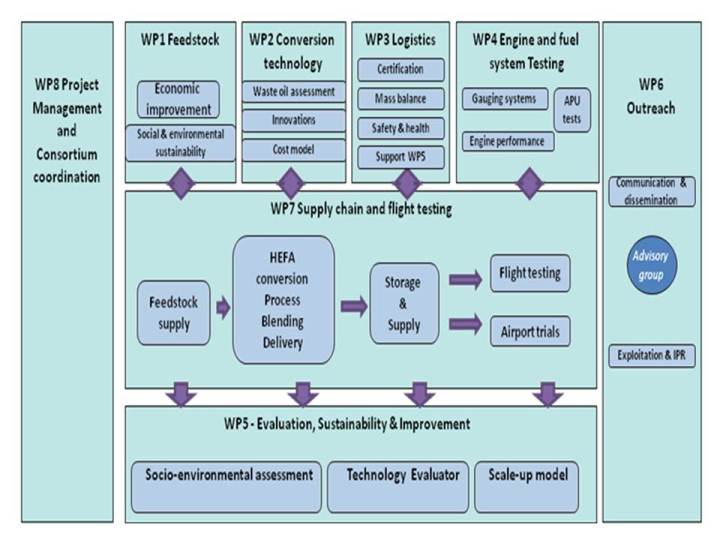
The generated knowledge will allow to identify and address barriers to innovation and commercial deployment. ITAKA project work plan relies on the following Work Breakdown Structure (WBS).
PartnersSenasa, AirBP, Airbus group, Asociatia Centrul de Biotechnologiimicrobiene, Avinor, Compañía Logística de Hidrocarburos, École Politechnique Federale de Lausanne, Embraer, Lufthansa, The Manchester Metropolitan University, Neste Oil, SAS, SkyEnergy, Camelina Company España, Consorzio per la Ricerca e la Dimostrazione Sulle Energie Rinnovabili. Collaborators: KLM Royal Dutch Airlines, USAMVB (Universitatea de Ştiinte Agronomice şi Medicină Veterinară Bucureşti) Achievements to dateSince the commencement of this project, the team has seen the following achievements:
In addition, important lessons have been learnt, key market barriers and enablers identified, and best-practices designed in relation to the general aim of ITAKA. As a result, a set of recommendations for the correct deployment of the biojet value chain in Europe is being developed. Deliverables with detailed information are available at the web page www.itaka-project.eu Contact informationProject website: www.itaka-project.eu |