
PBN Procedure Design Course
Overview
This course consists of criteria for the design of procedures for PBN navigation, including SIDs and STARs, RNP APCH LNAV procedure and Baro-VNAV procedure.
Objectives
At the end of this training, the participants, as future procedure designers tutored by a senior procedure designer is able to:
- Calculated the parameters for different PBN navigation specification
- Merging segments of different widths
- Design or Cross check PBN departures procedures (SIDs)
- Design or Cross check PBN arrival procedures (STARs)
- Design or Cross check PBN NPA procedures (ex. RNP APCH LNAV)
- Design APV barometric vertical navigation (Baro-VNAV) procedure
- Design PBN in combination with ILS procedure
- Gain the knowledge about the SBAS /GBAS
Participants concerned
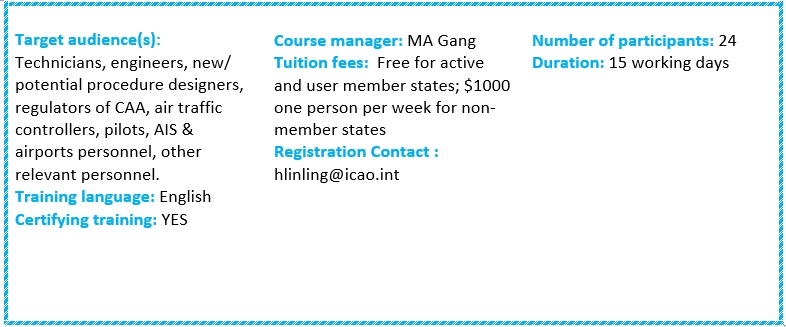
Future procedure designers, regulators of CAA, Air Traffic Controllers, and Pilots for flight inspection or validation, AIS personnel, and other relevant personnel.
Prerequisites
Attendance of APAC FPP Instrument Procedure Design Course: "Pans-Ops PD Initial Course "or "Flight Procedure Design online Course - Module 1 "or equivalent course is required.
Attendees be able to communicate in English.
Tuition fees
- Free for Active and User Member States,
- 1000$ one person per week for Non-Member States.
Content
At APAC FPP, according to ICAO Doc 9906 Volume 2, the initial training of IFR procedures designers consists of two main parts, PANS-OPS PD initial course and PBN PD course. Each part is independent; trainees can choose courses according to demands. This course is considered as the second step in a comprehensive training program to design IFR procedure.
The training is organized around courses, exercises and assessments to apply all the design criteria addressing PBN and conventional departures procedures. The pillars of this training include a case study from ICAO Doc 9368 and a published procedure.
Focus
- PBN navigation concepts
- Protection area width and connection methods
- Limitation elements of segments
- PBN SID (Standard Instrument Departure)
- PBN STARs
- RNP APCH procedure (LNAV)
- APV Baro-VNAV procedure
- Coding and publication (charting), procedure design documentation
Theoretical courses
3 weeks' courses are on-site classes. But online learning channel will be maintained for participants who are unable to participate in the on-site training, for the purpose of adapting to the actual situation and the different needs of APAC States. No certificate for the participants in the online channel. (和 PANOPS 一样 copy LLJ的 WP)
Presentation and explanation of the rules and principles described in Doc 8168 Volume II.
Exercises
Elementary use of the regulation concepts in a simplified environment, conducted to enforce the theoretical input.
Exercises are daily scheduled.
There is one on-site group-exercise about PBN SID, STAR and the approach procedures (LNAV and Baro-VNAV procedures), this group exercise is based on the real FPD cases.
Course Rundown
Topic | Further Description |
PBN concept | ICAO PBN Concept. Navigation Specifications |
Navigation Sensors in PBN | GNSS, DMEDME, VORDME, SBAS,GBAS |
PBN Departures | PBN Departures, contrast with conventional SIDs. |
Arrival Segment | Parameters and limitations for PBN arrival, protection areas and Obstacles clearance. |
Initial Approach Segment | Parameters and limitations for Initial Approach Segment of PBN (RNP APCH) procedure, protection areas and Obstacles clearance. |
Intermediate Segment | Parameters and limitations for Intermediate Segment of PBN (RNP APCH) procedure, protection areas and Obstacles clearance. |
Final Approach Segment | Parameters and limitations for Final Approach Segment of PBN (RNP APCH) procedure, protection areas and Obstacles clearance. Calculation and publishing of Minima OCH. |
Missed Approach Segment | Calculation of Start of Climb for LNAV procedure. Obstacle assessment in 3 phases of missed approaches. Turn at a point, turn at an altitude of Missed approach. |
Holding | Application of PBN holding area. |
T/Y Bar Layout Concept | T-Y bar concept of PBN procedure |
Terminal Arrival Altitude | Omnidirectional arrival. Contrast with MSA |
Baro-VNAV | Baro-VNAV concept, protection areas and obstacle assessments. |
GBAS/SBAS Concept | GBAS/SBAS concept, protection areas and obstacle assessments. |
PBN in combination with ILS | PBN + ILS method and Obstacles assessments. |
ARINC 424 Path/Terminators | ARNINC 424 coding issues for PBN procedures |
FAS Data block | FAS Data block parameters |
Charting&Coding/AIP | Charting requirements, published information for PBN procedures. |
Project
Design of PBN procedures (SIDs, STARs, RNP APCH LNAV and Baro-VNAV procedures) in a geographic and aeronautic realistic environment. The design is carried out step by step under the guidance of instructors. The project also includes the design of Coding, Charting and appropriate documentation.
Assessment
Several progress tests are carried out to identify the trainee's ability to apply procedure design criteria. Correction of the project is part of the assessment.
At the end of the course, an individual assessment report could provide to on-site participants as required.
Assistance
Contact with referent instructor (s) is provided throughout the course.
Delivered course material
Courseware will be uploaded to APAC FPP website.