  • English
User account menu
  • Log in
Home
International Civil Aviation Organization
ICAO store
User account menu
  • Log in
Seach MENU
About ICAO

About ICAO

  • Overview
  • Strategic Plan 2026-2050
  • Latest News and Highlights
  • FAQs
  • List - ICAO Member States
  • ICAO Museum
  • ICAO Carbon Calculator
  • Report Misconduct
  • Contact ICAO

Diplomatic Bodies

  • ICAO Assembly (193 States)
  • Sessions of the Assembly
  • Resolutions in Force
  • ICAO Council (36 States)
  • President of the Council
  • Sessions of the Council
  • Council State Representatives
  • Air Navigation Commission

ICAO Secretariat

  • Secretary General
  • Air Navigation Bureau
  • Air Transport Bureau
  • Capacity Development and Implementation Bureau
  • Legal Affairs and External Relations Bureau
  • Administration Bureau
  • Regional Offices
Global Priorities

Strategic goals

  • Every Flight is Safe and Secure
  • Aviation is Environmentally Sustainable
  • • CORSIA
  • • State Action Plans for Aviation CO2 Reduction
  • • Finvest Hub
  • Seamless, Accessible, and Reliable Mobility
  • No Country Left Behind
  • • Capacity Development and Implementation Support
  • Comprehensive Legal Framework
  • Economic Development

Enablers

  • ICAO Continuous Improvement
  • Innovation in Aviation
  • Next Generation Aviation Professionals
  • Gender Equality
  • ICAO Global Ambassadors Programme
  • ICAO Training
  • Partnerships and Resource Mobilization
Events

Featured Events

  • ICAO/AWG Joint Regional Workshop on Cross-Border Transferability of Aircraft (XBT) and Compliance with the Cape Town Convention (CTC)
  • ICAO Global Implementation Support Symposium 2026
  • Fourteenth Meeting of the Facilitation Panel (FALP/14)
  • 4th Civil Aviation Legal Advisers Forum (CALAF/4)
  • View the Full List of Coming and Past meetings and Events
  • Host your event at ICAO
Resources

Resources

  • ICAO E-Library
  • Publications
  • Annual Reports of the Council
  • Safety Audit Results - Interactive
  • Aviation Benefits Report
  • Economic Facts and Figures
  • Global Aviation Safety Plan
  • Safety Reports
  • Global Air Navigation Plan
  • Air Navigation Reports
  • ICAO Partnership Programme
  • ICAO API Data Service
  • ICAO Data+
  • ICAO iSTARS
  • Air Transport Monthly Monitor
  • Compendium: Competition Policies/Practices
  • Economic Analyses and Forecasting
  • Databases and Studies
  • Environment Reports
  • Environment Publications
  • ICAO TRIP Strategy Compendium
  • Unmanned Aviation
  • ICAO GIS Aviation Data
Careers
Featured Articles
ICAO TV
Subscribe
About ICAO
About ICAO
  • Overview
  • Strategic Plan 2026-2050
  • Latest News and Highlights
  • FAQs
  • List - ICAO Member States
  • ICAO Museum
  • ICAO Carbon Calculator
  • Report Misconduct
  • Contact ICAO
Diplomatic Bodies
  • ICAO Assembly (193 States)
  • Sessions of the Assembly
  • Resolutions in Force
  • ICAO Council (36 States)
  • President of the Council
  • Sessions of the Council
  • Council State Representatives
  • Air Navigation Commission
ICAO Secretariat
  • Secretary General
  • Air Navigation Bureau
  • Air Transport Bureau
  • Capacity Development and Implementation Bureau
  • Legal Affairs and External Relations Bureau
  • Administration Bureau
  • Regional Offices
Global Priorities
Strategic Goals
  • Every Flight is Safe and Secure
  • Aviation is Environmentally Sustainable
  • • CORSIA
  • • State Action Plans for Aviation CO2 Reduction
  • • Finvest Hub
  • Seamless, Accessible, and Reliable Mobility
  • No Country Left Behind
  • • Capacity Development and Implementation Support
  • Comprehensive Legal Framework
  • Economic Development
Enablers
  • ICAO Continuous Improvement
  • Innovation in Aviation
  • Next Generation Aviation Professionals
  • Gender Equality
  • ICAO Global Ambassadors Programme
  • ICAO Training
  • Partnerships and Resource Mobilization
Events
Featured Events
  • ICAO/AWG Joint Regional Workshop on Cross-Border Transferability of Aircraft (XBT) and Compliance with the Cape Town Convention (CTC)
  • ICAO Global Implementation Support Symposium 2026
  • Fourteenth Meeting of the Facilitation Panel (FALP/14)
  • 4th Civil Aviation Legal Advisers Forum (CALAF/4)
  • View the Full List of Coming and Past meetings and Events
  • Host your event at ICAO
Resources
Resources
  • ICAO E-Library
  • Publications
  • Annual Reports of the Council
  • Safety Audit Results - Interactive
  • Aviation Benefits Report
  • Economic Facts and Figures
  • Global Aviation Safety Plan
  • Safety Reports
  • Global Air Navigation Plan
  • Air Navigation Reports
  • ICAO Partnership Programme
  • ICAO API Data Service
  • ICAO Data+
  • ICAO iSTARS
  • Air Transport Monthly Monitor
  • Compendium: Competition Policies/Practices
  • Economic Analyses and Forecasting
  • Databases and Studies
  • Environment Reports
  • Environment Publications
  • ICAO TRIP Strategy Compendium
  • Unmanned Aviation
  • ICAO GIS Aviation Data
Careers
Featured Articles
ICAO TV
ICAO store
Subscribe
  • English

Breadcrumb

  1. Homepage
  2. Asia and Pacific (APAC) Office
  3. Flight Procedure Design Course- Module 3 (N/A)
  • APAC Newsletters
  • Asia and Pacific (APAC) FPP
  • News
Overview
  • About FPP
  • Contact Us
  • Facilities
  • FPP Staff
  • Information for Visitors
  • Members
Phase V of FPP
  • Scope of Activities
  • Training Phases
Secure Portal
  • Steering Committee Meeting
Training Introduction
  • Pans-Ops Procedure Design Initial Course
  • PBN Procedure Design Course
  • Procedure Design Refresher Course
  • PBN Flight Procedure Design Workshop for Non-Procedure Designer
  • RNP AR Workshop
  • Quality Assurance (QA) Workshop
  • Coding and Charting Workshop
  • Procedure Design Seminar
  • Flight Procedure Design Course Module 1 (N/A)
  • Flight Procedure Design Course Module 2 (N/A)
  • Flight Procedure Design Course Module 3 (N/A)
  • Training Programme

Flight Procedure Design Course- Module 3 (N/A)

Overview

This course details criteria for the design of three-dimensional (3D) instrument approaches for both conventional and PBN navigation.

Objectives

At the end of this training, the participant, as future procedure designer tutored by a senior procedure designer is able to:

  • Design ILS CAT I procedure
  • Design LOC Only (GP inoperative) procedure
  • Design APV barometric vertical navigation (Baro-VNAV) procedure
Participants concerned

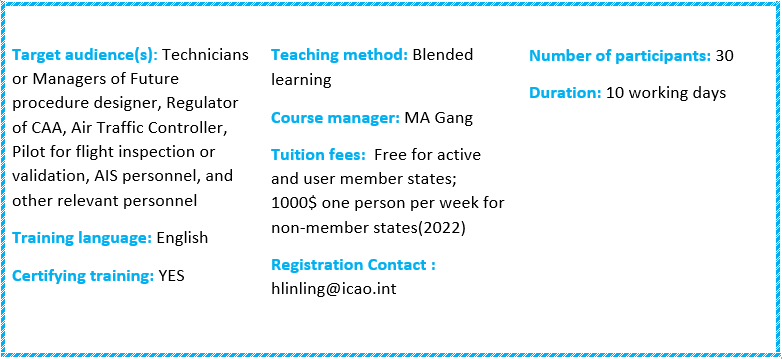
Future procedure designers, regulators of CAA, Air Traffic Controllers, and Pilots for flight inspection or validation, AIS personnel, and other relevant personnel.

Prerequisites

Attendance of APAC FPP Instrument Procedure Design Course: "Flight Procedure Design online Course - Module 1"and "Flight Procedure Design online Course - Module 2"or equivalent course(s) are required.

Attendees should feel comfortable to communicate in English.

Tuition fees
  • Free for active and User Member States,
  • 1000$ one person per week for Non-Member States.
Content

At APAC FPP, according to ICAO doc 9906 volume 2, the initial training of IFR procedures designer consists of three main modules. Each module is independent but completing each other, trainees can choose module on demand. This module is considered the third step in a comprehensive training program to design IFR procedure.

The training is organized around courses, exercises and assessments to apply all the regulatory criteria addressing precision approach and approach with vertical guidance procedures. The pillars of this training include a case study from ICAO 9368 and a real published procedure.

Focus

The course deals with:

  • Basic ILS surfaces, OAS for ILS CAT I
  • APV Baro-VNAV surfaces,
  • HL, OCA/H computation,
  • RF turn connection to OAS,
  • Limitation elements of segments, coding,
  • APV SBAS concept
  • Publication, procedure design documentation
Theoretical courses

2 weeks' courses are in remote classes.

Presentation and explanation of the rules and principles described in Doc 8168-OPS/611.

Exercises

Elementary use of the regulation concepts in a simplified environment, conducted to enforce the theoretical input.

Exercises are daily scheduled.

The exercises about criteria are in remote classes.

Course rundown

Topic

Module

Further Description

Charting/AIP

3

Charting requirements, published information for PA and APV procedures.

ARINC 424 Path/Terminators

3

ARNINC 424 coding issues for PBN 3D operations.

ILS General Principles

3

Introduction to ILS Systems

Basic ILS

3

Basic-ILS surfaces and Obstacle assessments.

OAS Cat I and II

3

OAS for CAT I and II

Collision Risk Model

3

Instruction of CRM

LOC only

3

LOC only procedures (2D operation)

ILS Missed Approach

3

Turn inside of OAS.

Baro-VNAV

3

Baro-VNAV concept, protection areas and obstacle assessments.

SBAS/GBAS Concept

3

SBAS concept, protection areas and obstacle assessments.

PBN in combination with ILS

3

PBN + ILS method and Obstacles assessments.

Project

Design of PA and APV Baro-VNAV procedures in a geographic and aeronautic realistic environment. The design is carried out step by step under the guidance of instructors. The project also includes the design of Instrument Approach Chart and appropriate documentation.

Assessment

Several progress tests are carried out to identify the trainee's ability to apply procedure design criteria. Correction of the project is part of the assessment.

At the end of the course, an individual assessment report is provided to each participant.

Certificate issuance

If participants who do not complete the daily practice (homework) during the two weeks of training will automatically lose the chance to attend the final tests.

The final tests can only be taken twice. The pass mark is 60.  APAC FPP offers any students with a fail grade to re-take the test. If a participant scores below 80 on both tests, the overall grade of the course will be a fail. If participants who can only take the test once for their personal reasons will automatically lose a chance, we will not provide an opportunity for individual make-up test.

Those who successfully complete and pass the test will be awarded the qualification certificate as below.
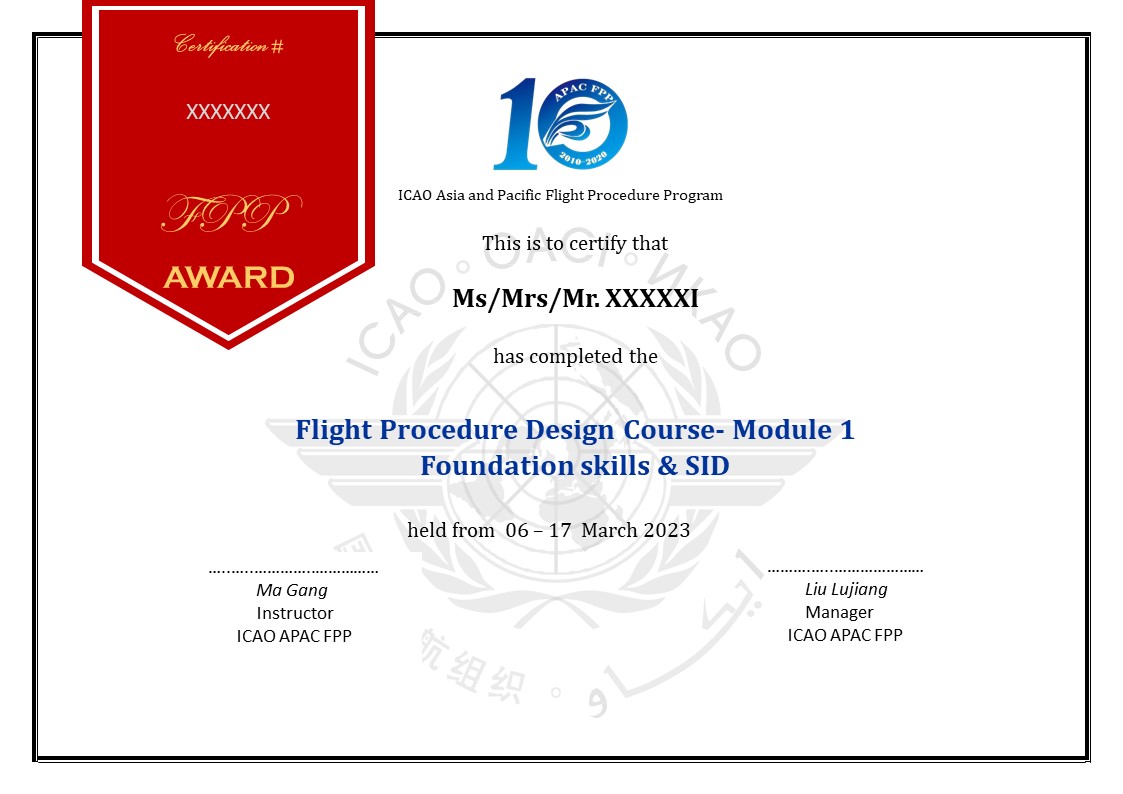
APAC FPP can only issue the attending training certificate without the certificate number to those who fail the tests twice. 

Assistance

Contact with referent instructor (s) is provided throughout the course.

Delivered course material

Courseware will be uploaded to APAC FPP website.

Learn more about ICAO
  • Contact ICAO
  • The United Nations
  • Terms & Conditions
  • External Resources
  • web [at] icao.int (Web Support)
  • FAQ
Connect with us :
  • linkedIn
  • Facebook
  • Unitingaviation
  • ICAO-TV
  • Instagram
  • Youtube

© 2025 International Civil Aviation Organization