  • English
User account menu
  • Log in
Home
International Civil Aviation Organization
ICAO store
User account menu
  • Log in
Seach MENU
About ICAO

About ICAO

  • Overview
  • Strategic Plan 2026-2050
  • Latest News and Highlights
  • FAQs
  • List - ICAO Member States
  • ICAO Museum
  • ICAO Carbon Calculator
  • Report Misconduct
  • Contact ICAO

Diplomatic Bodies

  • ICAO Assembly (193 States)
  • Sessions of the Assembly
  • Resolutions in Force
  • ICAO Council (36 States)
  • President of the Council
  • Sessions of the Council
  • Council State Representatives
  • Air Navigation Commission

ICAO Secretariat

  • Secretary General
  • Air Navigation Bureau
  • Air Transport Bureau
  • Capacity Development and Implementation Bureau
  • Legal Affairs and External Relations Bureau
  • Administration Bureau
  • Regional Offices
Global Priorities

Strategic goals

  • Every Flight is Safe and Secure
  • Aviation is Environmentally Sustainable
  • • CORSIA
  • • State Action Plans for Aviation CO2 Reduction
  • • Finvest Hub
  • Seamless, Accessible, and Reliable Mobility
  • No Country Left Behind
  • • Capacity Development and Implementation Support
  • Comprehensive Legal Framework
  • Economic Development

Enablers

  • ICAO Continuous Improvement
  • Innovation in Aviation
  • Next Generation Aviation Professionals
  • Gender Equality
  • ICAO Global Ambassadors Programme
  • ICAO Training
  • Partnerships and Resource Mobilization
Events

Featured Events

  • ICAO/AWG Joint Regional Workshop on Cross-Border Transferability of Aircraft (XBT) and Compliance with the Cape Town Convention (CTC)
  • ICAO Global Implementation Support Symposium 2026
  • Fourteenth Meeting of the Facilitation Panel (FALP/14)
  • 4th Civil Aviation Legal Advisers Forum (CALAF/4)
  • View the Full List of Coming and Past meetings and Events
  • Host your event at ICAO
Resources

Resources

  • ICAO E-Library
  • Publications
  • Annual Reports of the Council
  • Safety Audit Results - Interactive
  • Aviation Benefits Report
  • Economic Facts and Figures
  • Global Aviation Safety Plan
  • Safety Reports
  • Global Air Navigation Plan
  • Air Navigation Reports
  • ICAO Partnership Programme
  • ICAO API Data Service
  • ICAO Data+
  • ICAO iSTARS
  • Air Transport Monthly Monitor
  • Compendium: Competition Policies/Practices
  • Economic Analyses and Forecasting
  • Databases and Studies
  • Environment Reports
  • Environment Publications
  • ICAO TRIP Strategy Compendium
  • Unmanned Aviation
  • ICAO GIS Aviation Data
Careers
Featured Articles
ICAO TV
Subscribe
About ICAO
About ICAO
  • Overview
  • Strategic Plan 2026-2050
  • Latest News and Highlights
  • FAQs
  • List - ICAO Member States
  • ICAO Museum
  • ICAO Carbon Calculator
  • Report Misconduct
  • Contact ICAO
Diplomatic Bodies
  • ICAO Assembly (193 States)
  • Sessions of the Assembly
  • Resolutions in Force
  • ICAO Council (36 States)
  • President of the Council
  • Sessions of the Council
  • Council State Representatives
  • Air Navigation Commission
ICAO Secretariat
  • Secretary General
  • Air Navigation Bureau
  • Air Transport Bureau
  • Capacity Development and Implementation Bureau
  • Legal Affairs and External Relations Bureau
  • Administration Bureau
  • Regional Offices
Global Priorities
Strategic Goals
  • Every Flight is Safe and Secure
  • Aviation is Environmentally Sustainable
  • • CORSIA
  • • State Action Plans for Aviation CO2 Reduction
  • • Finvest Hub
  • Seamless, Accessible, and Reliable Mobility
  • No Country Left Behind
  • • Capacity Development and Implementation Support
  • Comprehensive Legal Framework
  • Economic Development
Enablers
  • ICAO Continuous Improvement
  • Innovation in Aviation
  • Next Generation Aviation Professionals
  • Gender Equality
  • ICAO Global Ambassadors Programme
  • ICAO Training
  • Partnerships and Resource Mobilization
Events
Featured Events
  • ICAO/AWG Joint Regional Workshop on Cross-Border Transferability of Aircraft (XBT) and Compliance with the Cape Town Convention (CTC)
  • ICAO Global Implementation Support Symposium 2026
  • Fourteenth Meeting of the Facilitation Panel (FALP/14)
  • 4th Civil Aviation Legal Advisers Forum (CALAF/4)
  • View the Full List of Coming and Past meetings and Events
  • Host your event at ICAO
Resources
Resources
  • ICAO E-Library
  • Publications
  • Annual Reports of the Council
  • Safety Audit Results - Interactive
  • Aviation Benefits Report
  • Economic Facts and Figures
  • Global Aviation Safety Plan
  • Safety Reports
  • Global Air Navigation Plan
  • Air Navigation Reports
  • ICAO Partnership Programme
  • ICAO API Data Service
  • ICAO Data+
  • ICAO iSTARS
  • Air Transport Monthly Monitor
  • Compendium: Competition Policies/Practices
  • Economic Analyses and Forecasting
  • Databases and Studies
  • Environment Reports
  • Environment Publications
  • ICAO TRIP Strategy Compendium
  • Unmanned Aviation
  • ICAO GIS Aviation Data
Careers
Featured Articles
ICAO TV
ICAO store
Subscribe
  • English

Breadcrumb

  1. Homepage
  2. Economic Development of Air Transport
  3. Public-Private Partnership (PPP)
  • Home
Economic Aspects of COVID-19 in aviation
  • Economic Impacts of COVID-19
  • Guidance on Economic and Financial Measures
  • COVID-19 Air Traffic Dashboards
  • Priority Brief: Air Cargo
  • Post COVID-19 Forecasts Scenarios
Regulatory and Policy Guidance
  • Air Transport Policy and Regulation
  • Connectivity
  • Competition
  • Emergency Response Planning
  • Infrastructure Management
Aviation Data and Analyses
  • Aviation Data and Statistics
  • Economic Analyses and Forecasting
  • Aviation Satellite Account
  • Aviation Data Solutions
  • Joint Financing
Events
  • ICAO Air Services Negotiation Event (ICAN)
  • Outcomes of Events
Resources
  • The World of Air Transport
  • Publications
  • Studies
  • Training
  • Contact Us

Public-Private Partnership (PPP)



General

A Public-Private Partnership (PPP) is a partnership between the public sector and the private sector for the purpose of delivering a project or a service traditionally provided by the public sector. The advantage of a PPP is that the management skills and financial acumen of private businesses could create better value for money for taxpayers when proper cooperative arrangements between the public and private sectors are used. 

PPP can increase the quality, the efficiency and the competitiveness of public services. It can supplement limited public sector capacities and raise additional finance in an environment of budgetary restrictions. The best use of private sector operational efficiencies can increase quality to the public and the ability to speed up infrastructure development. 

When considering the commercialization or privatization of airports and air navigation services providers (ANSPs), States should bear in mind that they are ultimately responsible for safety, security and economic oversight of these entities (Doc 9082 - ICAO's Policies on Charges for Airports and Air Navigation Services - Section I, para. 6 refers). 

Privatization should not in any way diminish the State’s requirement to fulfil its international obligations, notably those contained in the Chicago Convent ion, its Annexes and in air services agreements, and to observe ICAO’s policies on charges in Doc 9082 (Doc 9562 - Airport Economics Manual - para. 2.27 refers and Doc 9161 - Manual on Air Navigation Services Economics - para. 2.27 refers). 

PPP Case Studies


The case studies have been prepared by the ICAO Secretariat based on material available (such as websites, reports, studies and the aviation press) and do not constitute an assessment or the expression of view by ICAO.

Airports

  • Brazil
  • India
  • South Africa
  • China
  • Jamica
  • United States
  • Congo
  • Jordan
 
  • France
  • Saudi Arabia


 ANSPs

  • United States


PPP - Airport Economics figures and analysis


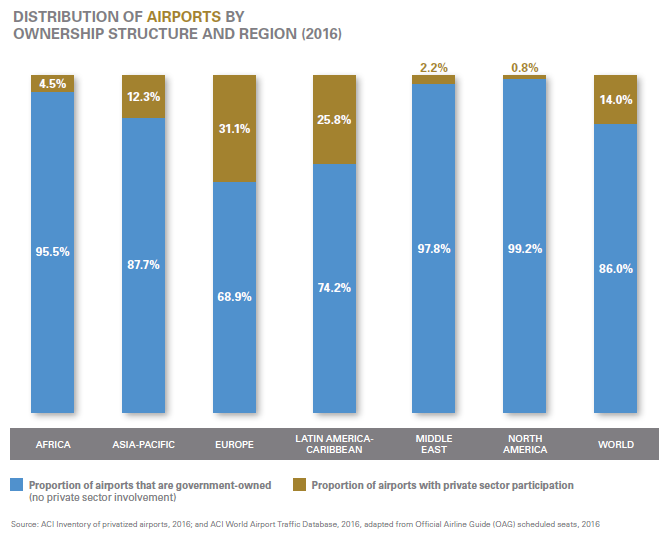
The following airport economics figures and analyses are extracted from the Airports Council International Policy Brief published in April 2017. More comprehensive and detailed airport economics figures and analyses are available in the ACI Airport Economics report and the policy brief. The following graph summarizes the percentage of airports in different regions of the world under different ownership models. As evident, by numbers the airports are mostly publicly owned. Government-owned operators or airports that are exclusively managed by public authorities continue to make up the lion’s share of airports across the globe, irrespective of the growing interest in private sector financing and management of the airports. An estimated majority (86%) of the 4,300 airports with scheduled traffic are public, in that they are owned by a government or governmental entity. Although airports with private sector participation account for an estimated 14% of airports worldwide, these airports handle over 40% of global traffic.
 

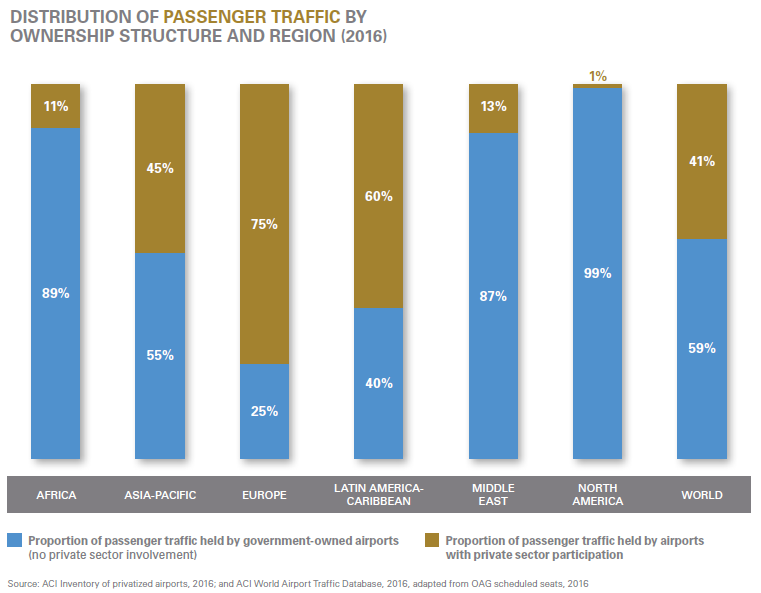
But if the distribution of passenger traffic is considered, as shown in the next graph, the growing involvement of private participation becomes explicit. 41% of global airport traffic is handled by airports that are managed and/or financed by private stakeholders. Private investments are essentially profit oriented, with a focus on good passenger service quality. Both these factors drive the private investors to the markets with greater traffic.​


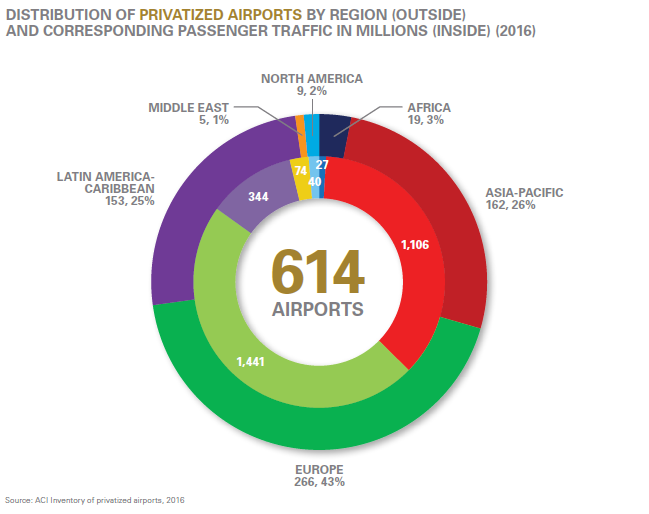
The figure below shows that out of the 614 airports as per the ACI Inventory of privatized airports, the highest number(266) exists in Europe, followed by Asia Pacific( 162). The figure also shows the corresponding passenger traffic in millions.​​


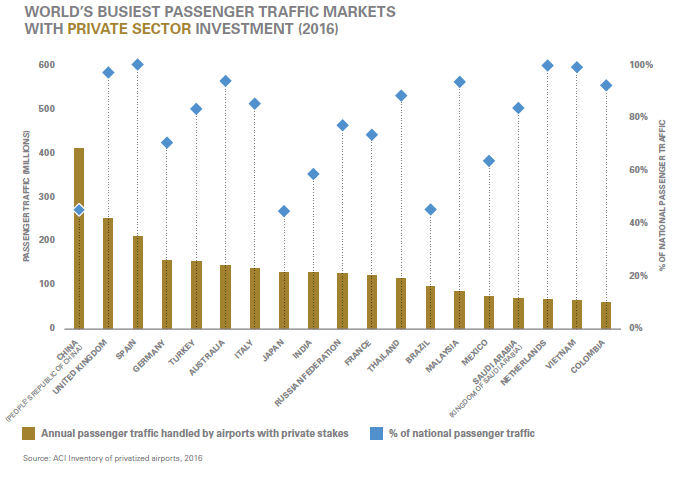
Finally, the graph below depicts the countries that are currently i.e. in 2016 the busiest markets by passenger traffic with the private sector investment. It shows relative passenger traffic proportions handled by airports that have private sector investment, compared to total traffic at the national level.​​​


Learn more about ICAO
  • Contact ICAO
  • The United Nations
  • Terms & Conditions
  • External Resources
  • web [at] icao.int (Web Support)
  • FAQ
Connect with us :
  • linkedIn
  • Facebook
  • Unitingaviation
  • ICAO-TV
  • Instagram
  • Youtube

© 2025 International Civil Aviation Organization