ICAO Journal
The objective of the Journal is to provide a concise account of the activities of the International Civil Aviation Organization and to feature additional information of interest to Contracting States and the international aeronautical world.
 (ICAO Journal is available in English only from 2013)
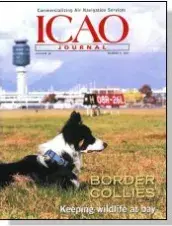
Preventing bird strikes near airports requires a variety of methods. One relatively new method that appears to be effective is patrol by trained Border collies. Even a lone dog and its handler can significantly impact the bird population or number of runway incursions by deer, according to airports which have incorporated the collie into their wildlife control programmes.
Several of the feature articles in this edition focus on training, including training in aviation language proficiency. The recent introduction of more stringent requirements for pilots and air traffic controllers highlights the need for effective and efficient language training programmes delivered by qualified teaching professionals.
While 2002 witnessed some improvement in airline traffic and financial results compared with the sharp downturn of 2001, the air transport industry remained embroiled in crisis last year. Our summary of major developments in 2002, as well as airline traffic and financial forecasts for the 2003-05 period, begins on page 5.
Feature articles in this edition focus on safety oversight developments. Included is an overview of the ICAO Universal Safety Oversight Audit Programme (USOAP): five years after its launch, USOAP is preparing to widen its focus to all safety-related provisions contained in the annexes to the Chicago Convention.
Both controlled flight into terrain (CFIT) and approach and landing accidents are known to be major contributors to the aircraft hull loss and passenger fatality statistics. As the article on page 5 indicates, a new "tool kit" for approach and landing accident reduction provides material that can be directly" used in developing training and accident prevention programmes.
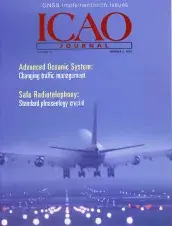
A newly designed ATM system that will soon be in place at oceanic facilities in the United States will employ a high level of automation to reduce controller workload significantly. As explained in the article beginning on page 18, the advanced technology will permit an increase in air traffic capacity and the provision of non-separation-related services, without compromising safety.