
Cross Border Transfers
What is Cross Border Transfer (XBT) of Aircraft?
According to Article 17 of the the Convention on International Civil Aviation ("Convention"), aircraft have the nationality of the State in which they are registered. Article 18 of the Convention, states that an aircraft cannot be validly registered in more than one State, but its registration may be changed from one State to another. The change of aircraft registration from one state to another is referred to as cross-border transfers of aircraft.

Why is ICAO involved in XBT?
The cross-border transferability issues are of interest to many stakeholders: States, operators, manufacturers, leasing companies and others.
The existing regulatory framework pertaining to cross-border transfers of aircraft were developed when commercial aircraft were predominantly purchased directly by their operators who then retained ownership of such aircraft for use during most or all of their useful lives. Changes to aircraft nationality were not common and aircraft tended to reside within one State for most or all of its useful life.
Over the past three decades, aircraft operators have realized substantial capital and operational efficiencies by leasing, rather than owning, a portion of their fleets for various periods of time. This has led to a sharp increase in the number of XBTs globally, yet the framework and resources allocated to perform the duties inherent in a transfer has not increased proportionally. The increase of XBT activities, along with differences in States' regulations, requirements and practices lead not only to the complexity of the process but in some cases, may cause duplication of efforts and inefficiencies for all participants, without providing an enhanced safety factor. Therefore, ICAO launched the XBT initiative with the aim of improving, standardizing and enhancing the efficiency of the XBT process.
What does a typical XBT process look like?
The XBT process inherently involves two States of Registry; the current State of Registry (the exporting State), and the intended future State of registry (the importing State). The main principle of the XBT process is that any aircraft registration should be made to the satisfaction of the importing State. The XBT process facilitates provisions of Annex 7 – Aircraft National and Registration Marks and Annex 8 – Airworthiness of Aircraft. The issuance of an Air Operator Certificate and its associated operations specifications (provided in Annex 6 – Operation of Aircraft) fall outside of the XBT process.
Typical XBT Process Map
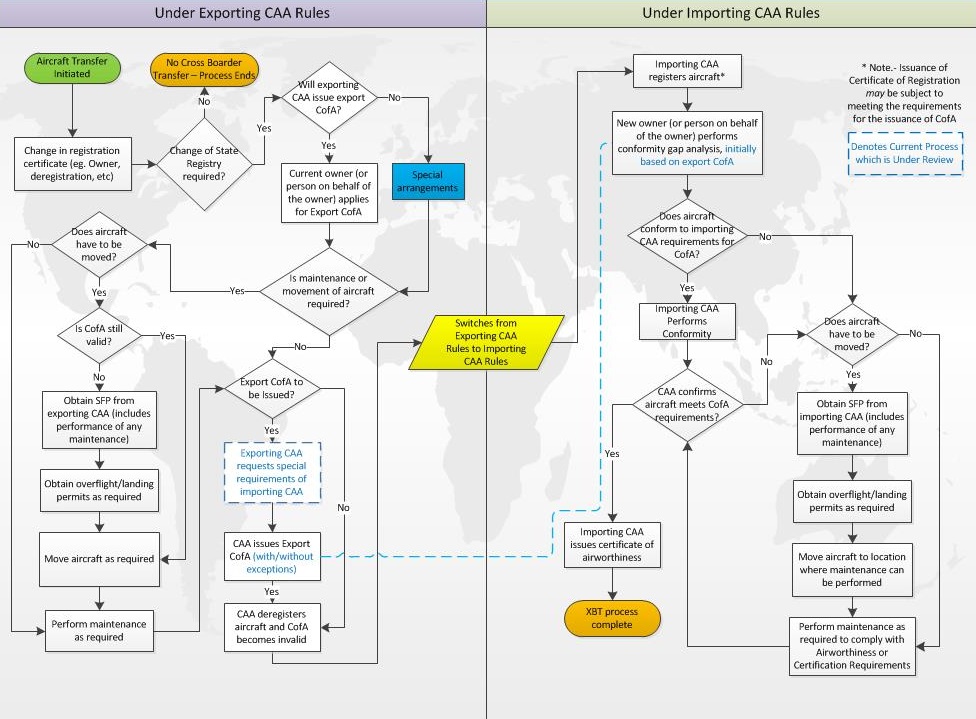
What does an exporting State need to know?
For the purpose of registration of aircraft in another State, the Exporting State needs to de-register the aircraft. If the exporting State is a party of the Convention on International Interests in Mobile Equipment, concluded on 16 November 2011 in Cape Town, and the Protocol on Matters Specific to Aircraft Equipment, and there is any Irrevocable De-registration and Export Request Authorisation (IDERA) or Certificate Designee Confirmation Letter (CDCL) associated with the aircraft, the applicant must either be the authorised party for the IDERA or certified designee for CDCL otherwise the IDERA or CDCL must be cancelled before the aircraft is deregistered.
In addition, the Exporting State will need to provide a statement describing the make, model, serial number and stating that the aircraft has been de-registered or has never been registered in the State in the case of a new production aircraft. The Exporting State may also provide evidence of de-activation of the Mode S transponder code.
Also, the original certificate of registration, certificate of airworthiness, noise certificate, flight manual acceptance will need to be voided. The identification plate and registration marks need to be removed.
Furthermore, the Exporting State may issue an Export Certificate of Airworthiness to facilitate the transfer of aircraft into the register of another State. The procedure for the issuance of an Export Certificate of Airworthiness can be found in the Airworthiness Manual (Doc 9760).
Depending on the location and registration of the aircraft, the Exporting State may need to issue a non-revenue special flight approval/authorisation/permit if the Certificate of Airworthiness is no longer valid.
What does an importing State need to know?
When the aircraft is imported, the Importing State (State of Registry) will register the aircraft and issue a Certificate of Registration. More details on aircraft registration can be found in ICAO Annex 7 – Aircraft National and Registration Marks and the Airworthiness Manual (Doc 9760).
Other requirements in Annex 7 include the need for the identification plate and new registration marks must be installed. The State of Registry will need to allocate ICAO address Mode S transponder code, receive notification of de-registration or non-registration from an Exporting State. If the Importing State is a party to the Convention on International Interests in Mobile Equipment, concluded on 16 November 2011 in Cape Town, and the Protocol on Matters Specific to Aircraft Equipment, the owner of the aircraft should register any Irrevocable De-registration and Export Request Authorisation (IDERA) or Certificate Designee Confirmation Letter (CDCL) with the State of Registry for record-keeping for aircraft deregistration.
In addition, the Importing State will need to issue a Certificate of Airworthiness after performing aircraft document review of maintenance, modification records and aircraft inspection to ensure that the aircraft remains in conformity with the type design approved by the State of Registry and maintained in an airworthy condition. If the aircraft is a first of type in the State of Registry, the State of Registry needs to certify/validate/accept the aircraft type certificate. More details can be found in the Airworthiness Manual (Doc 9760).
Depending on the location and registration of the aircraft, the State may need to issue a non-revenue special flight approval/authorisation/permit if the Certificate of Airworthiness is no longer valid.
What does an owner need to know?
The complexity of cross-border transferability of aircraft arises when there are different requirements on the registration process between States. Such differences may include age-based restrictions, management of stateless aircraft, standardization of information exchange and the de-registration process, the issuance of an Export Certificate of Airworthiness.
An owner will need to know and comply with aircraft registration, de-registration and airworthiness requirements of both the Exporting and Importing States.
The owner should perform conformity gap analysis based on the Export Certificate of Airworthiness to ensure that the aircraft conforms to the airworthiness requirements of the Importing State for issuance of the Certificate of Airworthiness. If the conformity gap analysis shows that the airworthiness requirements of the Importing State are not met, then the owner should perform maintenance as required.
Depending on the location and registration of the aircraft, the owner (or person on behalf of the owner) may need to apply for non-revenue special flight approval/authorisation/permit if the aircraft has to be moved for maintenance before the issuance of the Certificate of Airworthiness. In addition, the owner (or person on behalf of the owner) may need to obtain other authorisations to be able to overfly and land in other States' territory as required.