
Aircraft Parking and Storage
Due to the current global COVID-19 crisis, an unusually large number of commercial aircraft is currently parked or stored and are out of revenue service for an extended amount of time.
General information
This section provides specific OEM-identified measures to support operators in storing and preserving aircraft to allow for a smooth return to service as flight activities progressively return to normal. Operators are reminded that storage and maintenance actions on a stored aircraft must be approved by the State of the registry as part of the aircraft maintenance program.
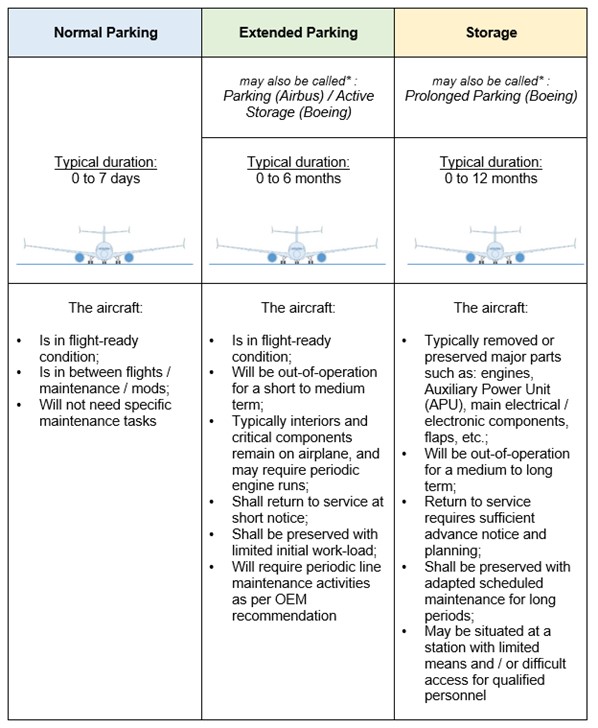
- Categories of parking and storage conditions
- Main watch areas for parking and storage of aircraft
- Exterior Corrosion on Bare Metal Surfaces
- Keeping bare metal surfaces clean and free of corrosion is a key consideration aircraft storage.
- During storage operators should inspect these areas and take preventative measures to protect bare metal surfaces.
- It is good practice to consistently apply corrosion preventative compounds or implement regular aircraft cleaning schedules.
- Extensive corrosion on surfaces could limit part life and possible cause out of sequence maintenance or repair during the return to service of the aircraft.
- Interior Cleanliness
- During the preparation for preservation it is important to clean the interior of the aircraft to remove any food based material.
- During storage operators should regularly inspect the cabin interior to ensure it is clean and free of contamination.
- The presence of interior contamination can reduce the appearance of interior surfaces and may shorten the life of components, and increase return to service maintenance or cleaning.
- Insect and Animal Nesting
- During storage, insects and animals will often make nests or store food in openings in the aircraft such as engines, control surfaces, vents, and probes.
- When possible, these openings should be covered to minimize the likelihood of animal nesting, and these locations should also be inspected regularly during storage as well as during return to service preparation.
- Animal nesting can possibly cause component failure during service of the aircraft, and extensive nesting can significantly impact aircraft performance.
- Cabin Temperature and Humidity
- Maintaining average cabin humidity below 70% relative humidity is recommended in order to minimize mold and corrosion issues.
- With airplanes stored all around the world in a range of different environments operators need to continue monitor conditions with the cabin and operate their environmental conditioning systems and possibly utilize desiccant bags to maintain consistent humidity levels.
- Maintaining consistent humidity levels reduces the risk of damage to interiors and electronic components, and minimizes unscheduled maintenance on these components when the aircraft returns to service.
- Fuel Drainage and Microbiological Contamination
- When moisture is present in the fuel it can increase the risk of microbiological growth which can contaminate the fuel.
- The presence of moisture can also cause corrosion to the fuel tank metal structure.
- Operators should perform preventative maintenance which may include adding fuel additives to reduce microbiological growth and performing regular sumping of the moisture that has accumulated in the fuel tank.
- If operators find corrosion or microbiological growth in the fuel tank it will need to be drain and serviced which can be a time consuming and costly maintenance activity.
- Power Plant and APU
- If the operator has the aircraft in long term storage the engine (or power plant) and the auxiliary power unit (APU) will be preserved using special procedures including adding preservation oil.
- If the operator is maintaining the aircraft under short term or active storage procedures, the engine and the APU will be operated regularly and used to help operate the ECS system to help maintain cabin humidity.
- At return to service the operator will need to perform maintenance on the APU and engine based on the OEM requirements.
- Flight Controls
- To prepare for storage the operator may lubricate movable flight control components and ensure surfaces are clean to prevent corrosion.
- During short term or active storage the operator will periodically operate control surfaces and examine components for corrosion, wear, or animal infestations.
- As part of returning the airplane to operational service, the operator will inspect the flight control surfaces for signs of environmental damage such as corrosion or pitting, and flight control cables may be lubricated and checked for proper tension.
- External Sensors(e.g. pitot probes)
- Exterior sensors such as pitot tubes or other ports have orifices that can attract debris or insects.
- Prior to returning the aircraft to operational service the operator should inspect these sensors for any signs of damage or nesting, and perform the necessary flushing procedures to ensure proper operation of these systems.
- The presence of foreign objects in these systems could cause the systems to give false readings which may lead to flight delays and additional unscheduled maintenance.
- Landing Gear, Wheels & Tires
- The landing gears and wheel wells of the aircraft are very susceptible to dirt and debris during normal operation.
- Therefore, in preparation for storage operators should extensively clean these areas, and apply corrosion preventive compounds to bare metal surfaces to maintain healthy components.
- Special care should be provided to the tire and wheel assembles to cover with UV resistant plastic to prevent damage to the tires and minimize break and wheel corrosion.
- During storage, operators should rotate tires to prevent flat spots or premature ware of the tread.
- Environmental Conditions
- The environment where the aircraft is stored can significantly impact the amount of man-hours the operator will need to spend maintaining the aircraft.
- For instance, if the aircraft is stored in a low humidity climate away from the coast the aircraft will see less corrosion on the exterior surfaces, and lower microbiological growth in interiors and wet fuel tanks.
- Electrical Components
- During long term storage operators may remove many electrical components and batteries, and store them in environmentally controlled spaces.
- For short term or active storage, operators may choose to leave these electrical components and batteries on the aircraft to regularly operate the aircraft.
- Care should be given to maintain humidity levels and temperatures within OEMs recommended limits for all electrical components which remain on the aircraft.
- Seals and Gaskets
- To prevent gaskets and seals from becoming brittle or drying out, operators can regularly inspect and maintain components per OEM guidelines.
- To maintain gaskets in the fuel tank operators can keep fuel levels high enough to cover fuel system components to maintain gasket moisture during storage.
- Return to Service Checks
- Each aircraft OEM has designed special return to service maintenance checks which incorporate lessons learned from each operator, and help ensure the aircraft will operate safely.
- The operator may have specific needs related to their storage program or operations which may require tailored return to service procedures.
- The operator may work with the OEM to identify the operation specific needs.
- Scheduled Maintenance Interval Extensions
- Scheduled maintenance tasks are periodically performed during normal operations of an aircraft.
- During aircraft storage, an operator may decide to defer certain scheduled maintenance procedures until a later time base on their operational needs.
- An operator may also work with their local regulatory authority to review the standard scheduled maintenance procedures to determine if they are eligible to extend any of their calendar driven maintenance cycle
Airplane Spacing
- During storage the aircraft will typically be parked near other aircraft, and the spacing between these aircraft is a consideration.
- Aircraft should be spaced to allow for maintenance and emergency vehicles to safely access the aircraft.
- During storage the aircraft may experience high winds which can potentially cause the aircraft to move, and operators should consider this potential for movement when parking aircraft together.
For comprehensive guidance on parking and storage of aircraft refer to the IATA Guidance for Managing Aircraft Airworthiness for Operations During and Post Pandemic.
- Exterior Corrosion on Bare Metal Surfaces
Security issues
The COVID-19 pandemic has forced many organizations to undergo significant transformation, rethinking key elements of their business processes and using information and communication technologies to support their operations.
This evolution, along with the unprecedented occupancy rate of the usual aircraft parking areas or the use of new ones, is likely to create staff dissatisfaction, new threat vectors and/or increased vulnerabilities that need to be addressed quickly in security risk management activities. This section provides guidance on measures to address threats to parked and stored aircraft in relation to:
Physical Security
Control of Physical Access to Aircraft
| Threat | Considerations |
|---|---|
The grounding of thousands of aircraft that need to be parked/stored for a long time during the COVID pandemic creates an opportunity for unauthorized access to aircraft |
|
Aircraft Hardware Configuration
| Threat | Considerations |
|---|---|
The grounding of thousands of aircraft that need to be parked/stored for a long time during the COVID pandemic creates an opportunity for unauthorized access to aircraft | Considerations for the aircraft hardware configuration are the following:
|
Personnel Involved in Aircraft Search and Inspection
| Threat | Considerations |
|---|---|
Due to the COVID pandemic, experienced search and inspection personnel may not be available to perform their duties |
|
Cyber Security
Aircraft Software Configuration
| Threat | Considerations |
|---|---|
The COVID pandemic has created the potential for challenges in managing the aircraft software configuration including the lack of security or functionality updates as well as the potential for corruption of software parts due to lapses in physical security of the aircraft or other unauthorized alteration of aircraft software. |
|
Aircraft Software Credentials
| Threat | Considerations |
|---|---|
Aircraft security credentials are in a known proper state |
|
Personnel involved in Aircraft Maintenance
| Threat | Considerations |
|---|---|
The proper maintenance of a commercial aircraft requires a combination of knowledgeable personnel with the proper training to accomplish their tasks. The COVID pandemic may disrupt the normal routine of maintaining aircraft and may require personnel not normally assigned these tasks to perform maintenance actions. |
|
Security Maintenance Tools/Ground Support Equipment
| Threat | Considerations |
|---|---|
The COVID Pandemic may have disrupted the normal maintenance and configuration management of the software dataloaders, media loaders and software maintenance devices and these should be verified to be suitable for use on an aircraft |
|
Aircraft Automated Logs
| Threat | Considerations |
|---|---|
Aircraft automated security logs are reviewed to support the identification of potential unusual activity to support management of the cyber-security risks |
|
Crew Devices
| Threat | Considerations |
|---|---|
Flight and Cabin Crew Devices such as IPADs, Surfaces and other portable electronic devices not permanently installed on the aircraft are validated to be in an approved configuration and are free from malicious software. Compromised devices may pose a threat to other aircraft systems as they may connect via wired or wireless connections to aircraft systems |
|