
Air Navigation Services
COVID-related constraints and concerns have led to significant changes to the state of the aviation industry, and consequently on the provision of Air Navigation Services (ANS). While it may be some time before operations can be considered "normal", guidance provided in this section offers a means for adapting air traffic services in the "new normal" of COVID conditions, as well as moving back towards a situation whereby the various standards and recommended practices are complied with, even if using alternative means.
Information is provided on the following:
A Simplified Procedure for Air Traffic Management Collaborative Decision Making (CDM)
A collaborative platform for the coordination and management of traffic to support a smooth and less challenging return to normal operations, including cross-border coordination with adjacent ANSPS for contingency situations.
Potential hazards to normal air traffic services following pandemic disruptions
A review of potential hazards to support ATS providers in the safety risk assessment processes during recovery to normal air traffic services.
ICAO NACC Air Traffic Services Guidance Material for Operation in a COVID-19 Context
This document, compiled by the ICAO NACC Regional Office, identifies key points to be taken into consideration for Air Traffic Services provision to allow the safe continuity of air operations during and after the COVID-19 pandemic.
Bowtie diagram for recovery to normal air traffic services (ATS) following disruptions resulting from the COVID-19 pandemic (Amsterdam Schiphol airport)
An example "Bowtie" diagram that identifies potential threats and hazards associated with returning air traffic services to normal at the Amsterdam Schiphol airport.
A "Bowtie" diagram can be used in safety risk assessments to analyse and demonstrate causal relationships in high risk scenarios – in this case, the challenge of returning air traffic services to normal.
The Amsterdam Schipol airport COVID-19 HIRM bowtie chart provides an example Bowtie diagram that identifies potential threats and hazards associated with returning air traffic services to normal at the Amsterdam Schiphol airport. It contains acronyms and references to organisations and locations on that airport, which may be unfamiliar to other parties. Rather than being a general template, it is provided to assist ANSPs to avoid overlooking potential threats and hazards at their own airports.
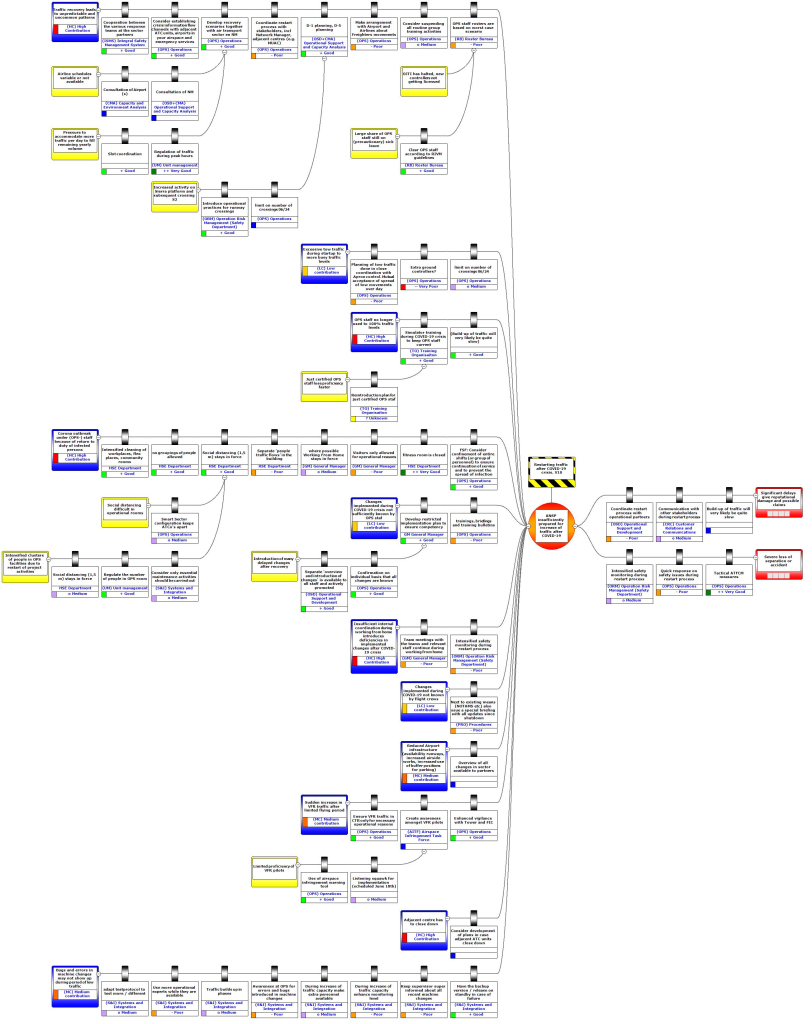
It should be noted that each actor with safety responsibilities within the Schiphol organisation will produce a similar diagram for their area of operations. These will then all be coordinated by a safety office to ensure that no threats are missed, and work is not duplicated. The colour coded rankings (for example, 'good', 'poor', 'medium', 'low contribution') refer to the estimated effectiveness of the barriers (i.e. the chance that a barrier could prevent a threat becoming an event).
Flight inspection periodicity considerations for radio navigation aids.
This section discusses issues related to flight inspection that could arise during the COVID-19 pandemic and during the recovery phase, with particular regard to periodicity. The information provided aims to ensure that flight inspection will be able to maintain safe operation of navigation aids during the pandemic and will not be on the critical path to aviation recovery after the pandemic. It stresses the need to maintain regular ground and flight checks of navaids to ensure that they are available during recovery (delaying implementation of new facilities if necessary). Information is presented under the following headings:
- ICAO requirements on flight inspection periodicity
- The fundamental ICAO provision addressing flight inspection in general is the Standard in Annex 10, Volume I, Chapter 2, 2.2.1:
[…]
2.2 Ground and flight testing
2.2.1 Radio navigation aids of the types covered by the specifications in Chapter 3 and available for use by aircraft engaged in international air navigation shall be the subject of periodic ground and flight tests.
Note.— Guidance on the ground and flight testing of ICAO standard facilities, including the periodicity of the testing, is contained in Attachment C and in the Manual on Testing of Radio Navigation Aids (Doc 8071).
[…]
- Guidance on flight inspection, including periodicity, is given in the ICAO Manual on Testing of Radio Navigation Aids (Doc 8071). See related excerpts.
- Relationship between ground testing and flight inspection:
Doc 8071 also specifies a number of ground tests with an associated periodicity. Normal practice is to ensure that a navigation facility passes all of its ground tests prior to conducting a flight inspection. Local maintenance staff normally accomplish this. Doc 8071 assumes that such ground testing can be carried out as required and in accordance with the local COVID-related health precautions. Some of the measures presented on flight inspection periodicities can also be applied to ground maintenance staff.
Flight inspection practices during the pandemic
This section provides information on flight inspection experiences and best practice currently adopted in several ICAO States, including recommendations on how to deal with periodicity intervals when delays are experienced.
Restoration to service after temporary removal of a navigational aid from service
- When, notwithstanding the above considerations, the inability to maintain appropriate maintenance or flight check intervals leads to the temporarily removal of a navigation aid from service, restoration of service should be conducted using appropriate precautions. Specific consideration should be given to the potential need for a full commissioning flight inspection (as defined in Doc 8071, 1.5.8), as opposed to a simple a periodic inspection (as defined in Doc 8071, 1.5.9). The main factor to be considered in this regard would be the length of time during which the facility was shut down, and the amount of change in the operating environment that may have occurred during the period. In other words, for a shutdown of a few weeks or months, a periodic inspection should be sufficient, while for a shutdown of several months may require a complete commissioning inspection.
Related links: