December 1928: The International Civil Aeronautics Conference
THIS IS THE CONTINUATION OF THE FIRST PAGE OF THIS STORY.
TO RETURN TO THE FIRST PAGE, CLICK ON THE FOLLOWING LINK: PAGE 1
|
|
|
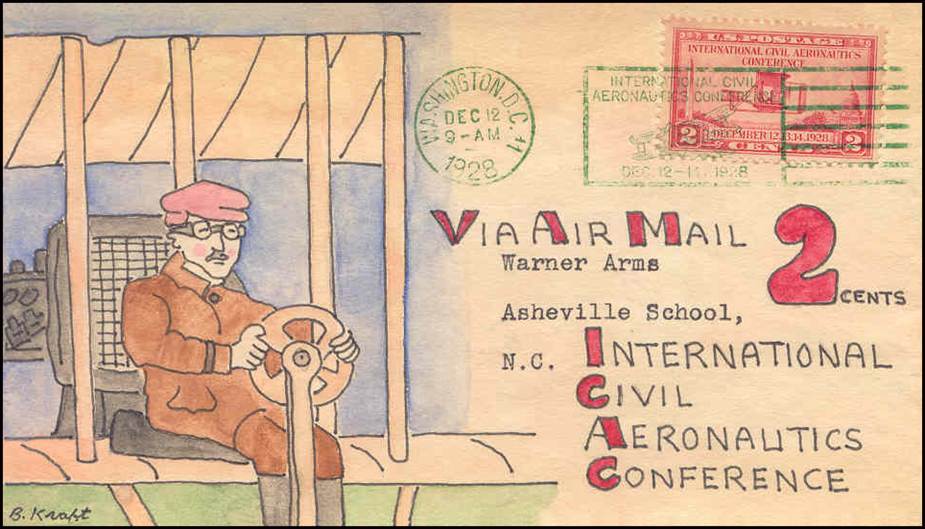
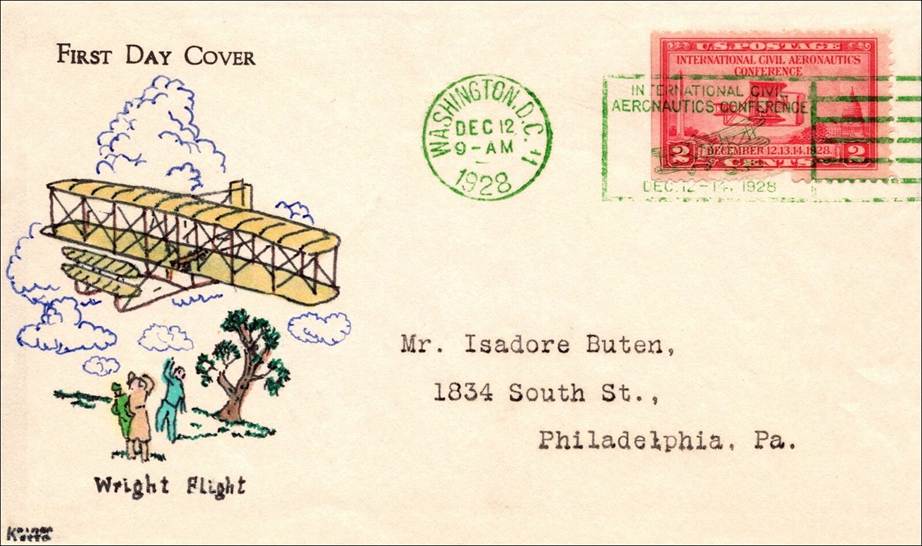
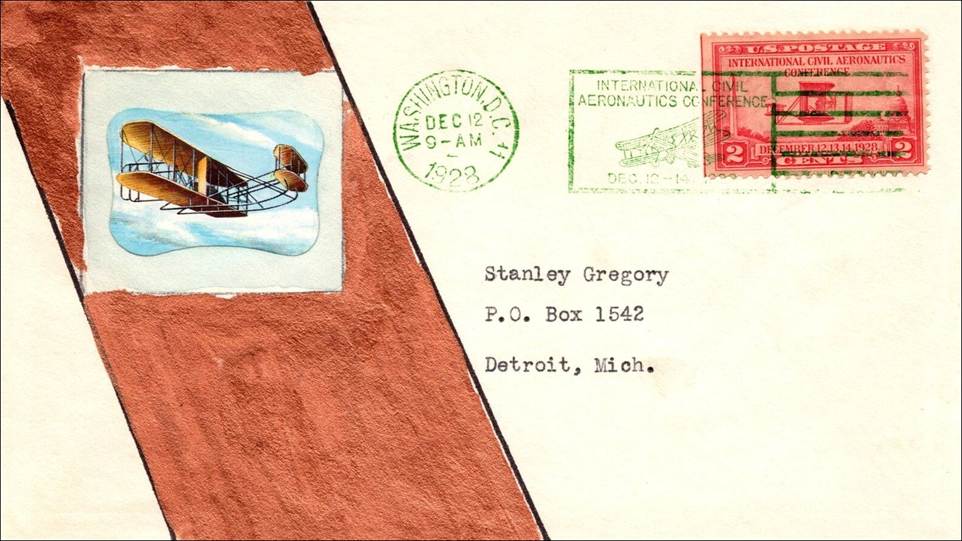
First Day Cover with hand-drawn and hand-painted cachet by Ben Kraft. One-of-a-kind item. Orville Wright at the commands of the Flyer.
|
|
|
|
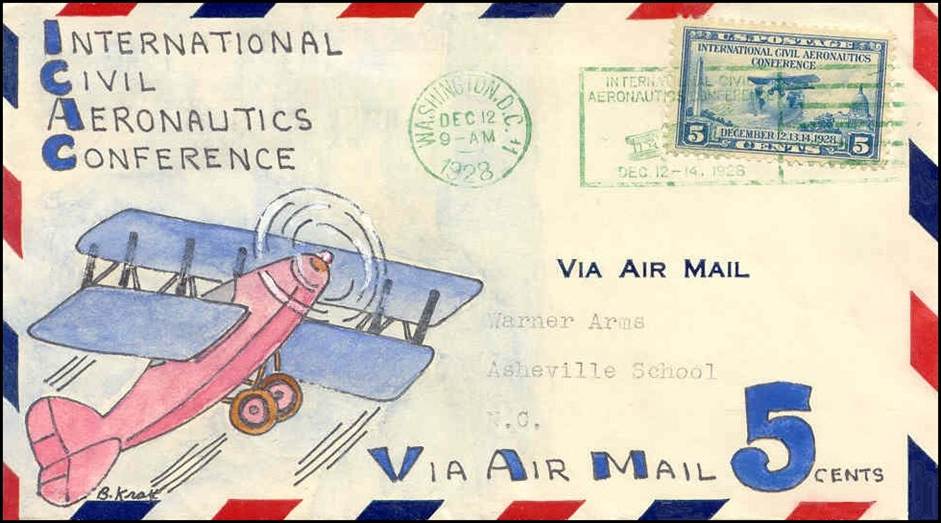
First Day Cover with hand-drawn and hand-painted cachet by Ben Kraft. One-of-a-kind item. The cachet depicts the Ryan B‑5 Brougham airplane. Although both stamps in this series feature airplanes, they were regular postage stamps, not airmail stamps. But since 5-cent was the then airmail postage rate, the higher value was often used for airmail by using an approved airmail envelope or by adding the legend Via Air Mail.
|
|
1
2
3
4
5
6
7
8
9
|
|
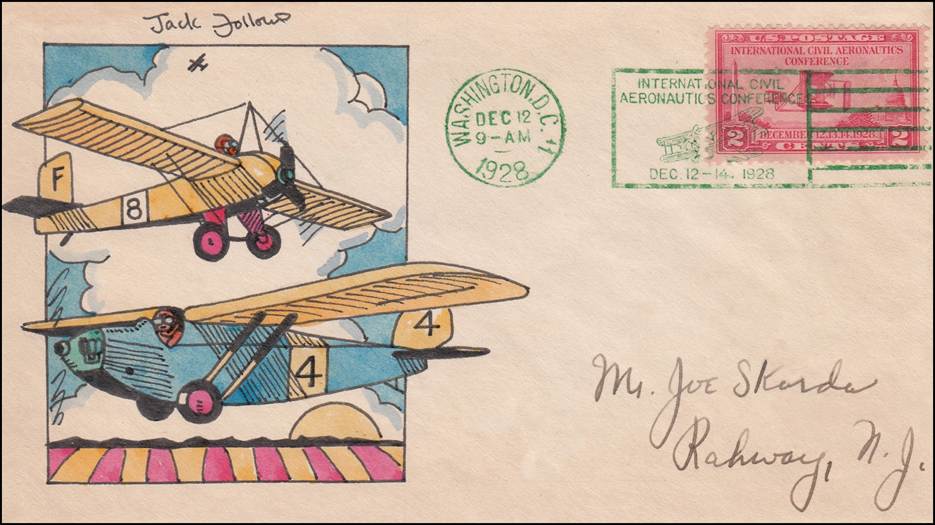
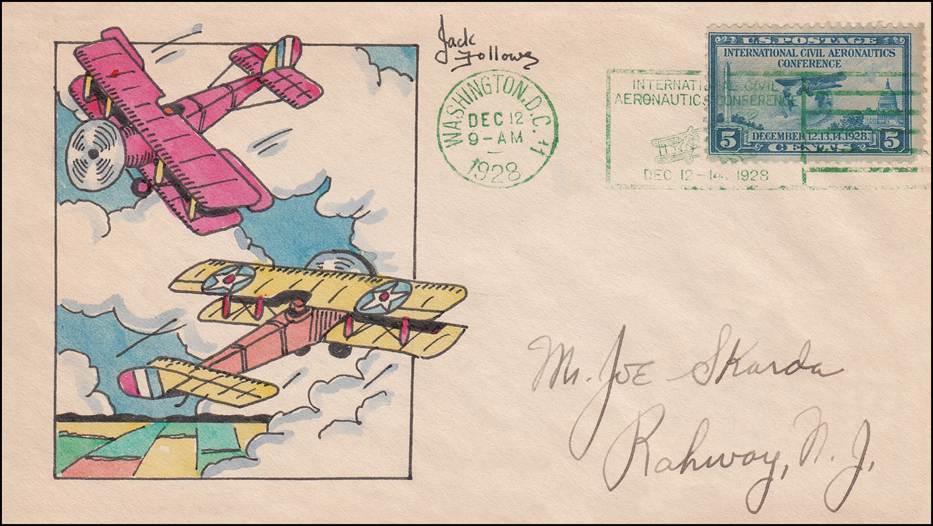
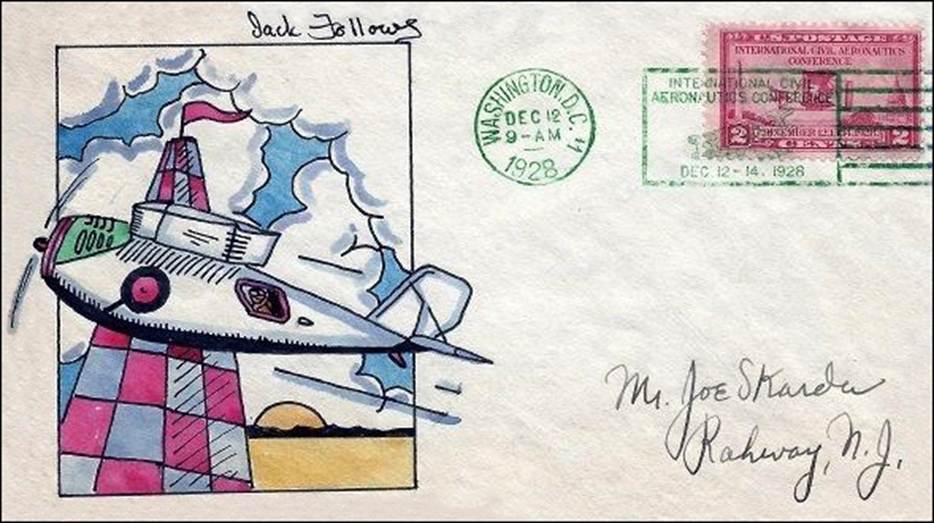
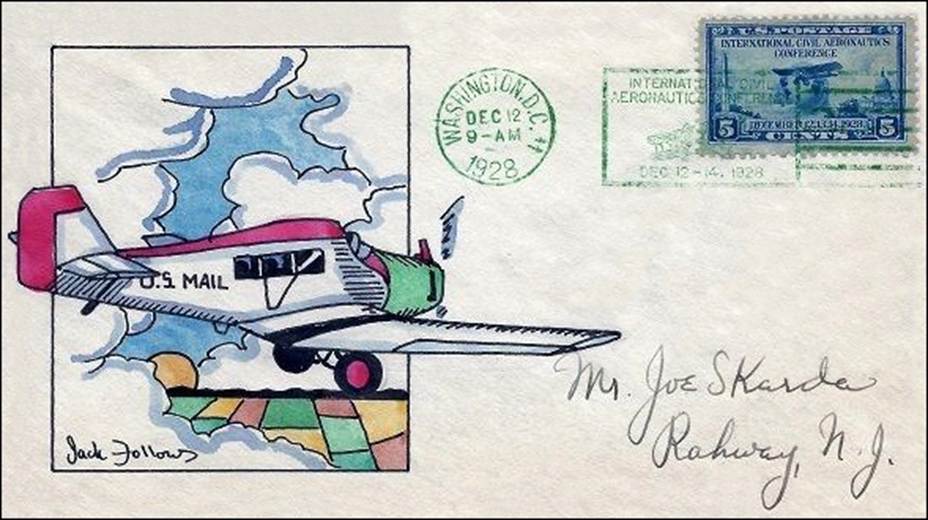
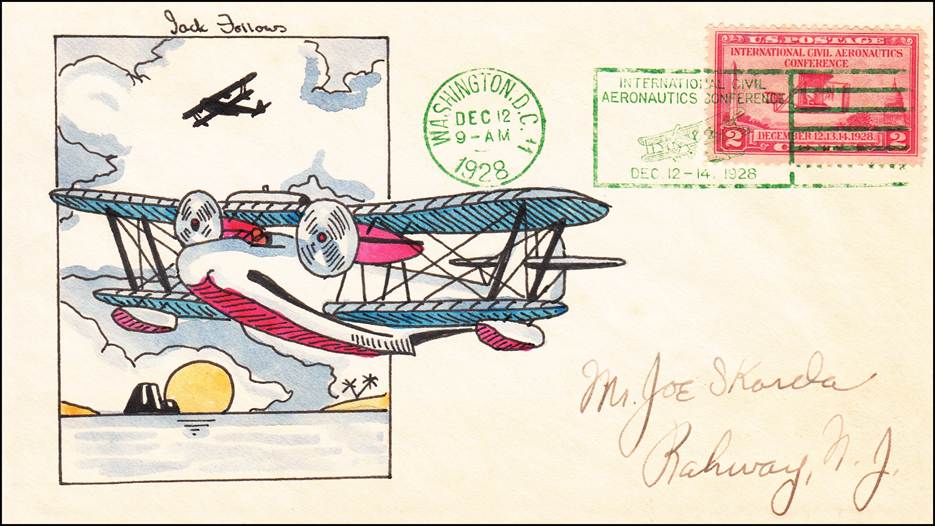
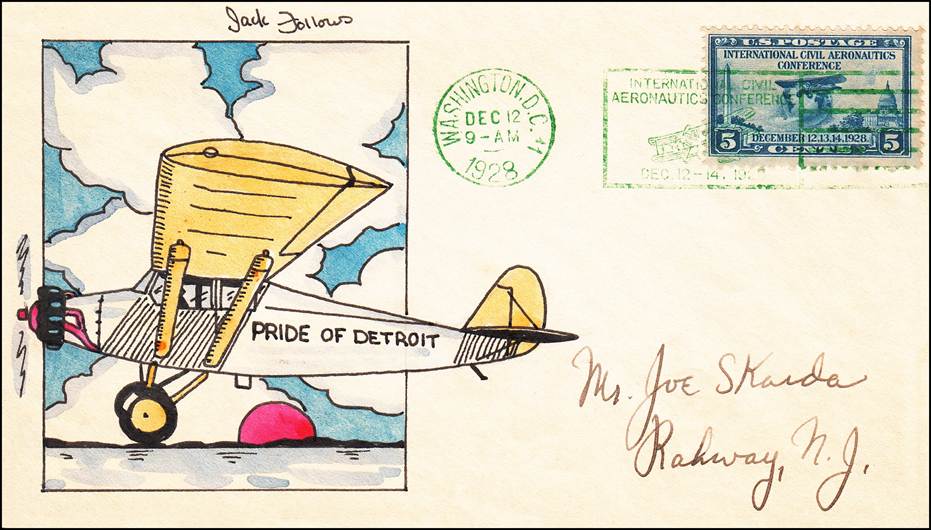
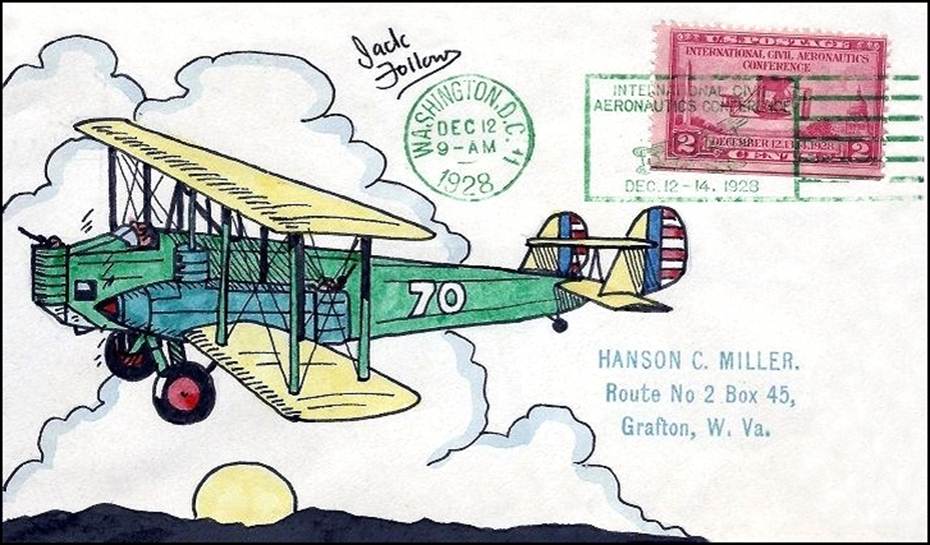
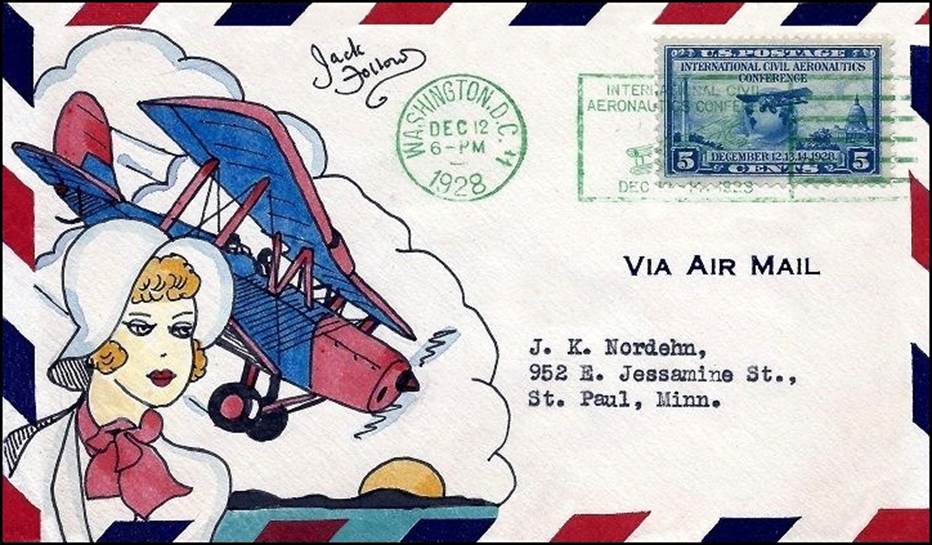
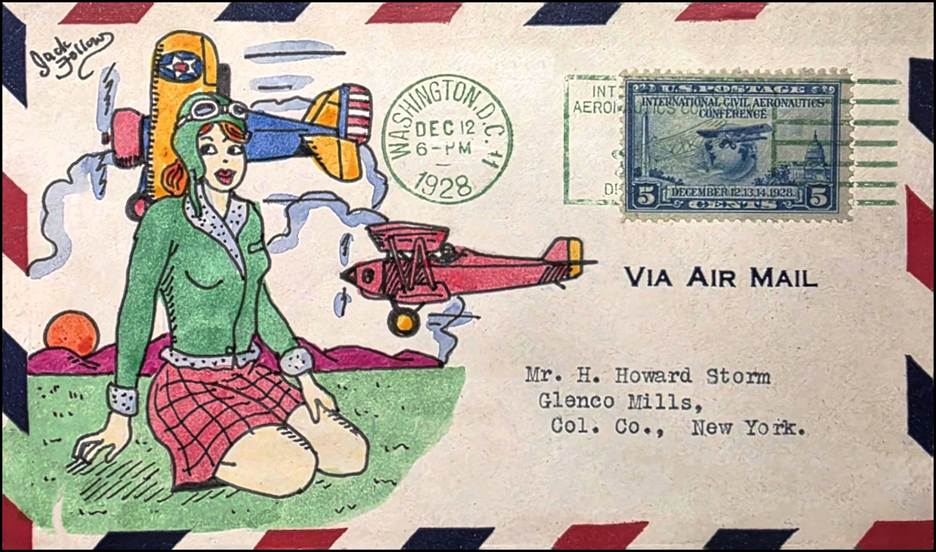
First Day Covers with hand-drawn and hand-painted cachets by Jack Follows. One-of-a-kind covers. On this totally awesome pairs of masterfully hand-drawn and lavishing hand-painted cachets, Jack Follows reminds us of the early days of air travel with his depiction of different vintage aircraft, single-wing and double-wing varieties, as they soar in the bountiful sky, which is punctuated with cotton-white clouds. The add-on cachets by Englishman, Jack Follows (1927-1997) are very popular with collectors. They do not appear in the marketplace very often. Follows was known for his cartoonlike cachets which combined the themes of women, aviation, and comic characters. Each cachet was unique in design. Several of these covers were sent to Joe Skarda. Joseph William Skarda (1906-1991) lived at Rahway, Union County, New Jersey.
Cover No. 1 shows two single-seat monoplanes; the upper one has wired-braced wings and an open cockpit; whereas the lower one resembles the Spirit of St. Louis of Charles Lindbergh. Cover No. 2 shows two French double-wing aircraft; the lower one is a French SPAD S.XIII biplane fighter aircraft of World War I. Cover No. 3 Follows depicts his view of air travel in the early days with this imaginary aircraft in the form of a submarine, soaring in the bountiful sky punctuated with cotton-white clouds and set against turquoise-coloured skies. Cover No. 4 refers to a low-wing Junkers F13 aircraft used by US mail. Developed in Germany at the end of World War I, this aircraft was an advanced cantilever-wing monoplane, with enclosed accommodation for four passengers and was used by the United States Post Office Department in the early 1920s. The aircraft soars in the bountiful sky, which is punctuated with cotton-white clouds and set against turquoise-coloured skies. Cover No. 5 shows a vintage double-engine, eye-propeller aircraft (unequal-span biplane) zooming over exotic island waters, while being shadowed by its silhouetted counterpart overhead. Cover No. 6 reminds us of the early days of air travel with his depiction of the Pride of Detroit aircraft, which is a philatelic shout-out to the ace aviator Charles Lindbergh, who was born in Detroit and who, a year earlier, in 1927, made the world’s very first, non-stop transatlantic flight when he took off from New York City and landed in Paris, France, a formerly unheard of distance of 3,600 miles which he covered in 33 hours.On the Stinson SM-1 NC857 Detroiter Monoplane, The Pride of Detroit, William S. Brock and Detroit businessman Edward F. Schlee tried to fly this airplane around the world in 1927. Starting from Harbour Grace, Canada, they flew east for 12,295 miles; but at Tokyo, Japan, a typhoon convinced them to end the attempt.Cover No. 7 depicts a double engine, double wing, double tail vintage aircraft, as it zooms through a peaceful sky, punctuated with pillow-y clouds. A twin tail is a specific type of vertical stabilizer arrangement found on the empennage of some aircraft. Two vertical stabilizers are mounted on the outside of the aircraft's horizontal stabilizer. This arrangement is also known as an H-tail, as it resembles a capital H when viewed from rear. Cover No. 8 Follows casts his philatelic spotlights on the single-engine, single-wing vintage plane, as it approaches land, accented by a pretty woman who is taking a leisurely walk nearby and is, no doubt, awaiting the arrival of the lone pilot aboard. Follows' stellar artistry is accented all the more by the red, while, and blue diagonal strips which border this piece of official USPS postal stationery. Cover No.9 shows two French double-wing aircraft; the higher one is a French SPAD S.XIII biplane fighter aircraft of World War I.
|
|
|
|
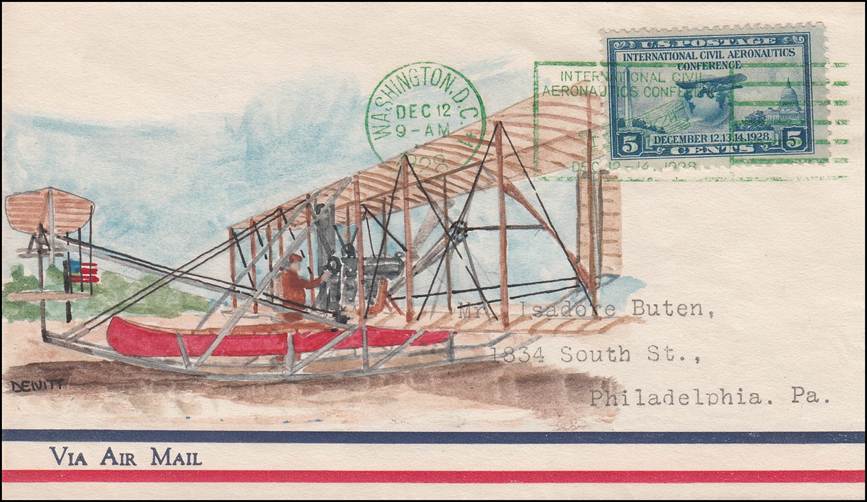
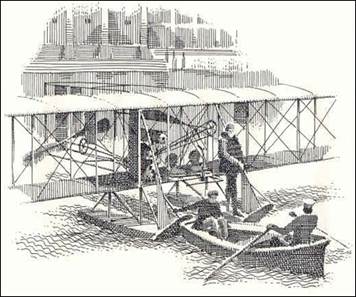
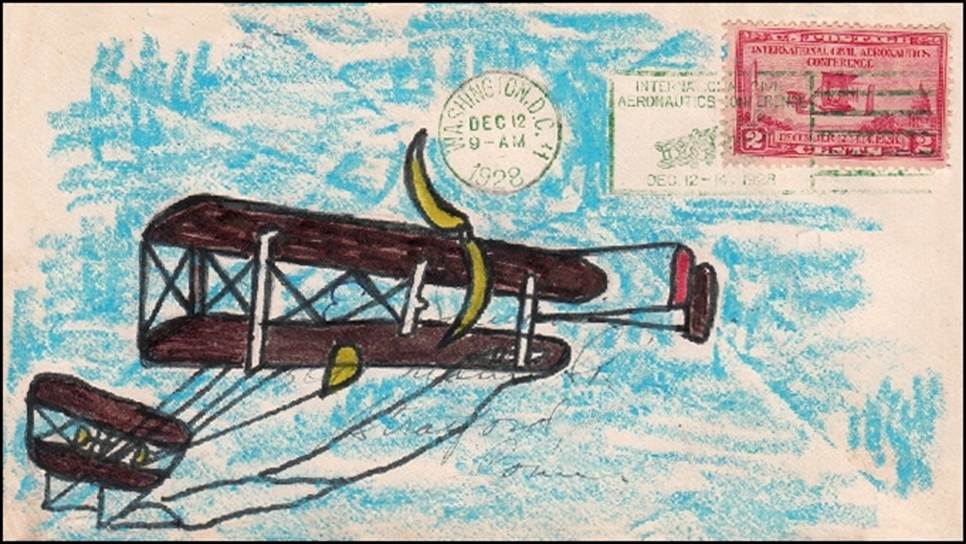
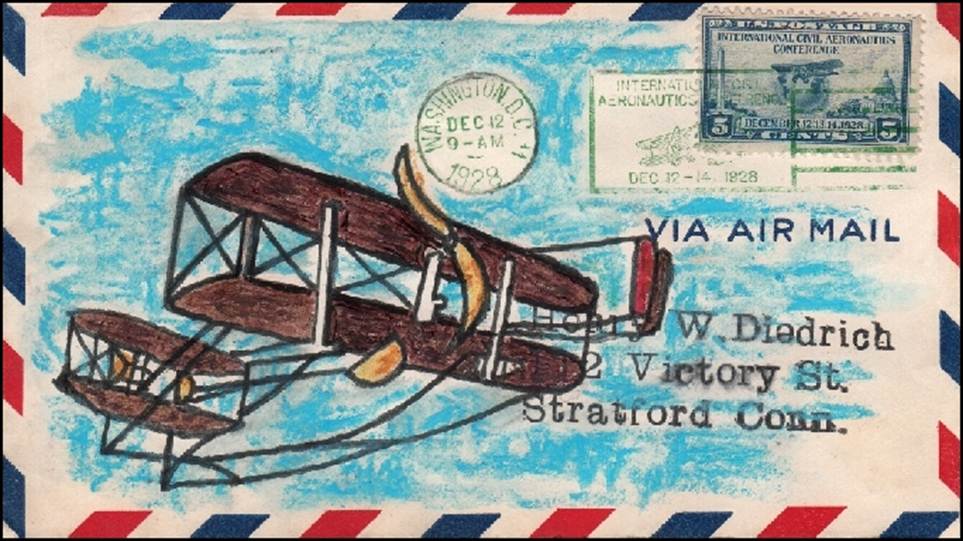
First Day Cover (5-cent) – One-of-a-kind item – Hand-drawn and hand painted by Cachetmaker DeWitt. Showing one of the Wright Brothers tuning up his aircraft by the side of a river, the cachet seems to refer to the Wright Model CH. The Wright Brothers produced this hydroplane in early 1913. It was a Model C equipped for taking off and landing on water. Originally,it used two twin pontoons affixed to the skid supports, but this made the aircraft difficult to turn; the Wrights switched to one large pontoon under the centre and small ones under each wingtip and tail. The cachet seems to be a reworking of a picture showing the Model C on water. As cachet maker, DeWitt made so few covers and did not stay in the hobby long enough to get a reputation.
|
|
|
|
First Day Covers – One-of-a-kind item – Hand-drawn and hand painted by Cachetmaker Joan Willen Cohen (JWC).
|
|
|
|
First Day Cover with 5-cent stamp. Hand-drawn and hand-painted cachet by Kenneth D. Kribbs. Artist identifies his covers by Kribbs’ Kover.
|
|
|
|
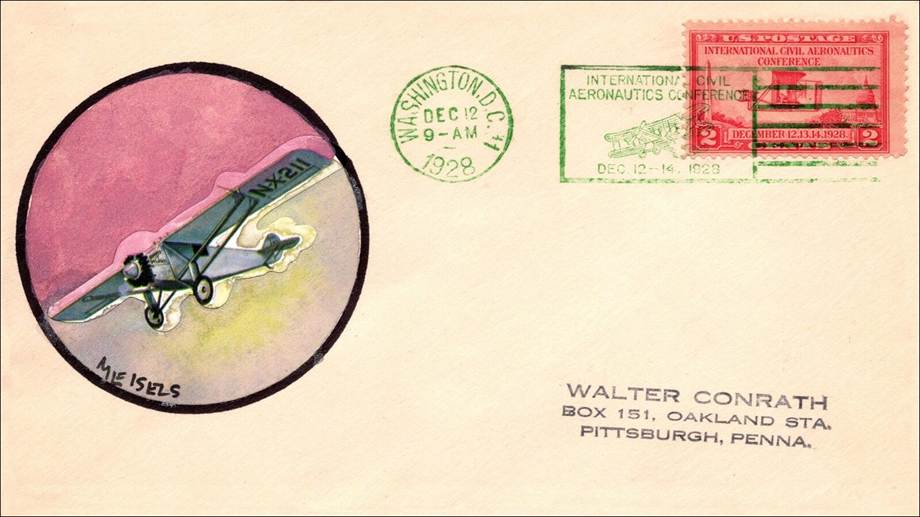
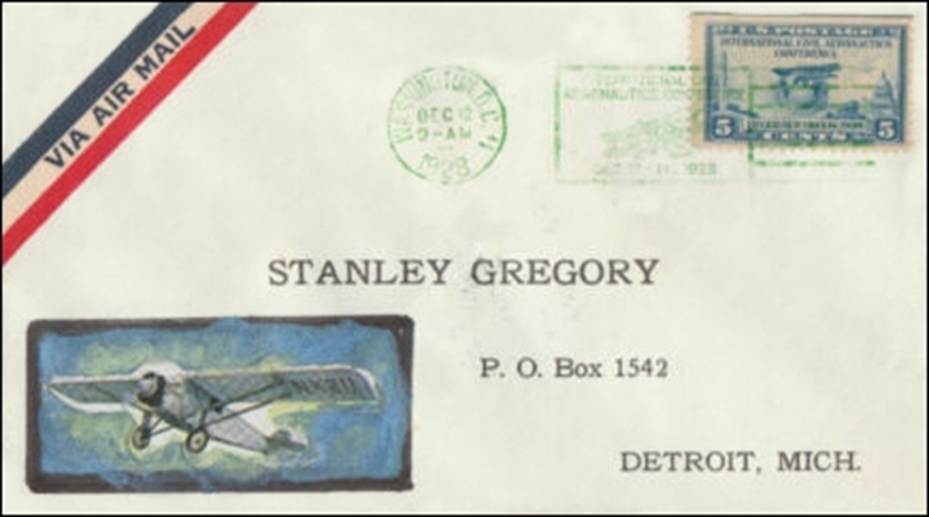
First Day Cover with 5-cent stamp. Hand-drawn and hand-painted cachet by Herbert Meisels. The cachet shows the Spirit of St. Louis registered NX211, that was flown by Charles Lindbergh on 20-21 May 1927, on the first solo nonstop transatlantic flight from Long Island, New York, to Paris, France, for which Lindbergh won the $25,000 Orteig Prize. The Orteig Prize was a reward offered to the first Allied aviator(s) to fly non-stop from New York City to Paris or vice versa. Herbert Meisels (1925-2016) and Henry Otto Meisel (1900-1966) are different Cachet makers, but are not related. Henry Otto Meisel was also a dealer of "Indian" motorcycles.
|
|
|
|
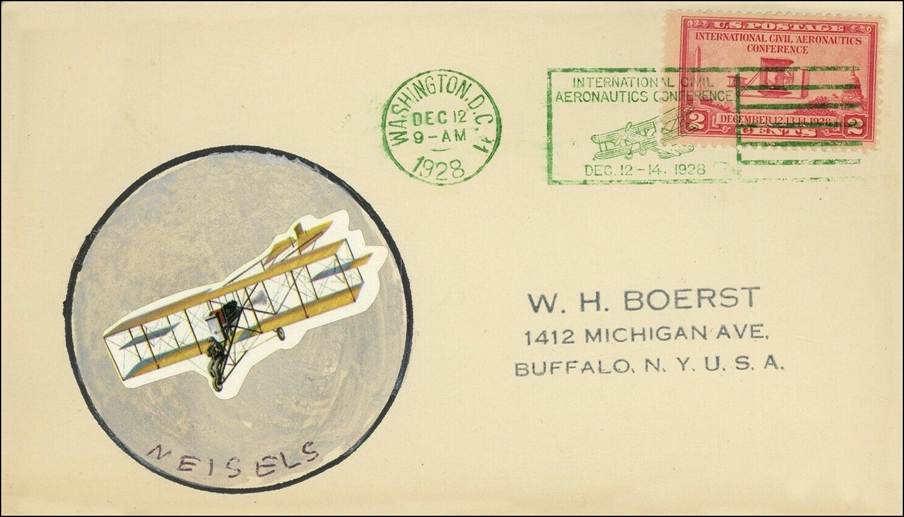
First Day Cover with 2-cent stamp. Hand-drawn and hand-painted cachet by Herbert Meisels. Wright Brothers Flyer I.
|
|
|
|
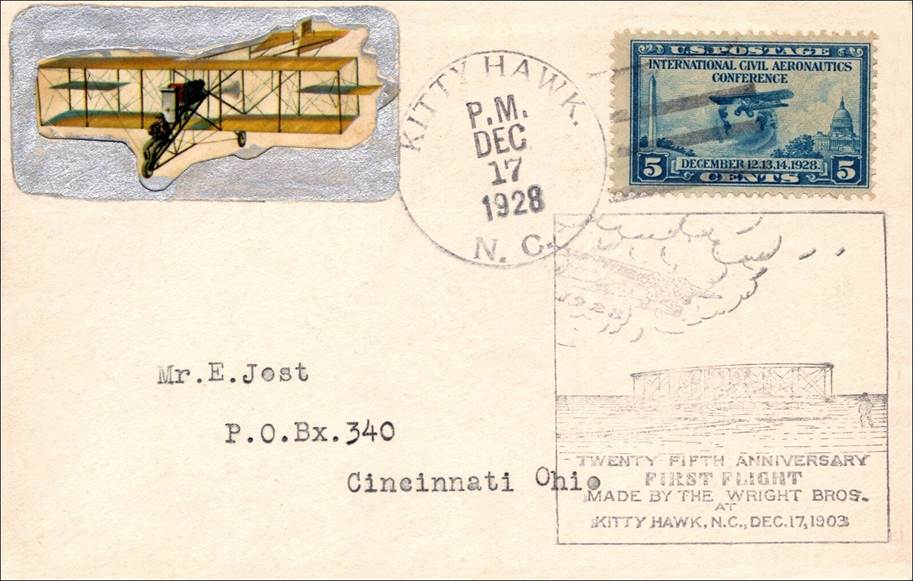
Cover with 5-cent stamp. Hand-drawn and hand-painted cachet by Herbert Meisels. Wright Brothers Flyer I.
|
|
|
|
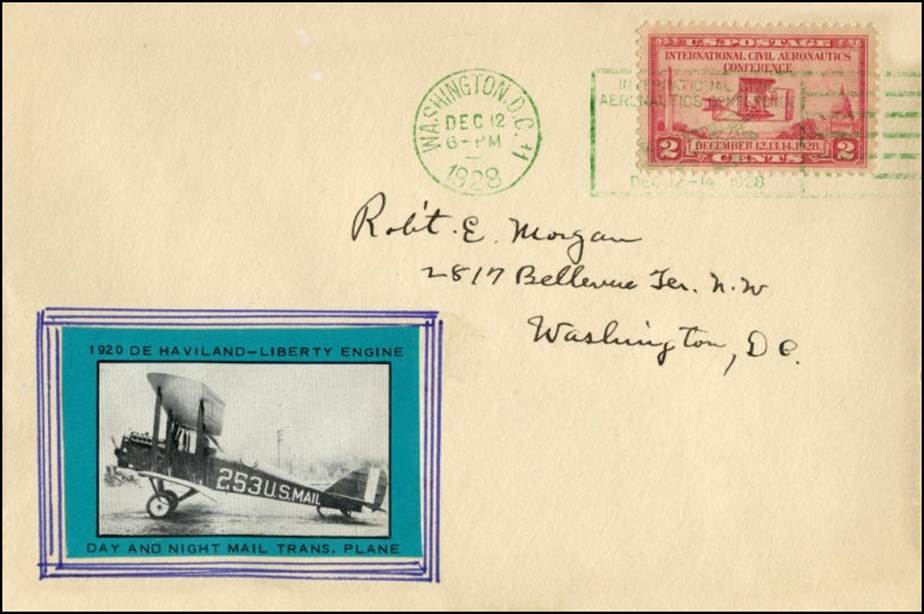
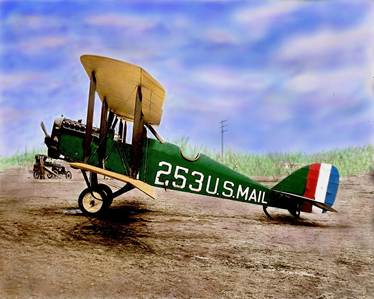
First Day Cover with 2-cent stamp by Herbert Meisels. Picture of 1920 De Havilland DH-4B biplane (see colour picture). The Aircraft Manufacturing Company (Airco, de Havilland) DH.4 was a British two-seat biplane day bomber of the First World War. It was designed by Geoffrey de Havilland (hence "DH") for Airco, and was the first British two-seat light day bomber to have an effective defensive armament. The DH-4 performed its first flight in August 1916; less than a year later, it entered operational service in France on 6 March 1917. The majority of DH-4s were actually manufactured as general-purpose two-seaters in the United States, the majority of which were intended to be used in service with the American expeditionary forces being deployed to fight in France. Named the "Liberty Plane" (due to its Liberty Engine), the DH-4 was chosen by the United States Army for its simplicity and potential for mass production. Cooperation between the US Army and the Post Office Department was essential during the infancy of the Airmail Service; the Post Office Department not only bought planes built by the Army, it also employed Army fighter pilots to run the first airmail routes and test out new planes. The Postal Service acquired 100 of them from the army in 1918, and retrofitted them to make them safer, denominating them as the DH-4B. In 1919, the DH-4B was standardized by the US Post Office, being modified to be flown from the rear cockpit with a 400 lb (180 kg) watertight mail compartment replacing the forward cockpit. By 1921, pilots were assigned an individual plane on the DH-4B, hence the 253 number seen on the plane. On 21 August 1924, a transcontinental night and day route between San Francisco and New York was established on an experimental basis, involving night flight and using light beacons to guide open-cockpit planes at night. The DH-4B continued in Post Office service until August 1927, when the last airmail routes were passed to private contractors.
|
|
|
|
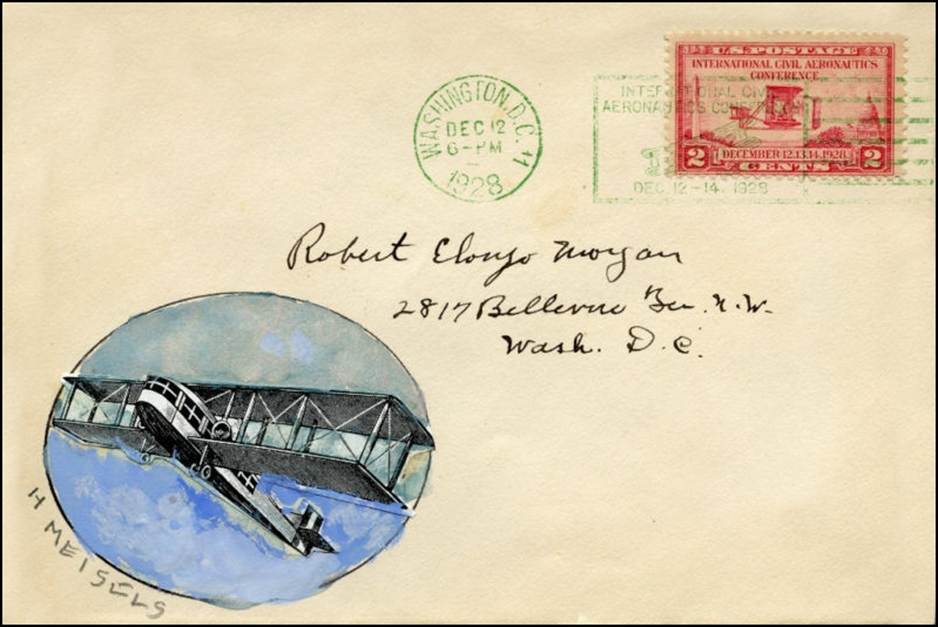
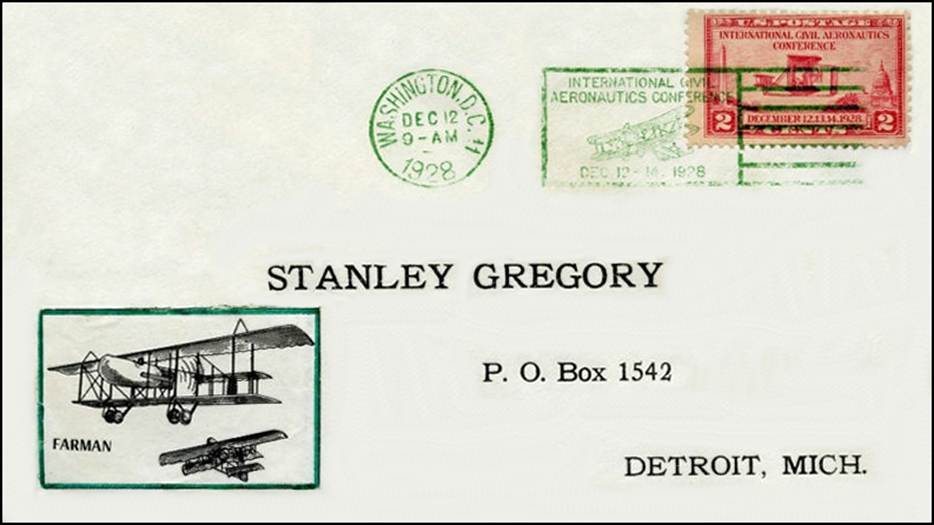
First Day Cover with 2-cent stamp. Hand-drawn and hand-painted cachet by Herbert Meisels. Farman F.60 Goliath. The Farman F.60 Goliath was the first French civil transport aircraft. Derived from the F.50 bomber, which became useless with the end of hostilities, the F.60 inaugurated in 1919 the first airline link from Paris to London, then Brussels and Casablanca non-stop. The following year, it was used by many airline companies.
|
|
|
|
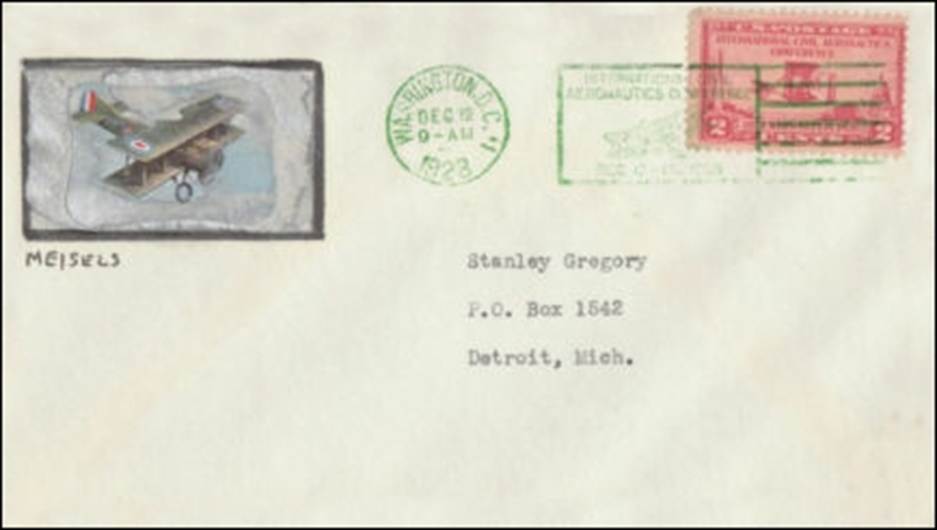
First Day Cover with 2-cent stamp. Hand-drawn and hand-painted cachet by Herbert Meisels. Spad S.XIII biplane. The SPAD S.XIII was a French biplane fighter aircraft of the First World War, developed by Société Pour L'Aviation et ses Dérivés (SPAD) from the earlier and highly successful SPAD S.VII. By the end of the First World War, the S.XIII had equipped virtually every fighter squadron of the Aéronautique Militaire. In addition, the United States Army Air Service also procured the type in bulk during the conflict, and some replaced or supplemented S.VIIs in the Royal Flying Corps (RFC),
|
|
|
|
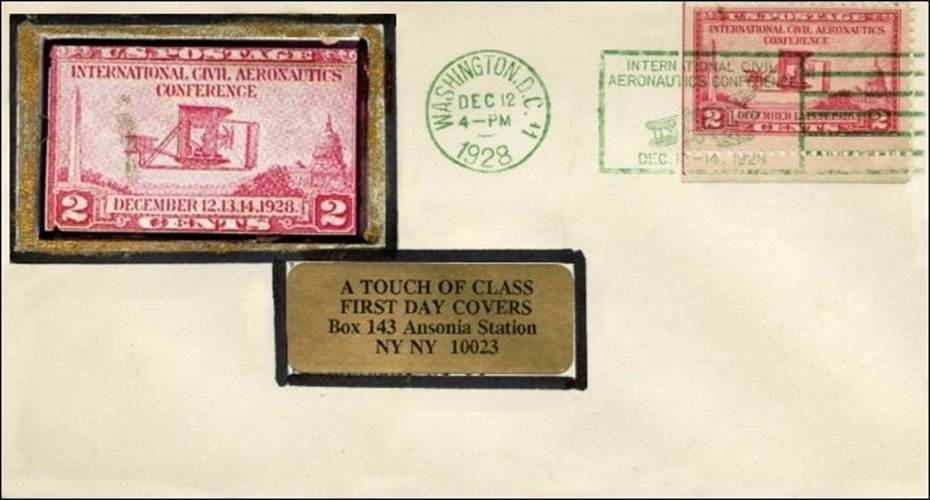
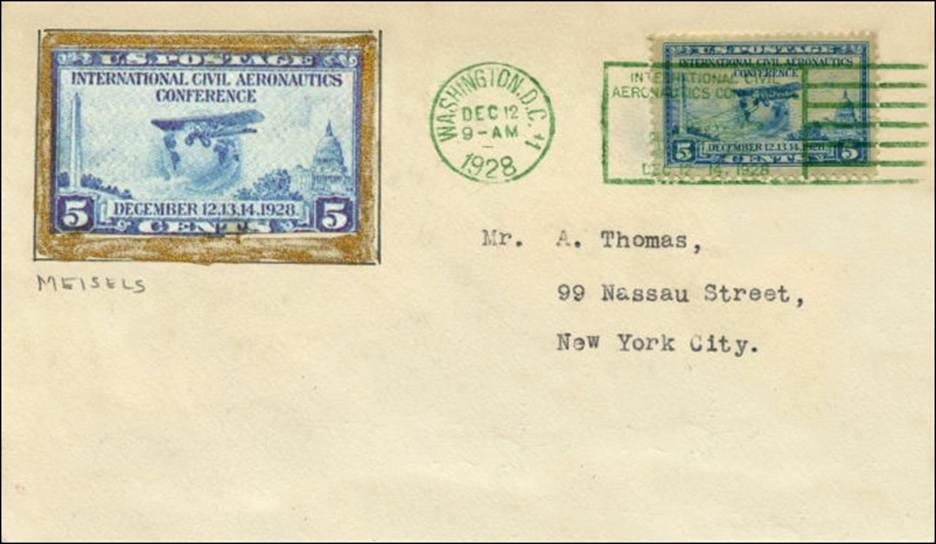
First Day Covers with 2-cent and 5-cent stamps by Herbert Meisels. Cachet at the left side: a reproduction of the stamps is affixed and highlighted by a brown frame.
|
|
|
|
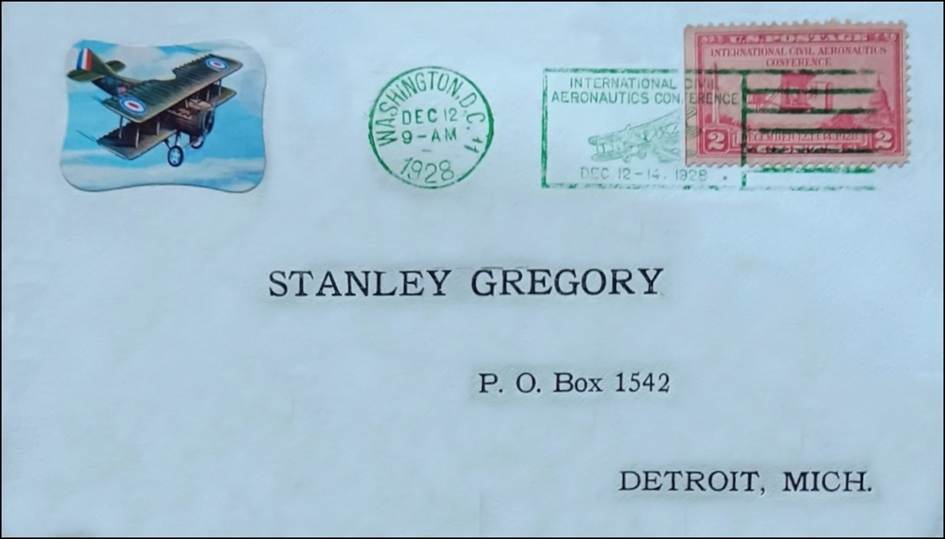
First Day Cover with 2-cent stamp. Hand-drawn and hand-painted cachet by Beverly Gregory. Farman MF.11 biplane. The Maurice Farman MF.11 Shorthorn is a French aircraft developed before World War I by the Farman Aviation Works. It was used as a reconnaissance and light bomber during the early part of World War I, later being relegated to training duties.
|
|
|
|
First Day Cover with 2-cent stamp. Hand-drawn and hand-painted cachet by Beverly Gregory. Sopwith Camel aircraft. The Sopwith Camel is a British First World War single-seat biplane fighter aircraft that was introduced on the Western Front in 1917. It was developed by the British Sopwith Aviation Company as a successor to the Sopwith Pup and became one of the best-known fighter aircraft of the Great War.
|
|
|
|
First Day Cover with 5-cent stamp. Hand-drawn and hand-painted cachet by Beverly Gregory.
|
|
|
|
First Day Cover hand-drawn and hand-painted stamp by Beverly Gregory, with the 2-cent stamp. The cahet shows the Flyer I flown by the Wright Brothers in 1903.
|
|
|
|
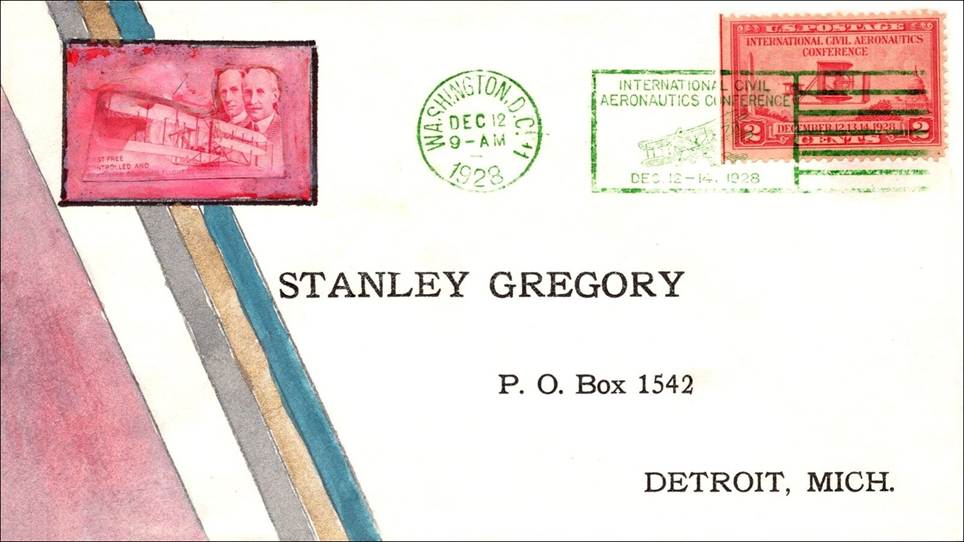
First Day Cover hand-drawn and hand-painted stamp by Beverly Gregory, with the 2-cent stamp. The cachet shows a desing of the Wright Brothers and their Flyer I. The text on tis picture reads as follows: “FIRST FREE CONTROLLED AND SUSTAINED (?) POWERED FLIGHT BY …”; some words are illisible.
|
|
|
|
First Day Cover with 5-cent stamp. Hand-drawn and hand-painted cachet by Beverly Gregory. Lindbergh’s Spirit of St. Louis (formally the Ryan NYP, registration: NX211). Charles Lindbergh was the winner of the Orteig Prize for making a nonstop flight from New York to Paris. Lindbergh covered the 33½-hour, 3,600-statute mile (5,800 km) flight alone in a single-engine purpose-built Ryan monoplane, the Spirit of St. Louis. This was the first solo transatlantic flight.
|
|
|
|
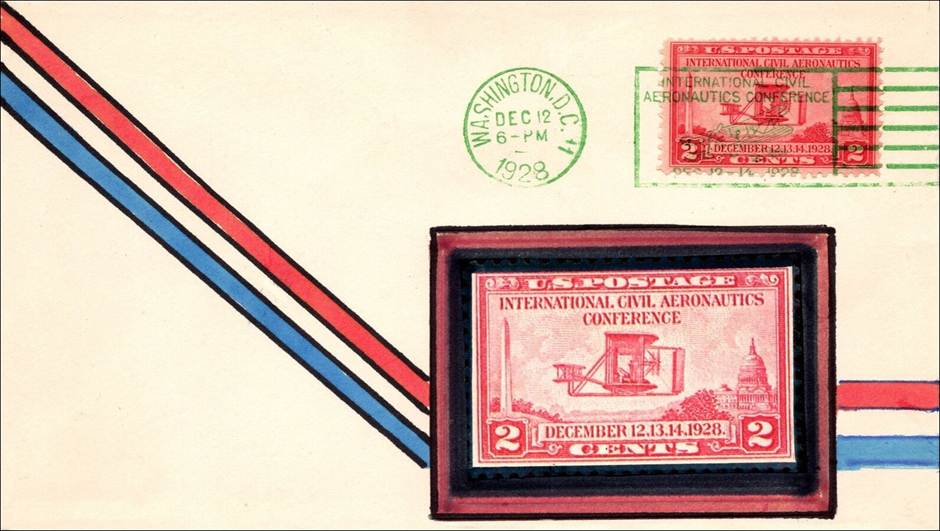
First Day Cover with the 2-cent stamp. Cachet at the bottom: a reproduction of the stamp is affixed and highlighted by a black and red frame.
|
|
|
|
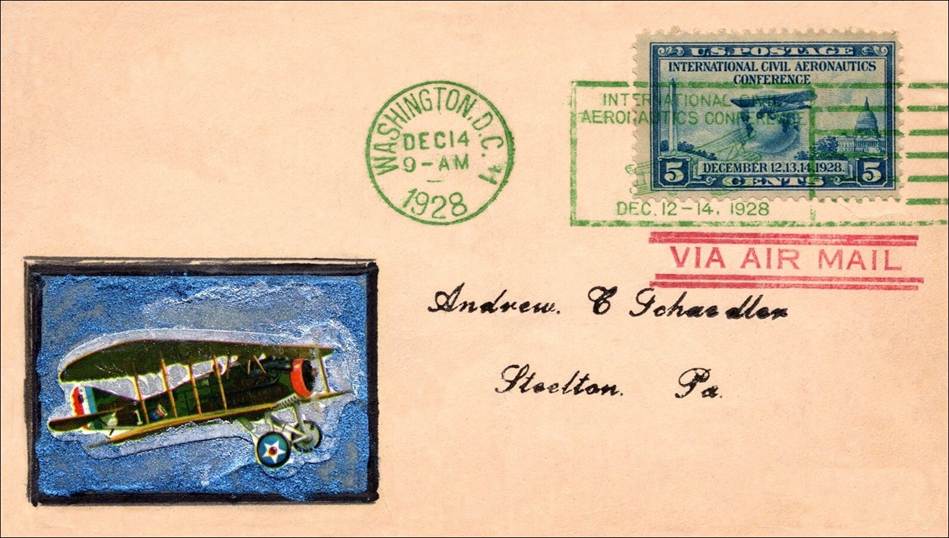
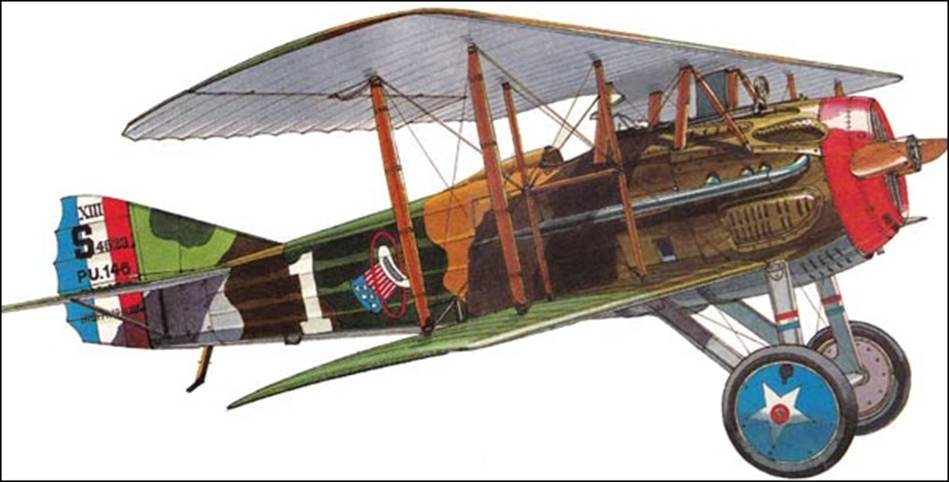
Last Day Cover with the 5-cent airmail stamp. The cachet at the left side shows a SPAD S.XIII-C1 fighter (identified by S4523 PU.146 PC160 on the tail). SPAD S.XIII of the 94th Fighter Squadron was flown in France by WW1 top ace US Captain Edward (Eddie) Rickenbacker. The 94th Squadron was part of the 1st Fighter Group, which was part of the American Expeditionary Force in France. Rickenbacker chose this aircraft in July 1918 at Orly when returning to his unit from the hospital. The emblem of the 94th squadron is depicted on the side of the fuselage with a hat cylinder in the colours of the US flag in a red circle. Note: this aircraft was intended for the squadron commander, but Rickenbacker claimed it for himself. The SPAD S.XIII is a French biplane fighter aircraft of the First World War, developed by Société Pour L'Aviation et ses Dérivés (SPAD) from the earlier and highly successful SPAD S.VII. During early 1917, the French designer Louis Béchereau, spurred by the approaching obsolescence of the S.VII, decided to develop two new fighter aircraft, the S.XII and the S.XIII, both using a powerful new geared version of the successful Hispano-Suiza 8A engine.
|
|
|
|
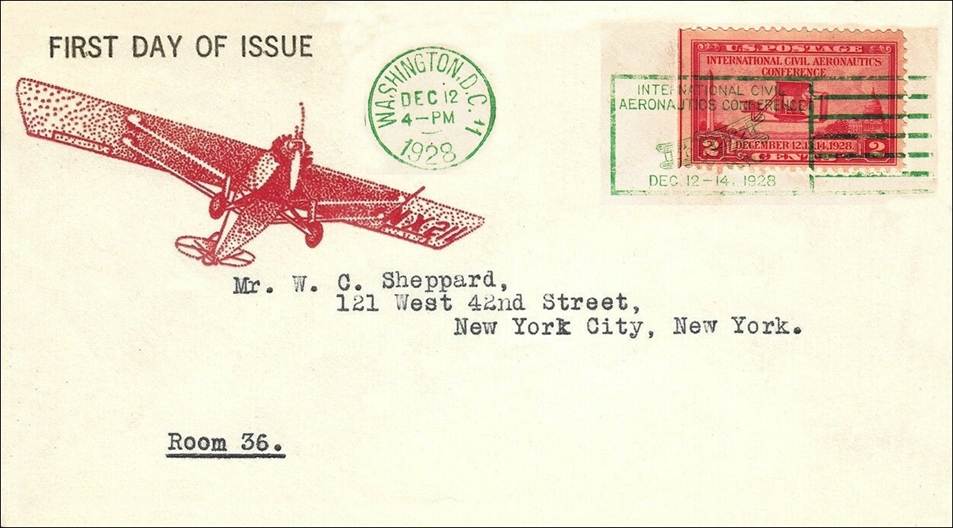
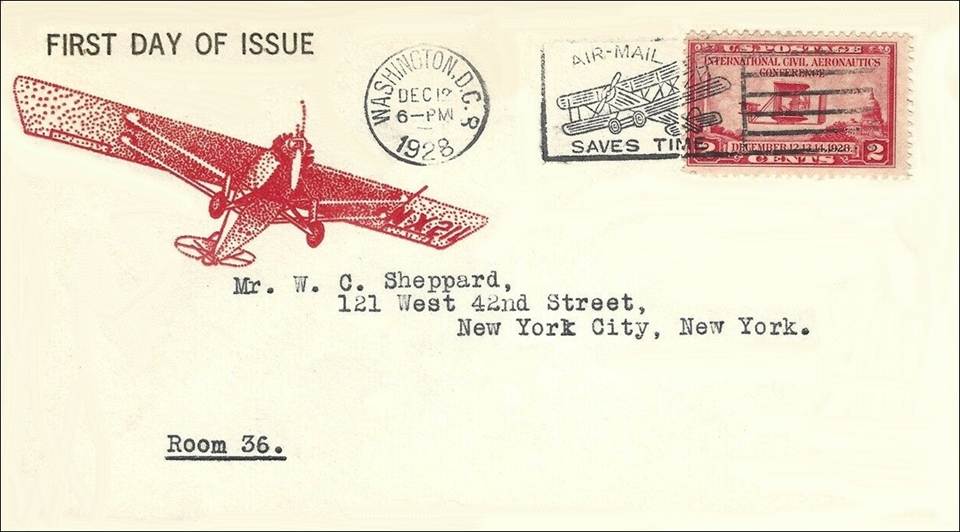
First Day Covers with the 2-cent stamp. Cachet by W.C. Sheppard. Picture of the Spirit of St. Louis NX211. Lindbergh’s Spirit of St. Louis (formally the Ryan NYP, registration: NX211). Charles Lindbergh was the winner of the Orteig Prize for making a nonstop flight from New York to Paris. Lindbergh covered the 33½-hour, 3,600-statute mile (5,800 km) flight alone in a single-engine purpose-built Ryan monoplane, the Spirit of St. Louis. This was the first solo transatlantic flight.
|
|
|
|
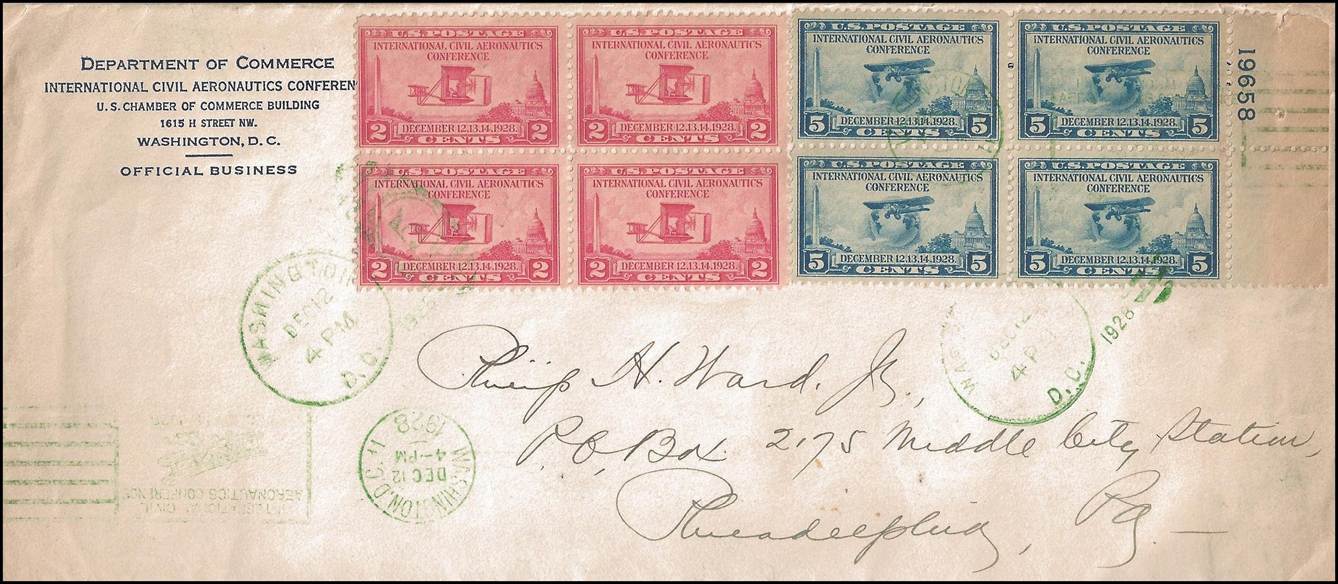
First Day Cover on the stationery specially prepared by the Department of Commerce for this Conference, which was held in the U.S. Chamber of Commerce Building. Two blocks of four stamps, one with the marginal inscription.
|
|
|
|
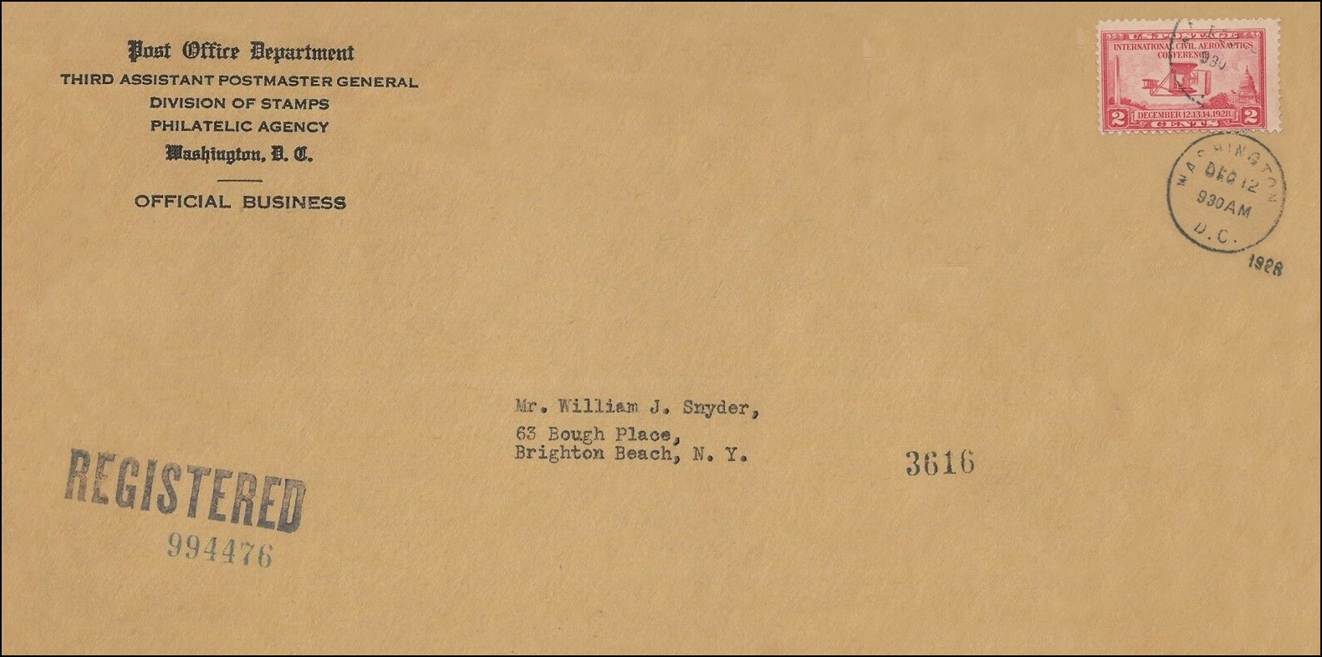
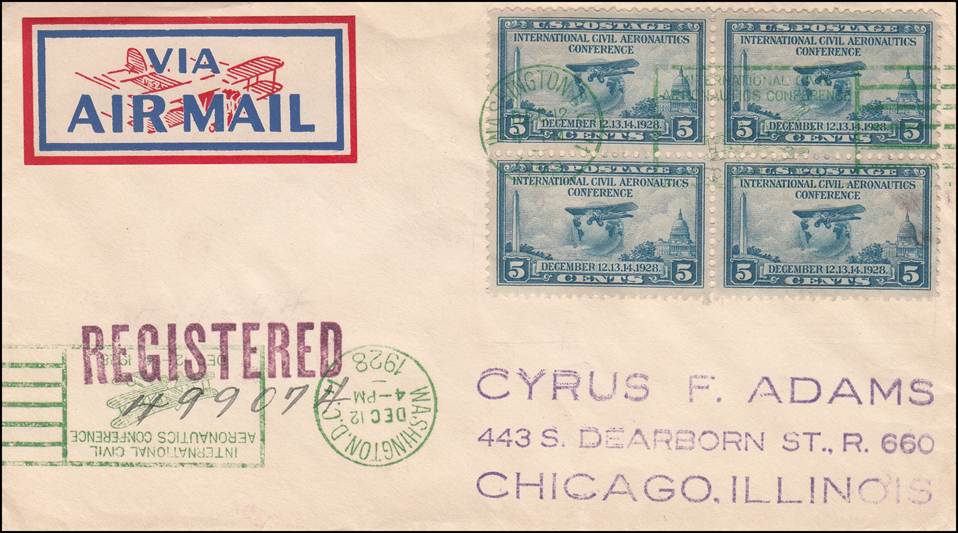
Registered cover on stationery from the Post Office Department (Division of stamps). Postmark at Washington on 12 December 1928.
|
|
|
|
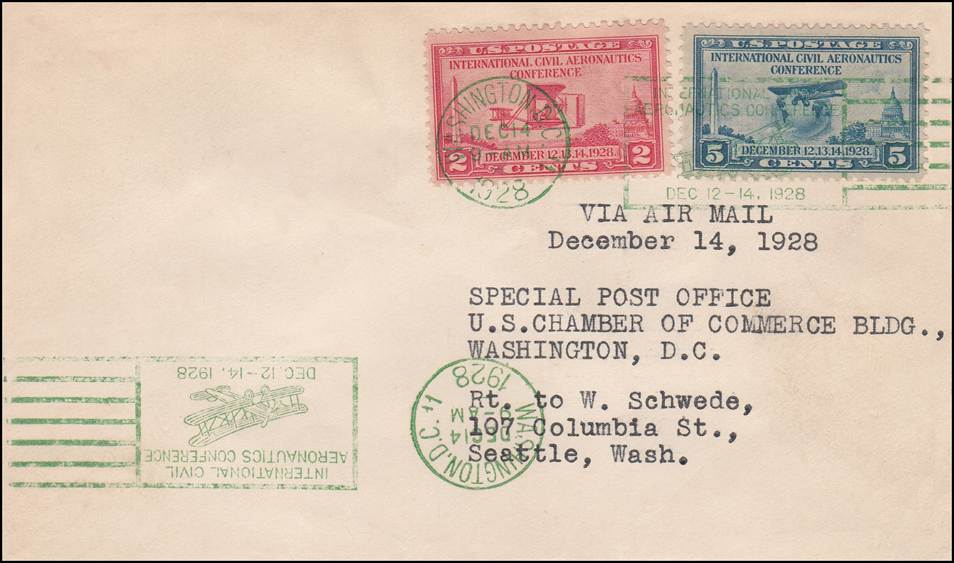
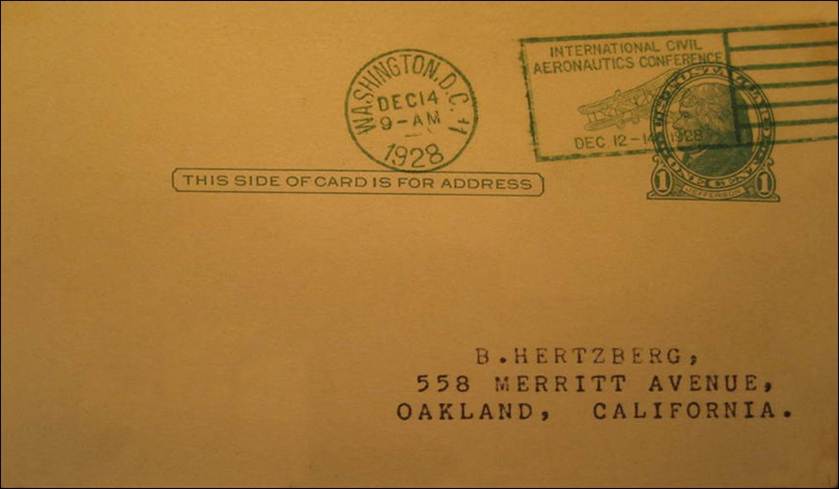
Cover sent from the Special Post Office opened in the U.S. Chamber of Commerce Building. Postmark dated 14 December 1928 (last day of issue). In those days, the establishment of a temporary post office station at a non-postal facility was unusual, thus reflecting the level of interest provided to this event by senior management.
|
|
|
|
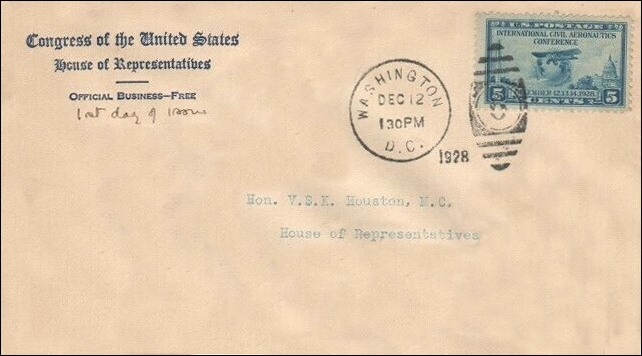
Last Day Cover (12 December 1928) sent from the House of Representatives to the Delegate in Congress from Hawaii V.S.K. Houston. Hawaii was then a possession.
|
|
|
|
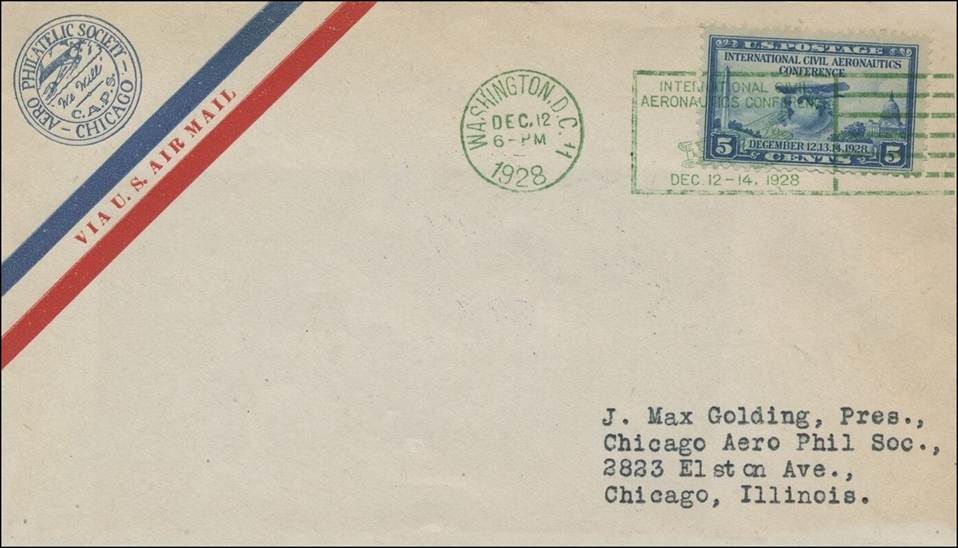
First Day Cover on stationery from the Aero Philatelic Society in Chicago.
|
|
|
|
|
|
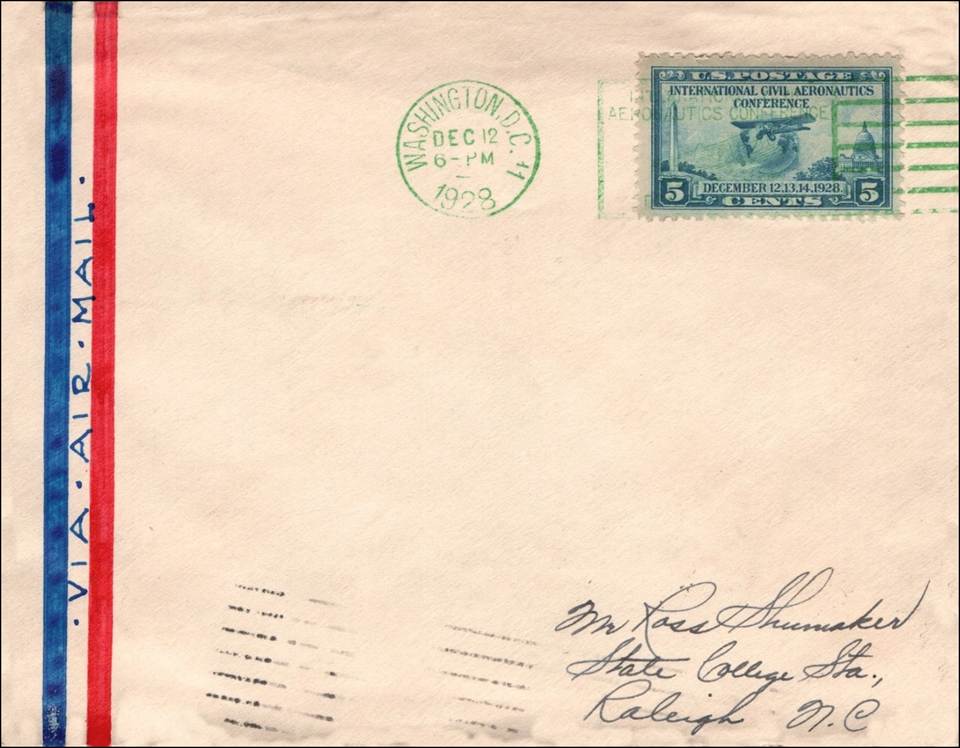
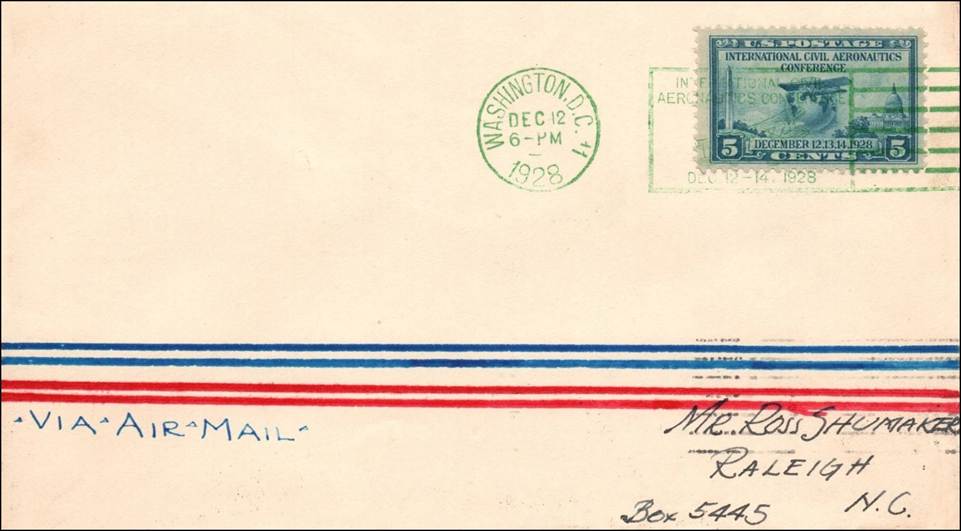
Date covers 12 December 1928. Personal designs by Architect Ross Schumaker (1889-1960), Raleigh, N. C., USA.
|
|
|
|
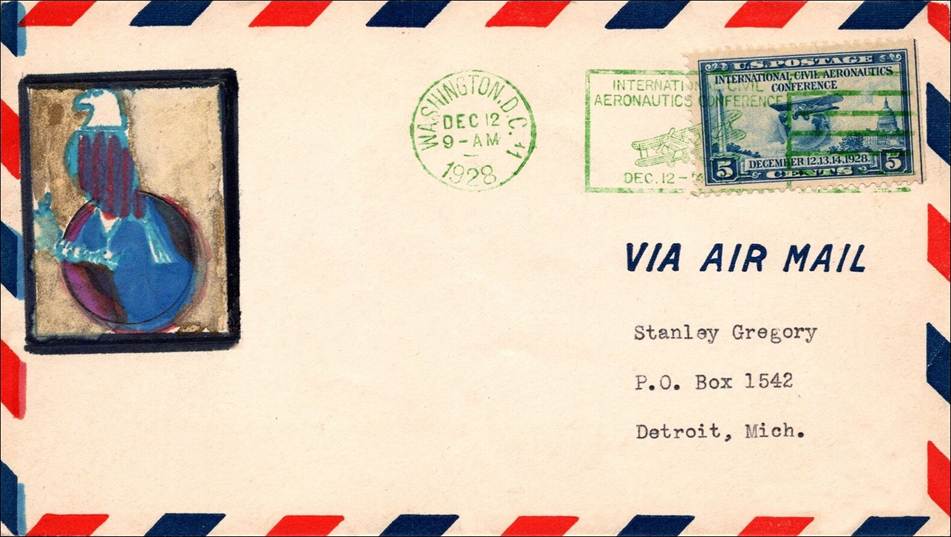
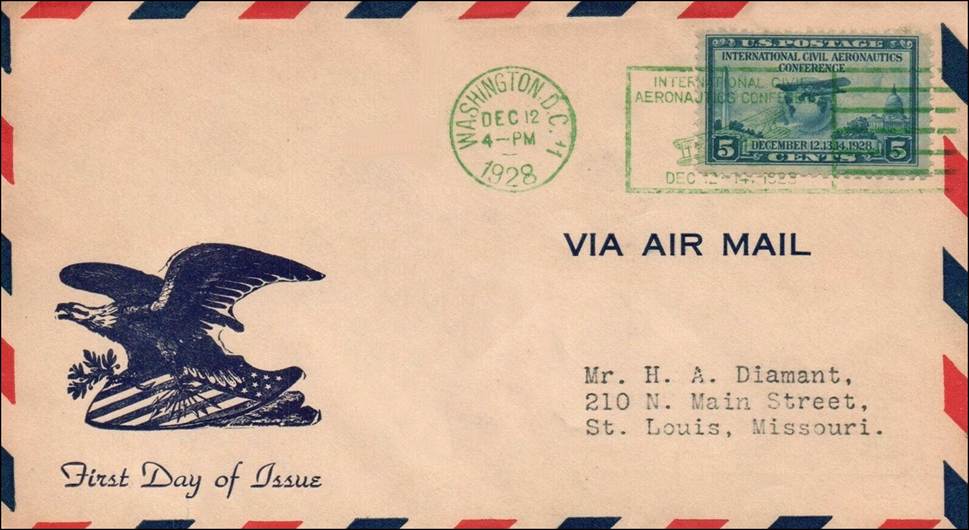
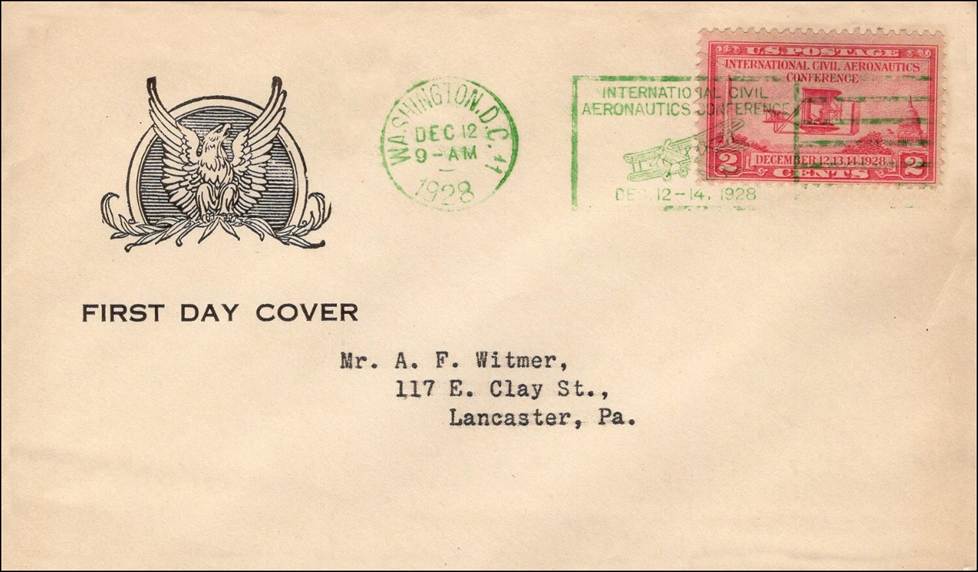
First Day Cover - Eagle and Shield Cachet.
|
|
|
|
This cachet depicts a mother pelican wounding her breast to feed her hungry chicks with her own blood.
|
|
|
|
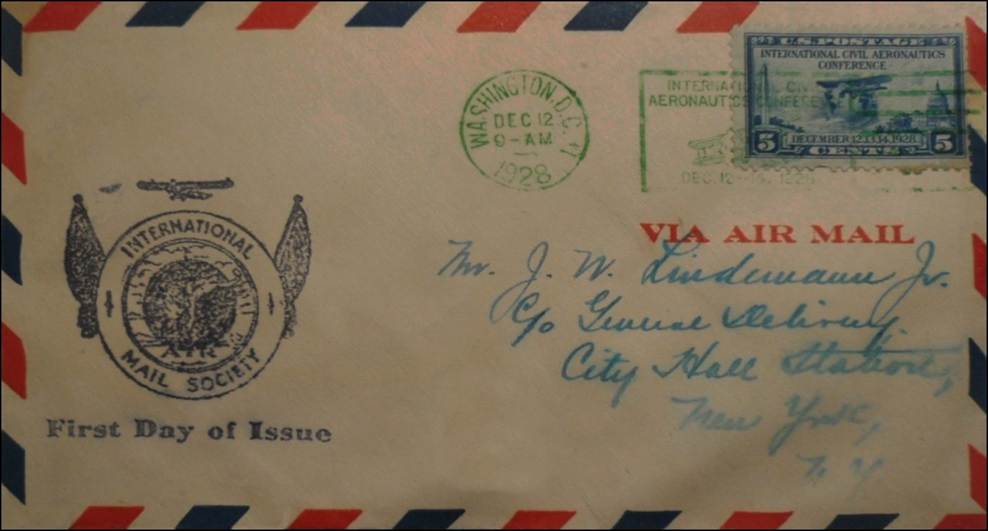
This cachet depicts the emblem of the International Mail Society.
|
|
|
|
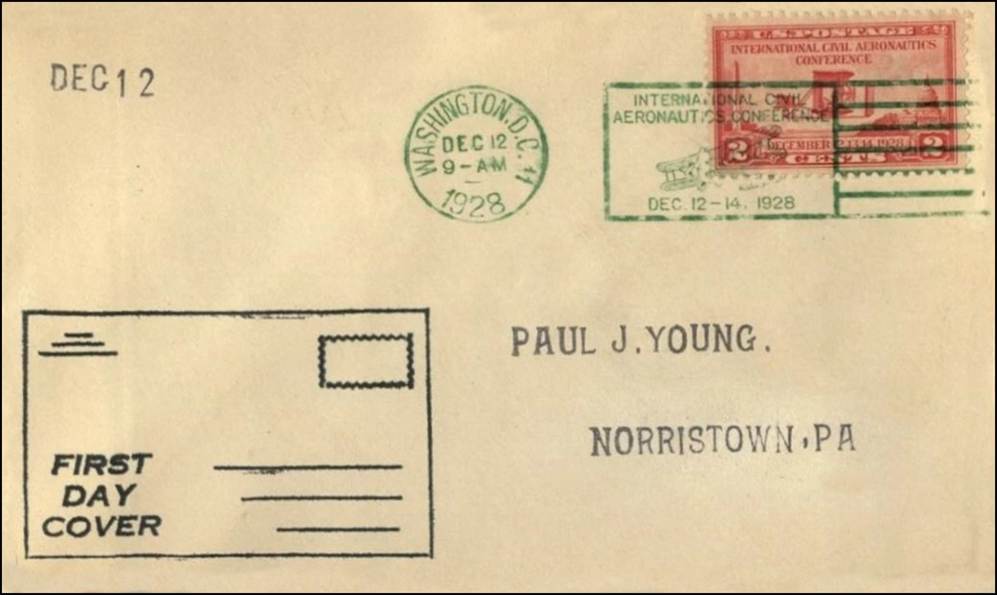
The cachet simulates a mailing box, i.e., a small first day cover for the inscription of the return address.
|
|
|
|
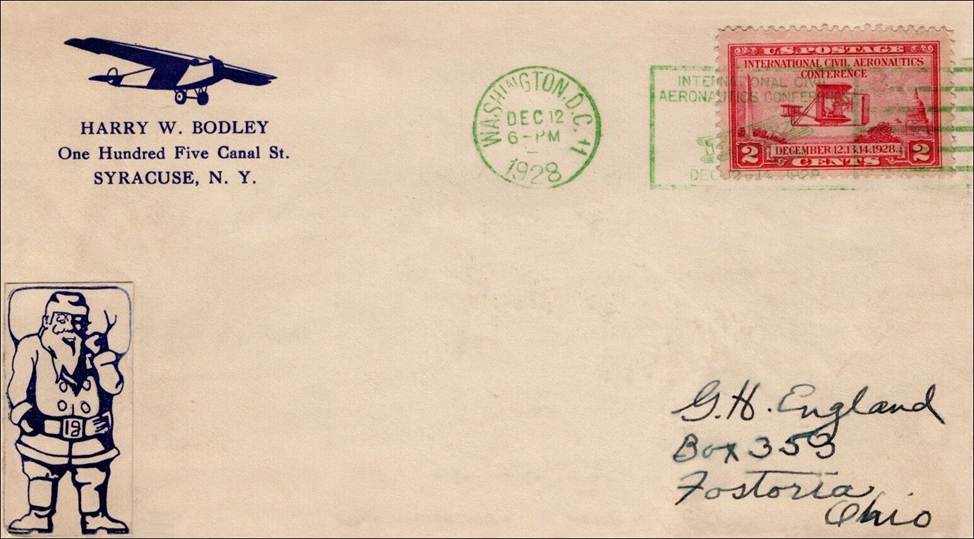
First Day Cover - H.W. Bodley cover. Santa Claus picture at the lower left.
|
|
|
|
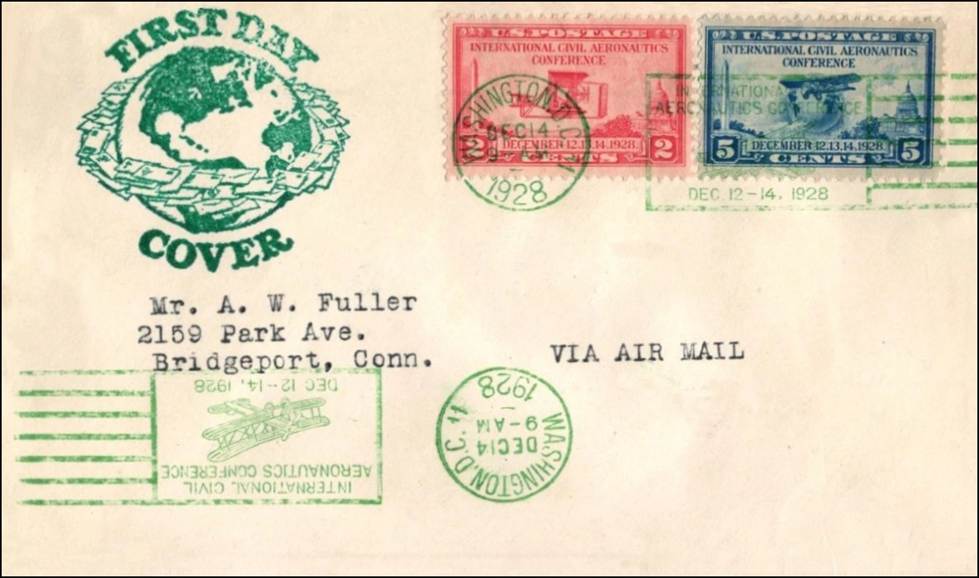
The cachet of ths cover features the emblem of the Universal Postal Union (UPU), i.e. a globe encircled by envelopes, with the text "FIRST DAY COVER".
|
|
|
|
First Day Cover - Benjamin Franklin stationery.
|
|
|
|
First Day of Issue (12 December 1928). Block of four 5-cent stamps - Special registered red hand-stamp.
|
|
|
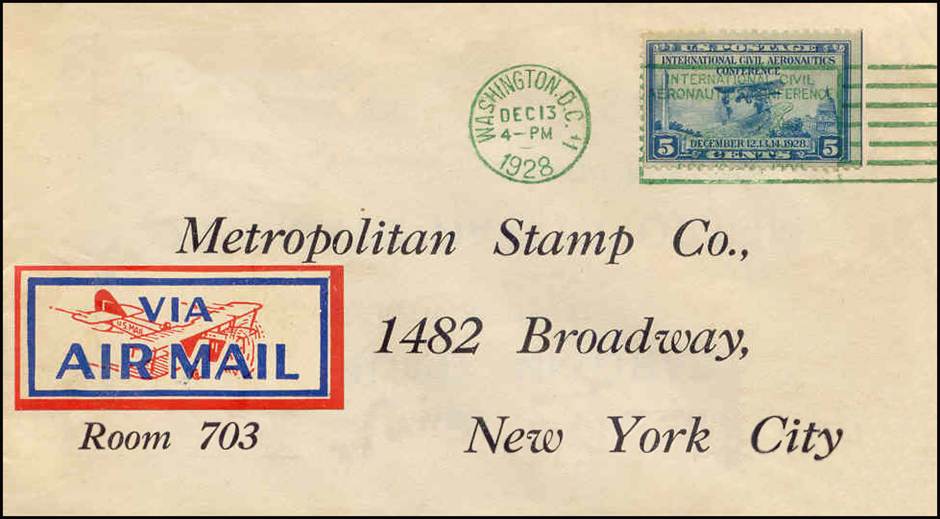
Second Day of Issue (13 December 1928).
|
|
|
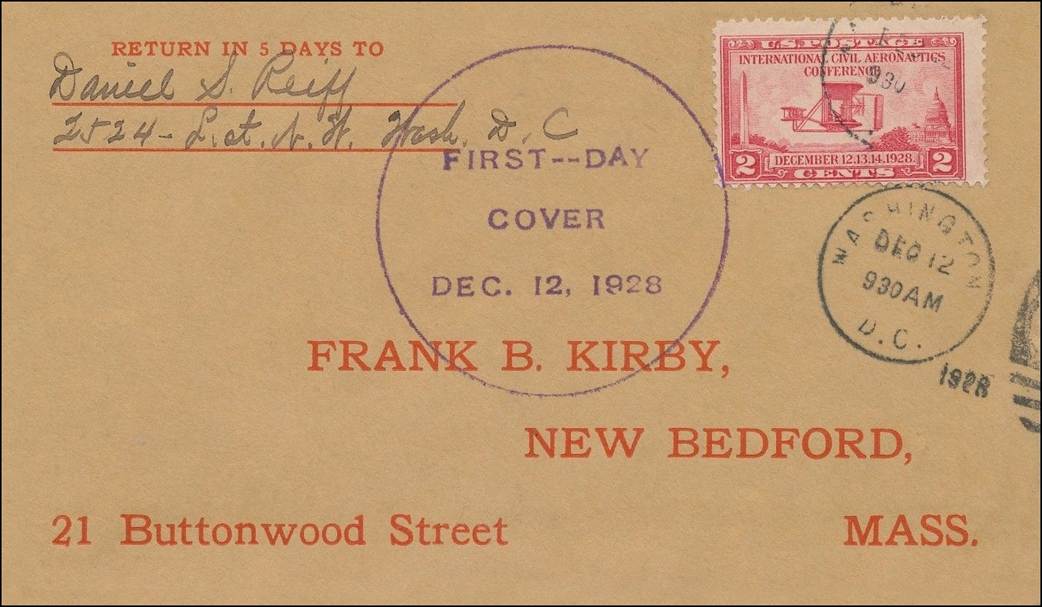
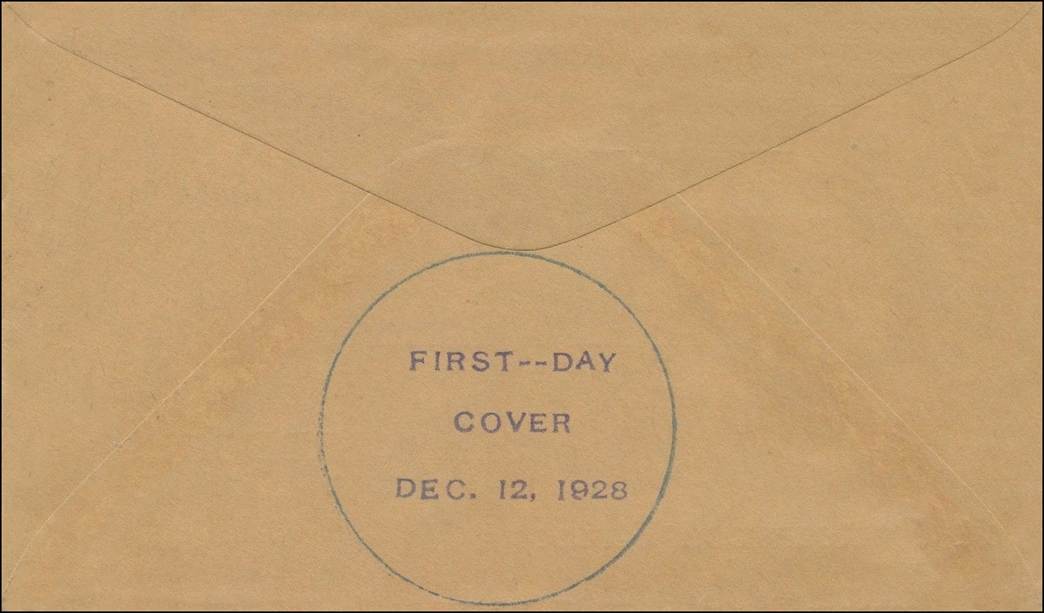
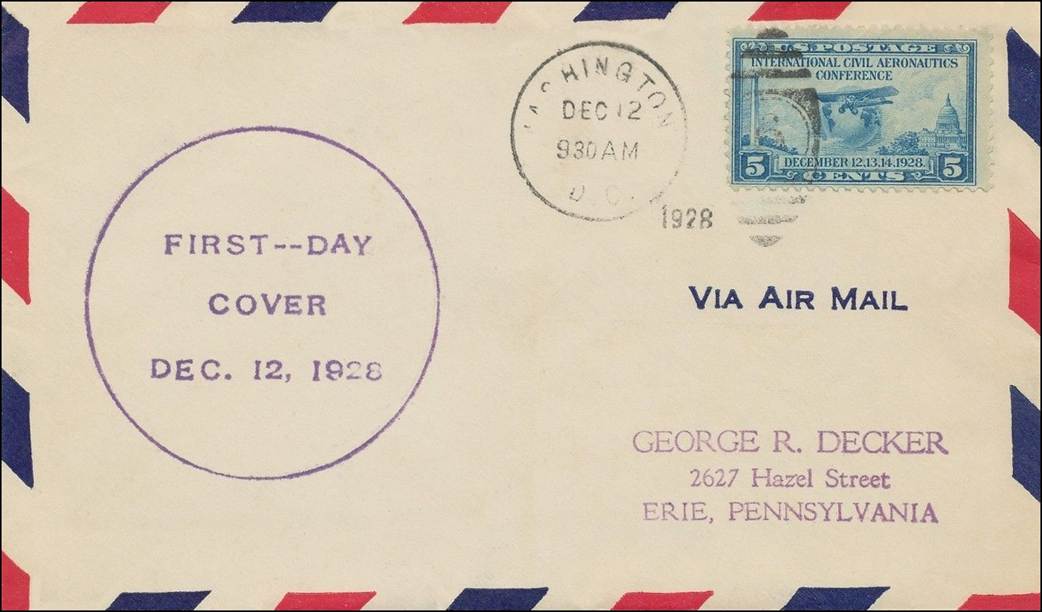
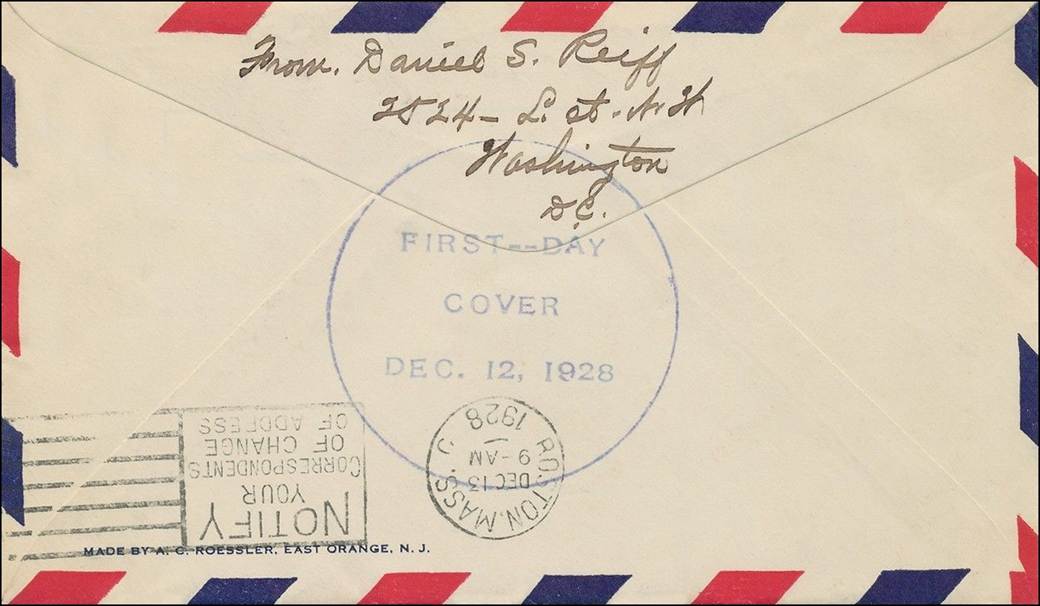
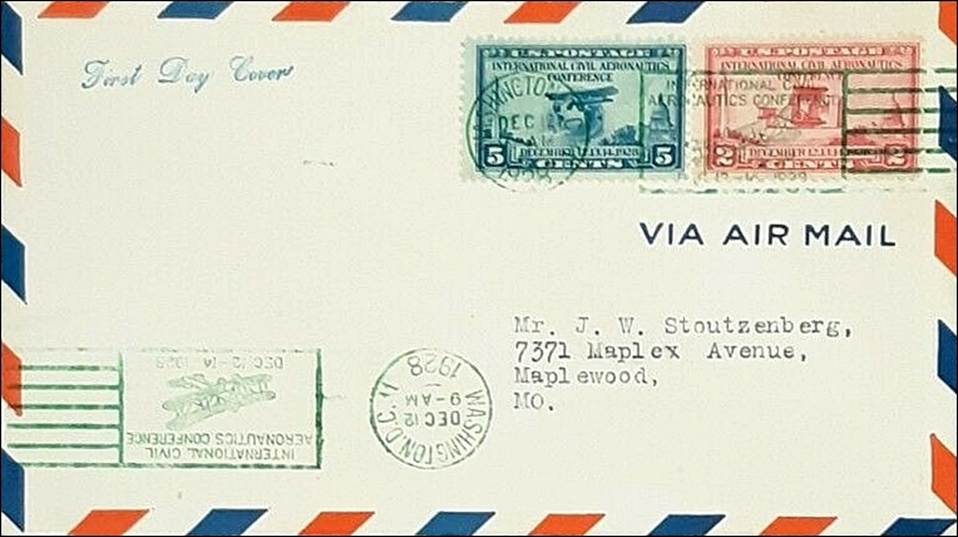
Front and back covers with CDS (Circular Date Stamp) special cancel on 12 December 1928.The airmail cover was produced by Albert Charles Roessler, who was both a stamp and coin collector and dealer.
|
|
|
|
|
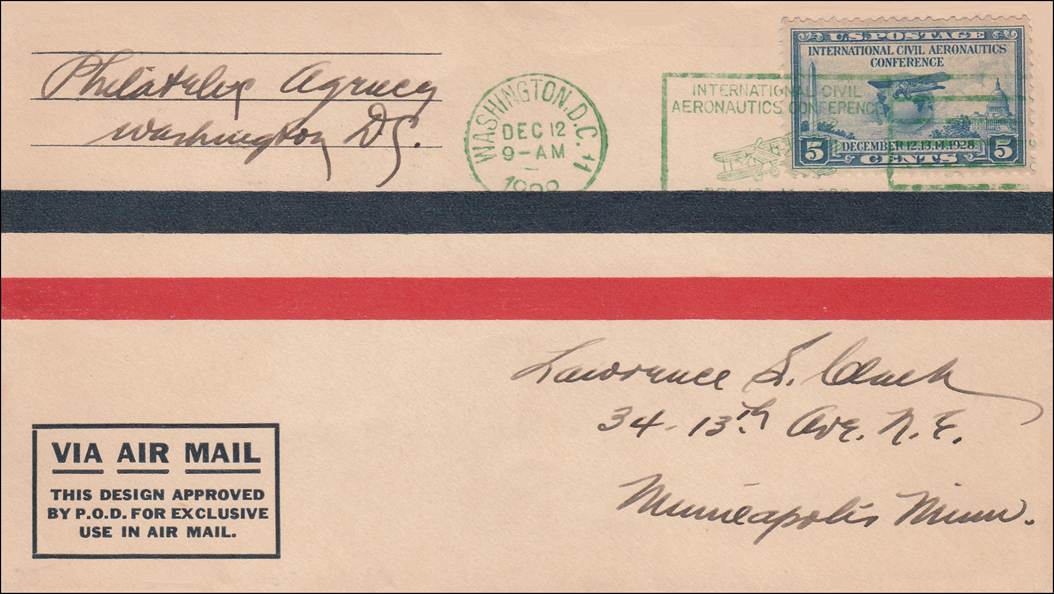
First Day Cover - Special design for airmail use approved by the Post Office Department (POD).
|
|
|
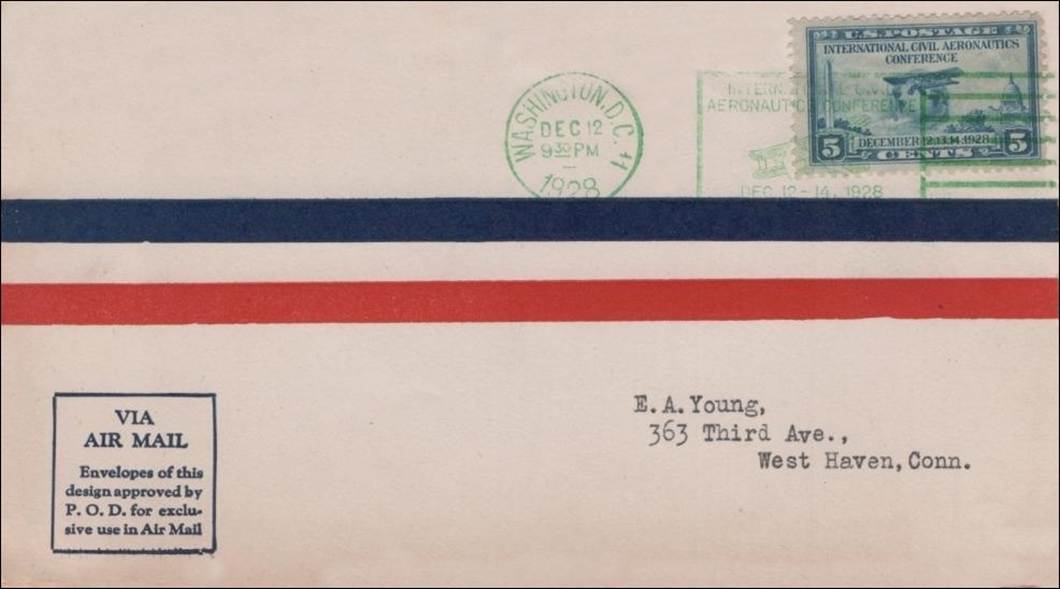
First Day Cover - Special cover for airmail use as approved by the U.S. Post Office Department.
|
|
|
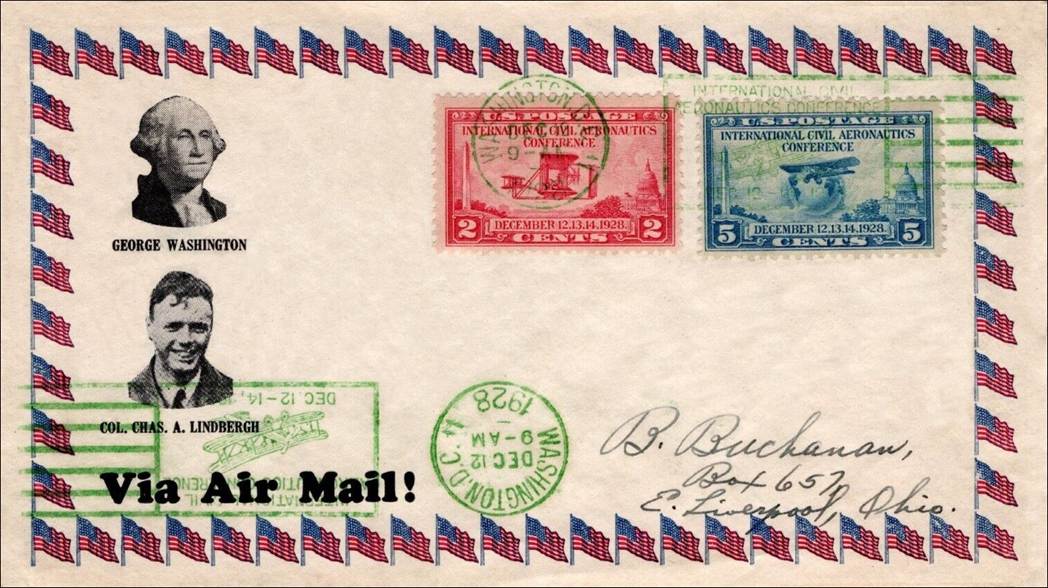
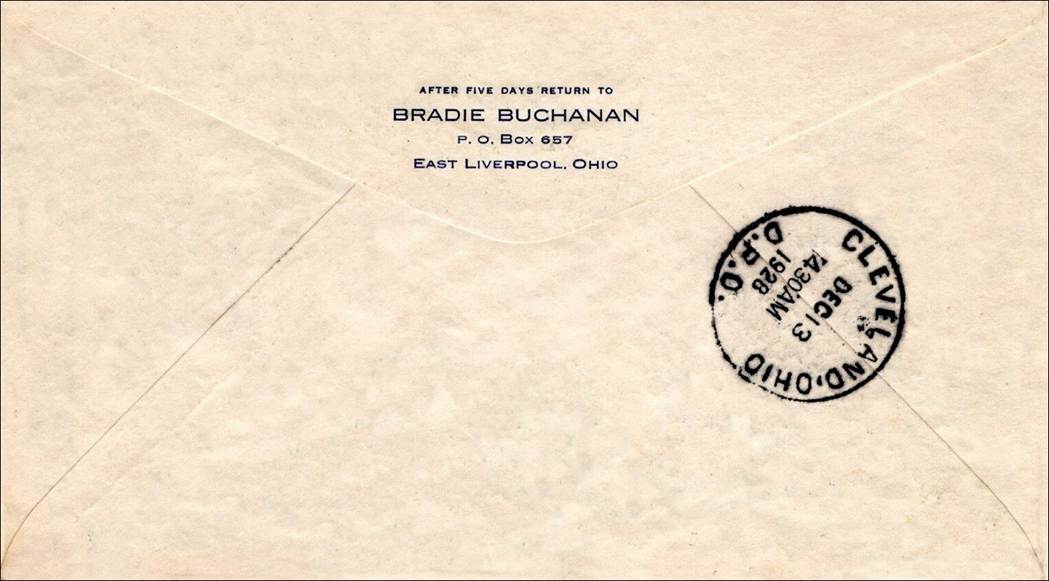
Bradie Buchanan First Day Cover (recto and verso).Silhouettes of George Washington, first President of the United States from 1789 to 1797, and of Colonel Charles Augustus Lindberg, well known for the first nonstop flight from New York City to Paris on 20-21 May 1927.
|
|
|
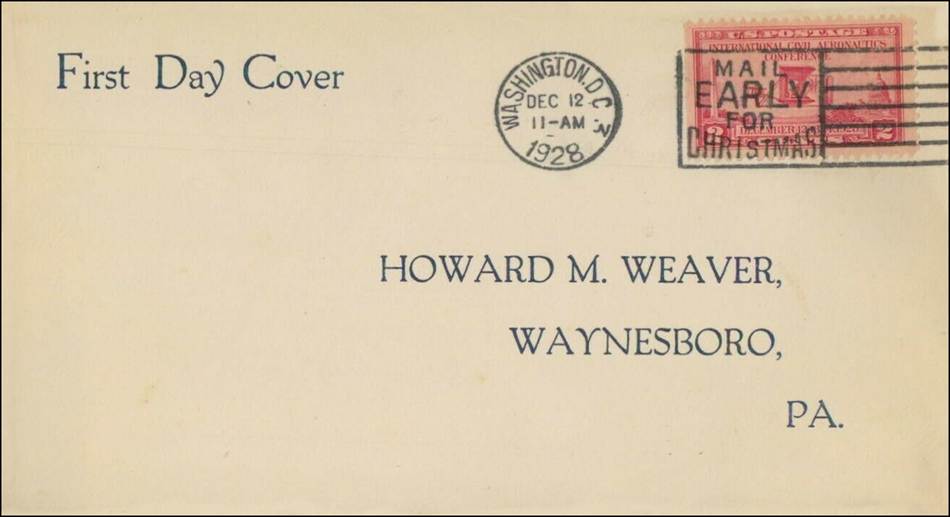
First Day Cover sent to Howard M. Weaver (1879-1962). He was a clerk in the Waynesboro post-office and one of Waynesboro’s first rural mail carriers delivering mail to the rural communities in the early days.
|
|
|
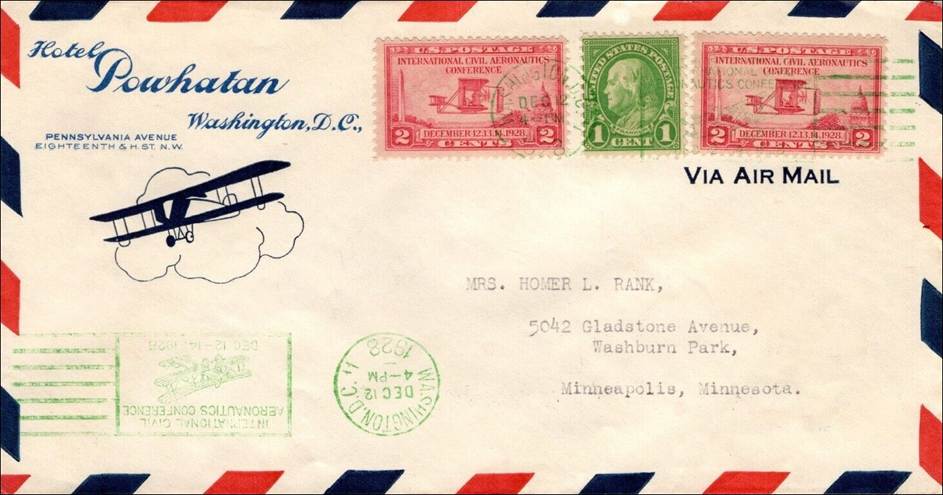
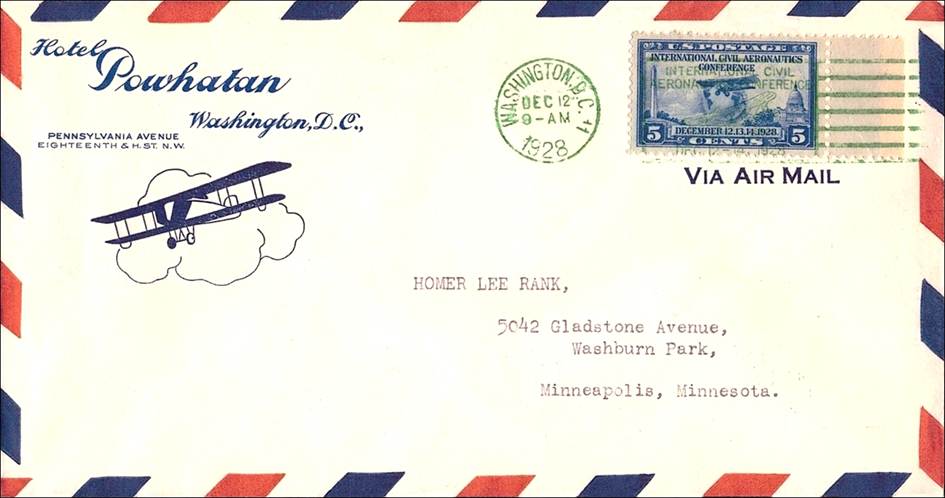
First Day Cover sent from the Powhatan Hotel located on Pennsylvania Avenue in Washington.The Powhatan Hotel, built in 1911, was an interesting example of early 19th century hotel architecture. The building's roof garden was a popular dining and dancing spot for many years. Notice the particular silhouette of the aircraft at the left side.
|
|
|
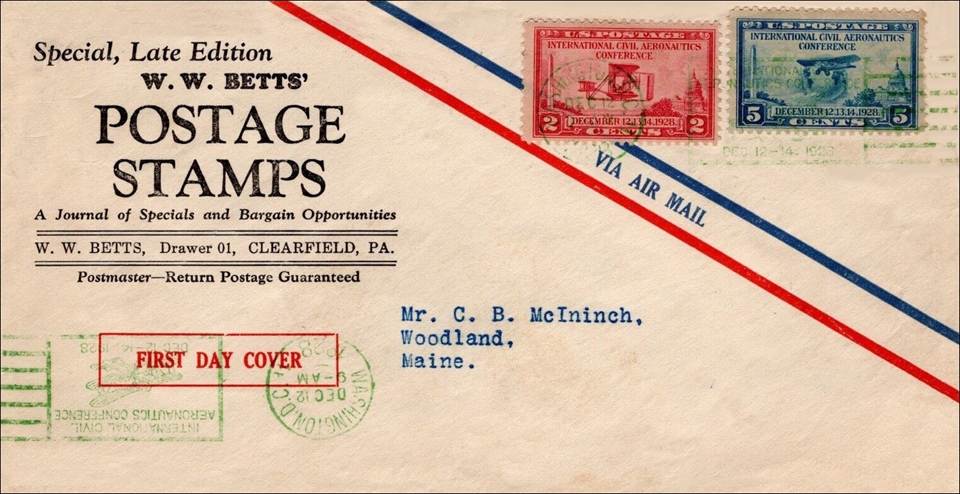
Historic postal cover with 1928 combo stamp. First Day Cover on stationery of W.W. Betts, Stamp Dealer in Clearfield.
|
|
|
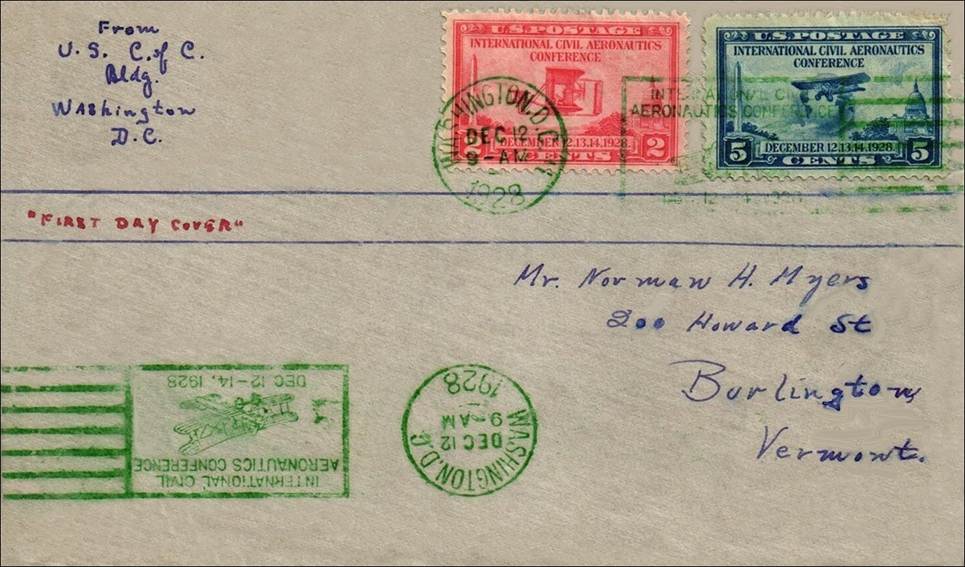
First Day Cover sent from the US Chamber of Commerce (C. of C.) Building in Washington, D.C.
|
|
|
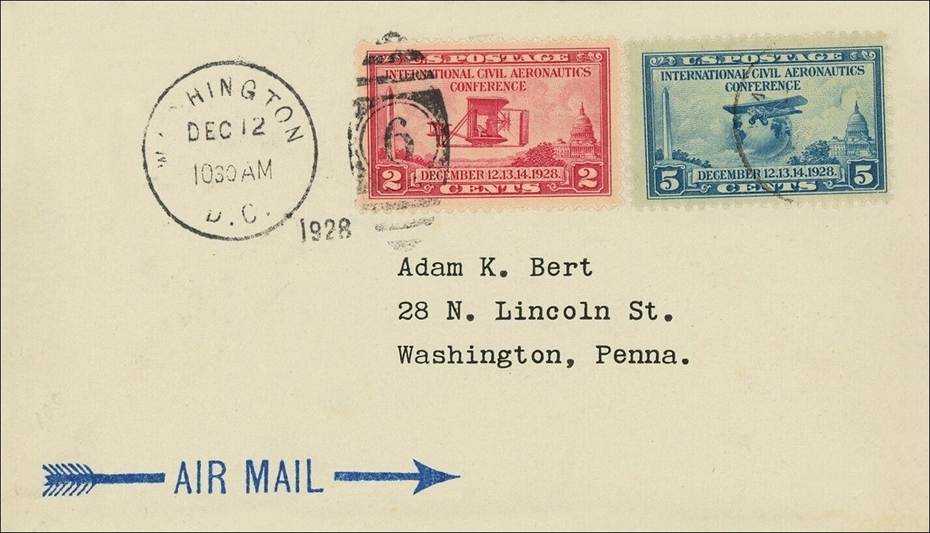
First Day Cover sent from Washington with the 2 stamps of the issue, addressed to FDC pioneer Adam Bert on his unique size envelope.
Adam K. Bert (1905–2007), of Beaver Falls, Pennsylvania, was a stamp collector and dealer, who operated his stamp business in Pittsburgh.
|
|
|
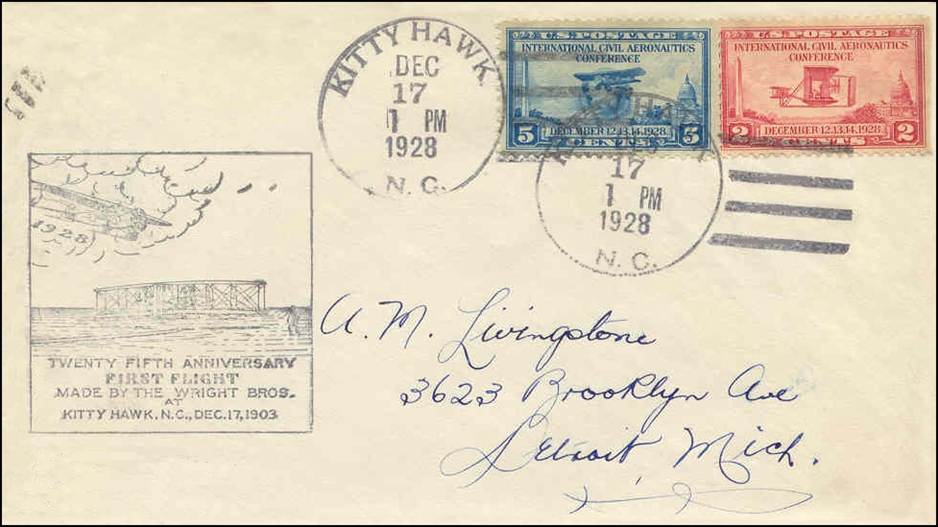
Historic postal cover with 1928 5c stamp postmarked Kitty Hawk, North Carolina, Dec 17 1928, with special rubberstamped pictorial cachet commemorating the 25th anniversary of the Wright brothers' first flight.
|
|
|
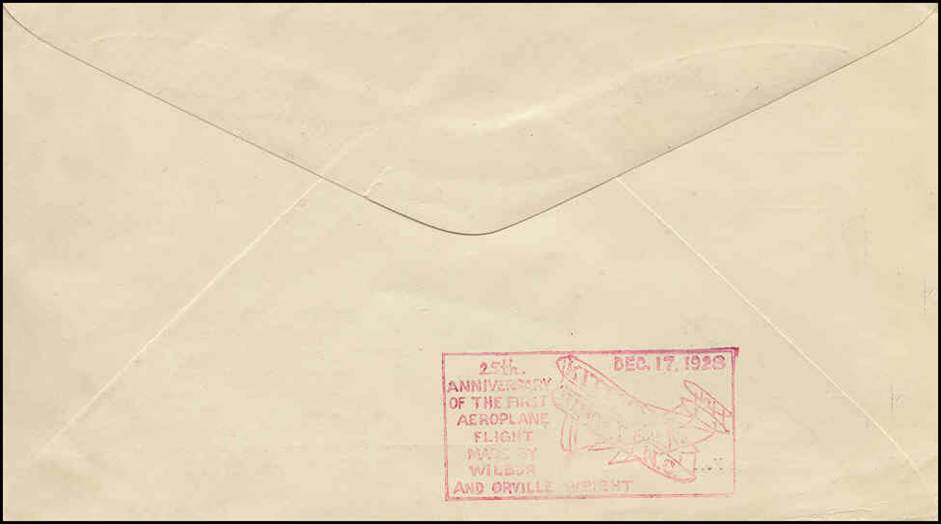
Back of the above cover with red imprint for the 25th anniversary of the first aeroplane flight.
|
|
|
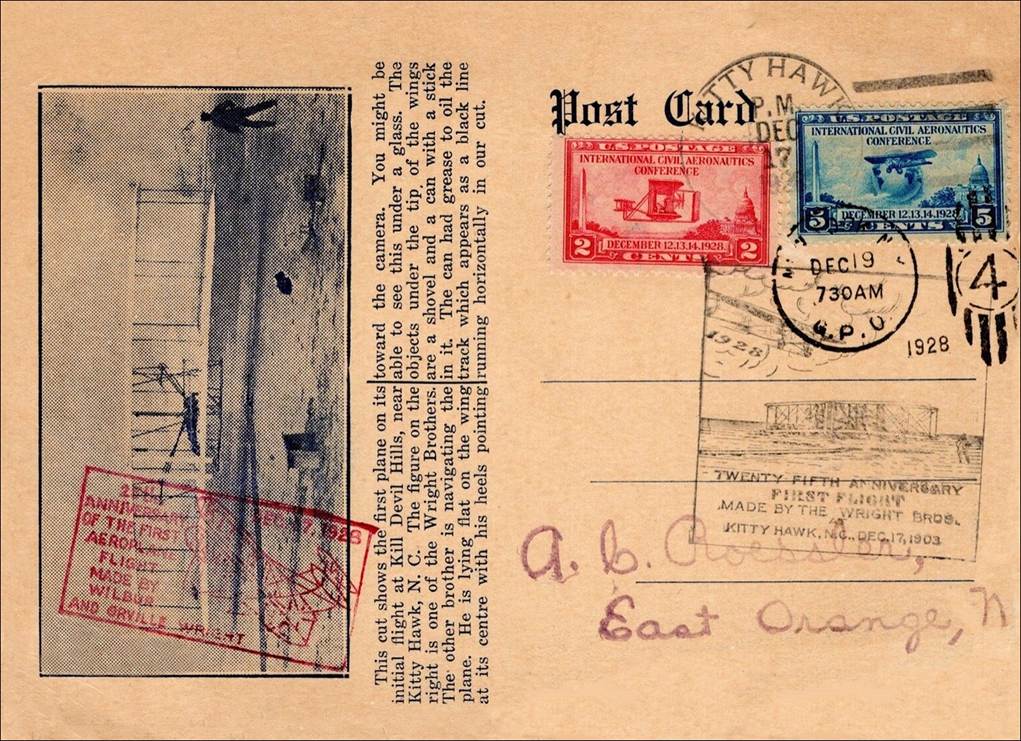
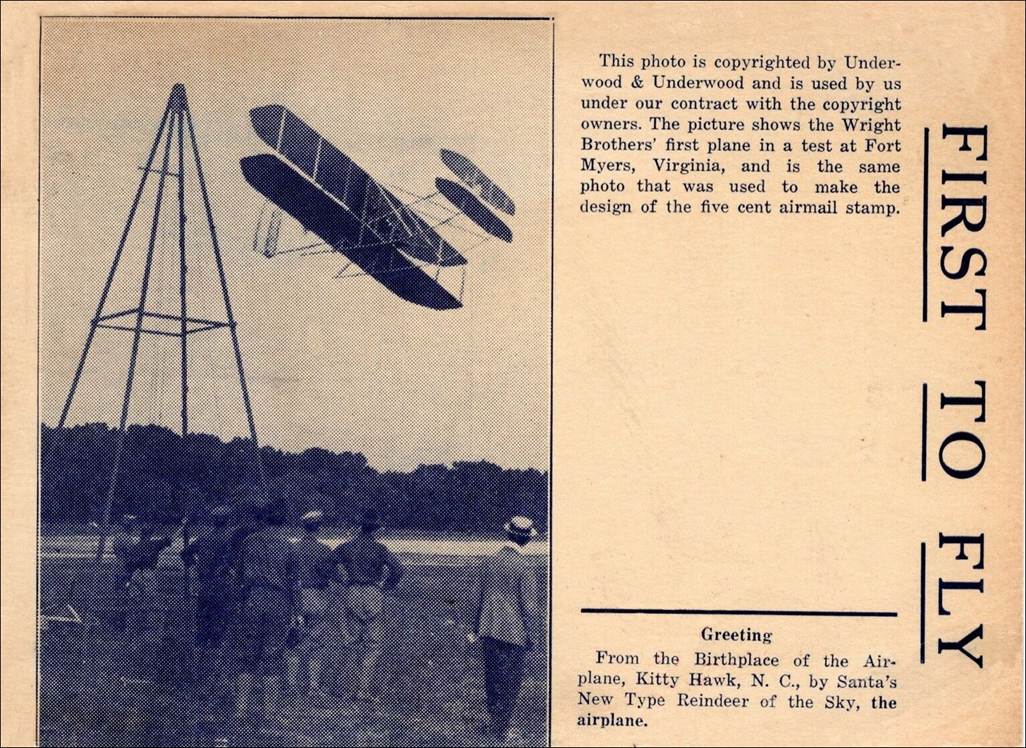
1928 Roessler - Wright Brothers 25th Anniversary First Flight Card (Front and Back).
|
|
|
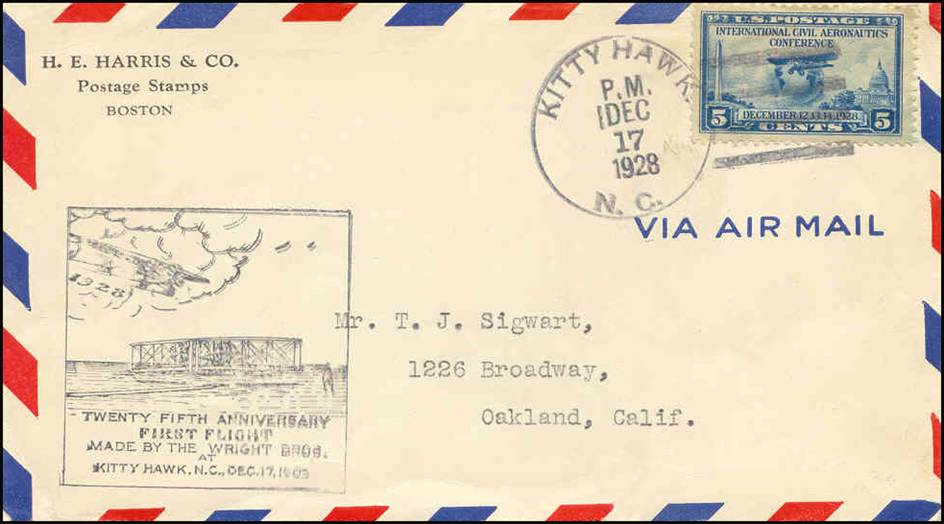
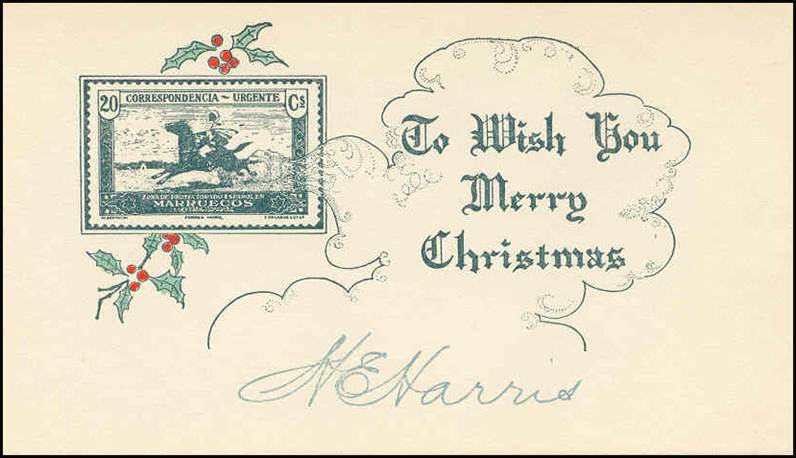
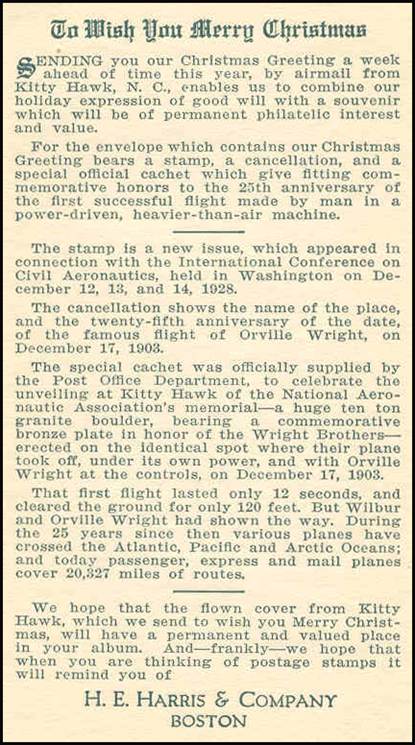
Cover postmarked in Kitty Hawk, N.C., on 17 December 1928 for the Wright Brothers 25th anniversary first flight celebration. Cachet says "Twenty-fifth anniversary first flight made by the Wright Brothers at Kitty Hawk, N.C., Dec. 17, 1903”. It was a gift sent to stamp collectors from long-time dealer H. E. Harris & Co., Boston, Mass.; it includes two enclosures (see here below), providing an interesting example of a combo Christmas, special event and advertising cover.
|
|
|
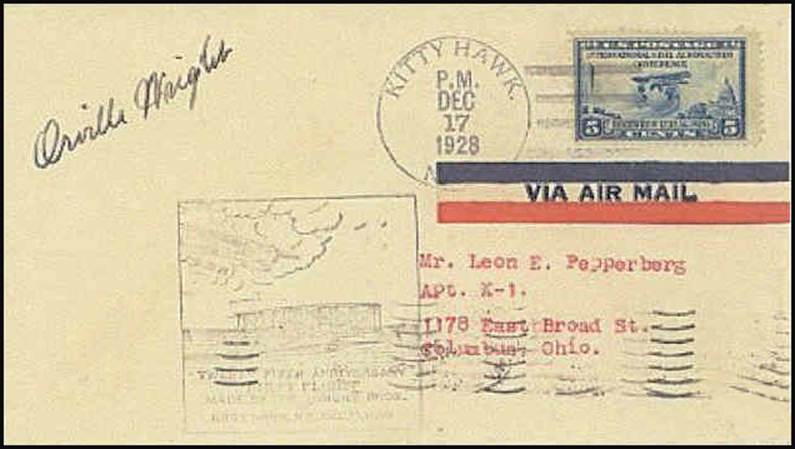
Historic postal cover with 1928 5c stamp postmarked Kitty Hawk, North Carolina, 17 December 1928, with special rubberstamped pictorial cachet commemorating the 25th anniversary of the Wright brothers' first flight, nicely signed in ink at the upper left by Orville Wright.
|
|
|
|
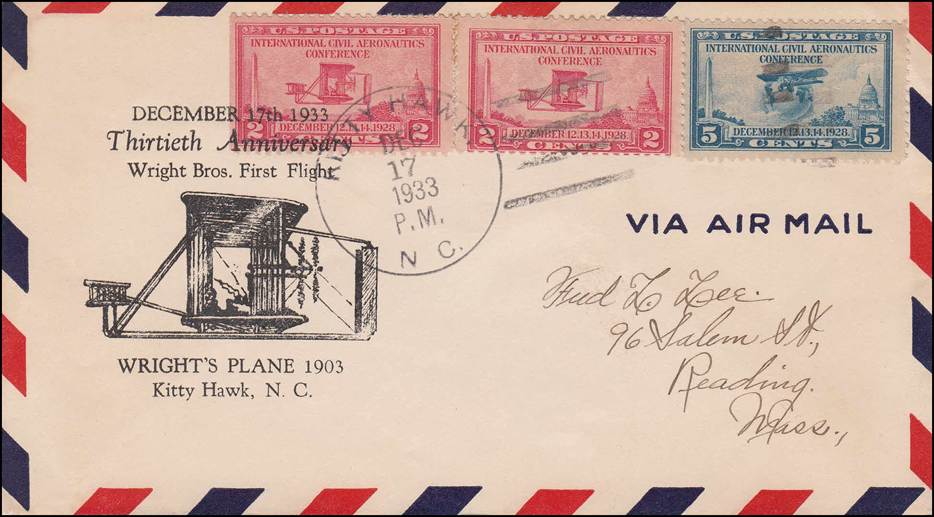
First Day Cover with cancel on 17 December 1933, commemorating the 30th anniversary of the Wright’s feat. Picture showing Wright’s Flyer I.
|
|
|
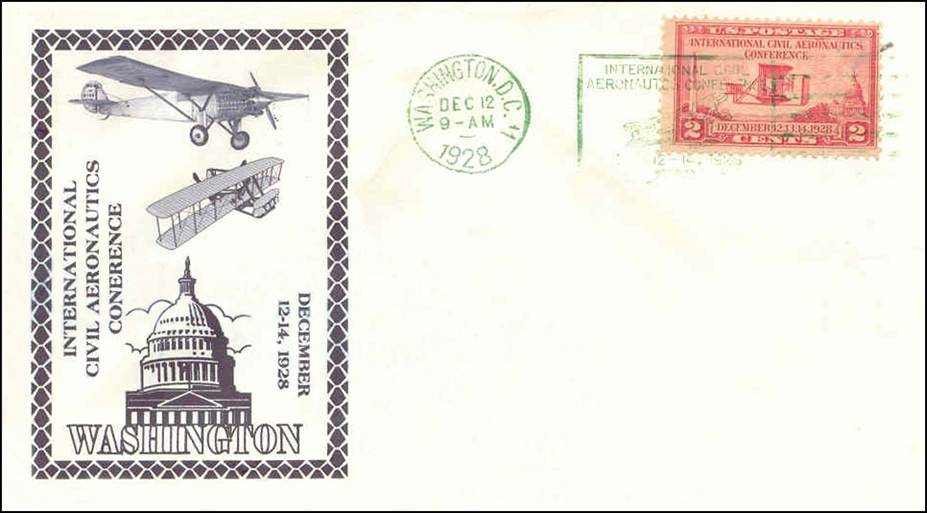
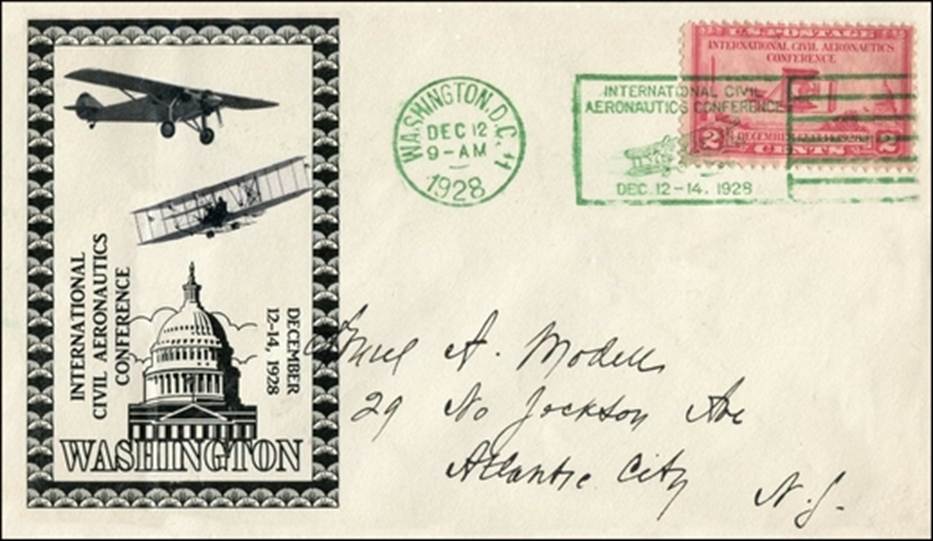
First Day Covers – Webcraft add-on cachet (applied in 2007 on the upper cover and in 2018 on the lower cover).The word CONFERENCE is misspelled (Missing F) in the upper cover, while it is correct in the lower cover.The upper aircraft is Charles Lindbergh's Ryan NYP Spirit of St. Louis, while the lower is the Wright Flyer 1.House of Representatives in Washington, D.C.
|
|
|
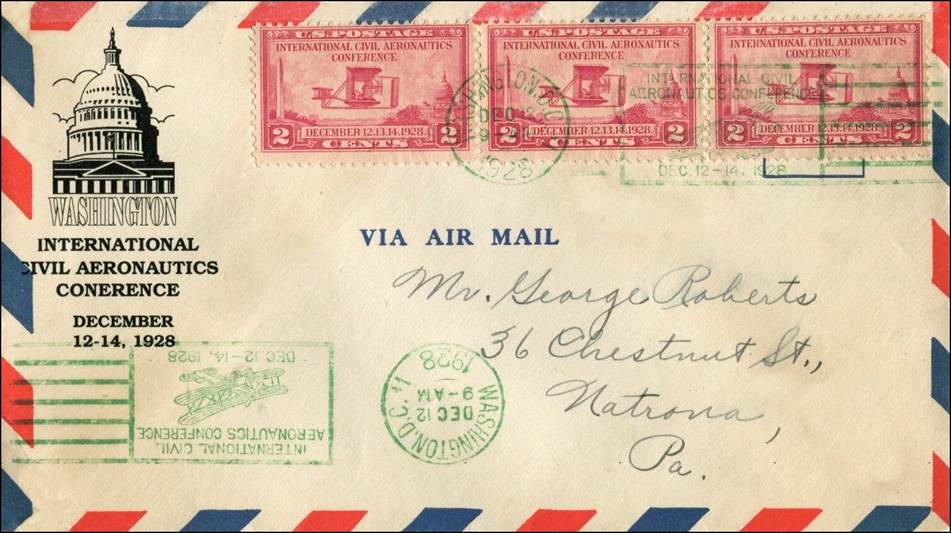
First Day Cover – Webcraft add-on cachet (applied in 2009). House of Representatives in Washington, D.C.The word CONFERENCE is misspelled (Missing F).
|
|
|
First Day Cover – Hand Stamped cachet.
|
|
|
First Day Cover with the two stamps of the issue.
|
|
|
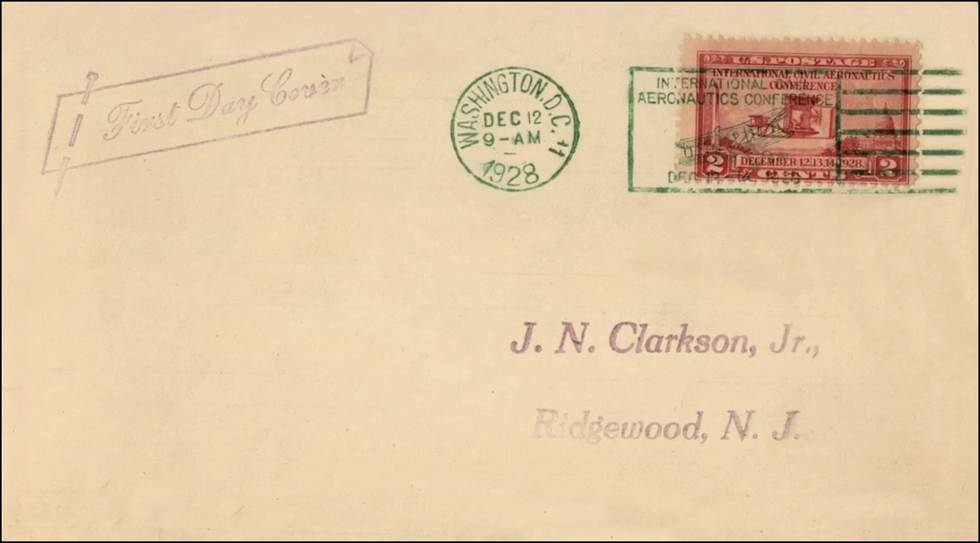
First Day Cover - J.N. Clarkson Jr. cachet.J.N. Clarkson, Jr. was a well-known stamp dealer and cachetmaker in Ridgewood, New Jersey. |
|
|
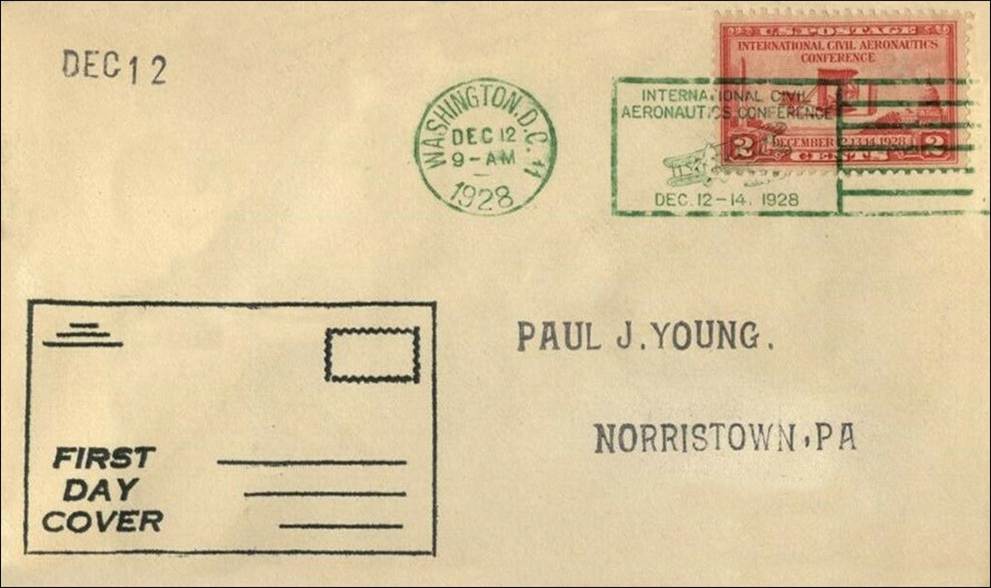
First Day Cover - Paul J. Young cachet.
|
|
|
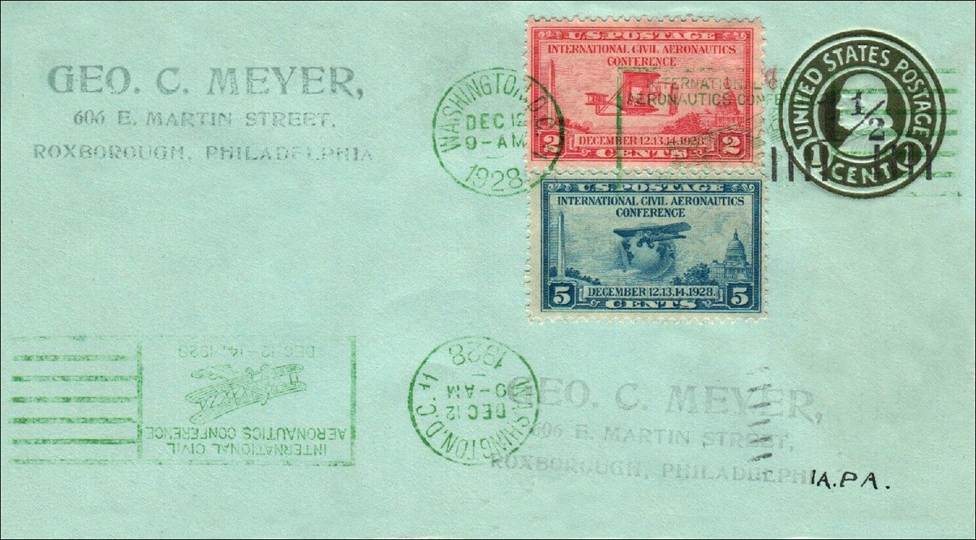
Postal stationery.
|
|
|
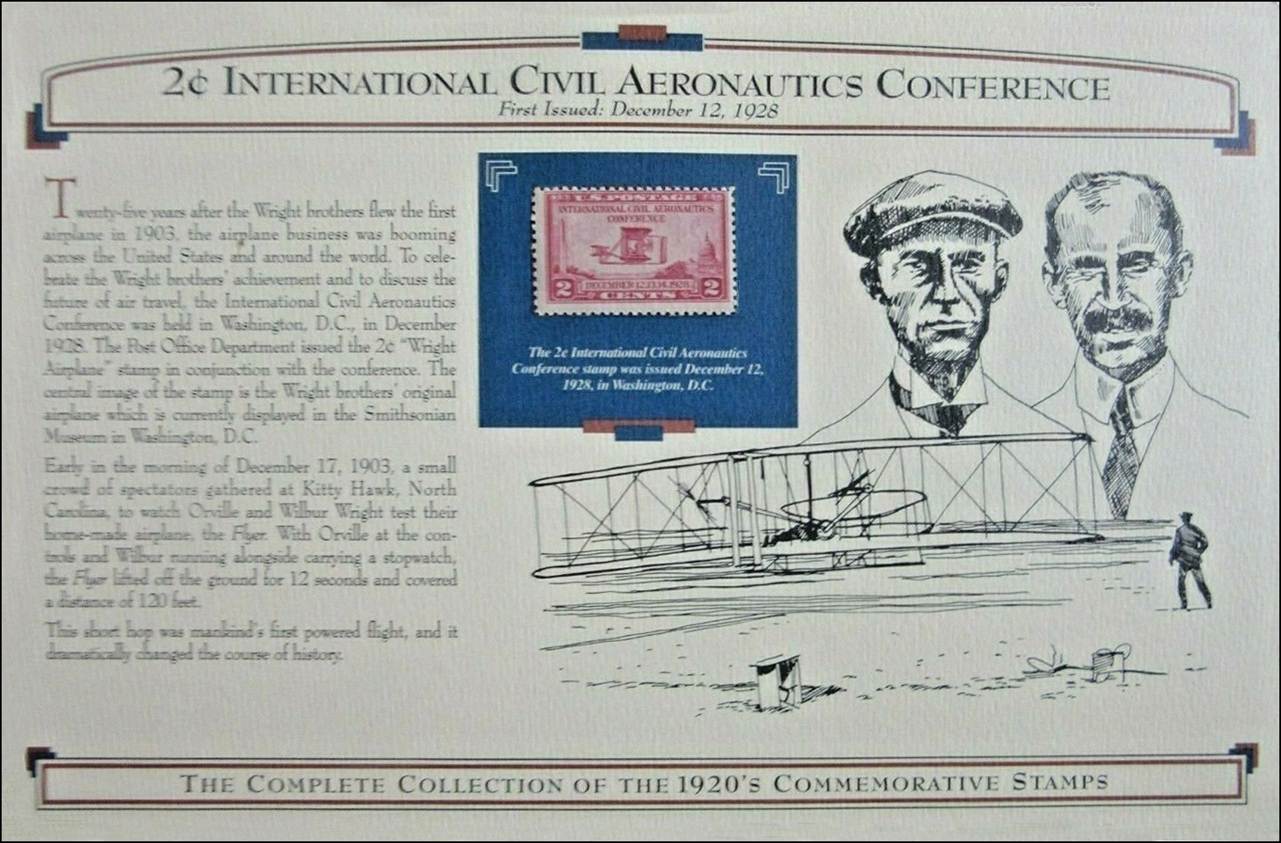
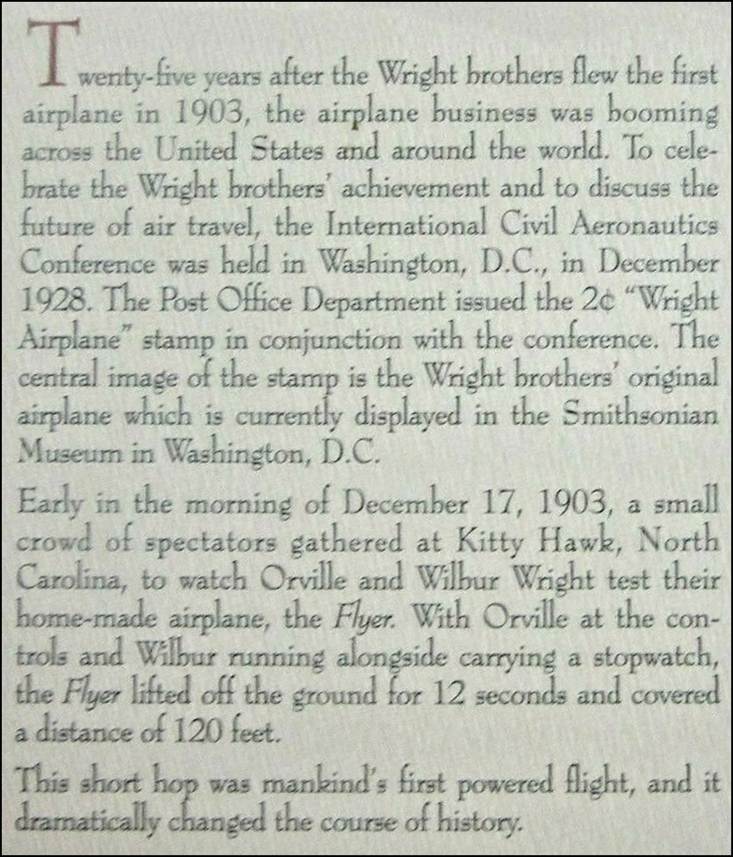
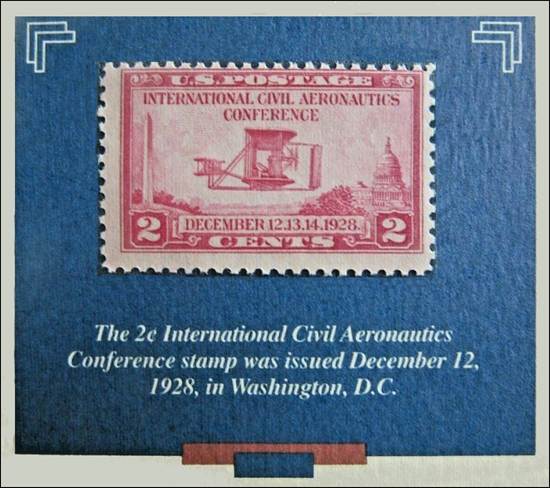
Historical description card of the first powered flight with the 2-cent stamp - Size: 10" x 6.5".
|
|
|
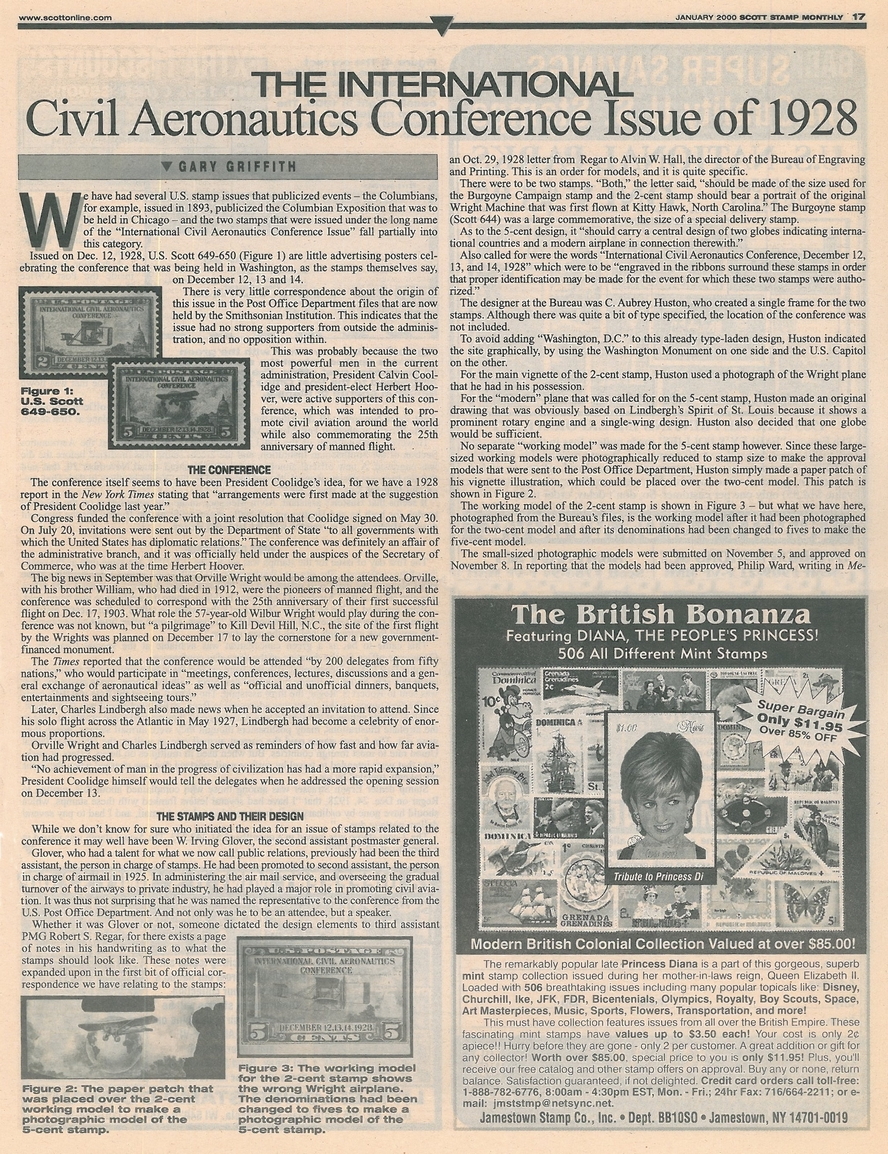
Excerpt from the Scott Stamp Monthly, January 2000, Page 17.
|
|
|
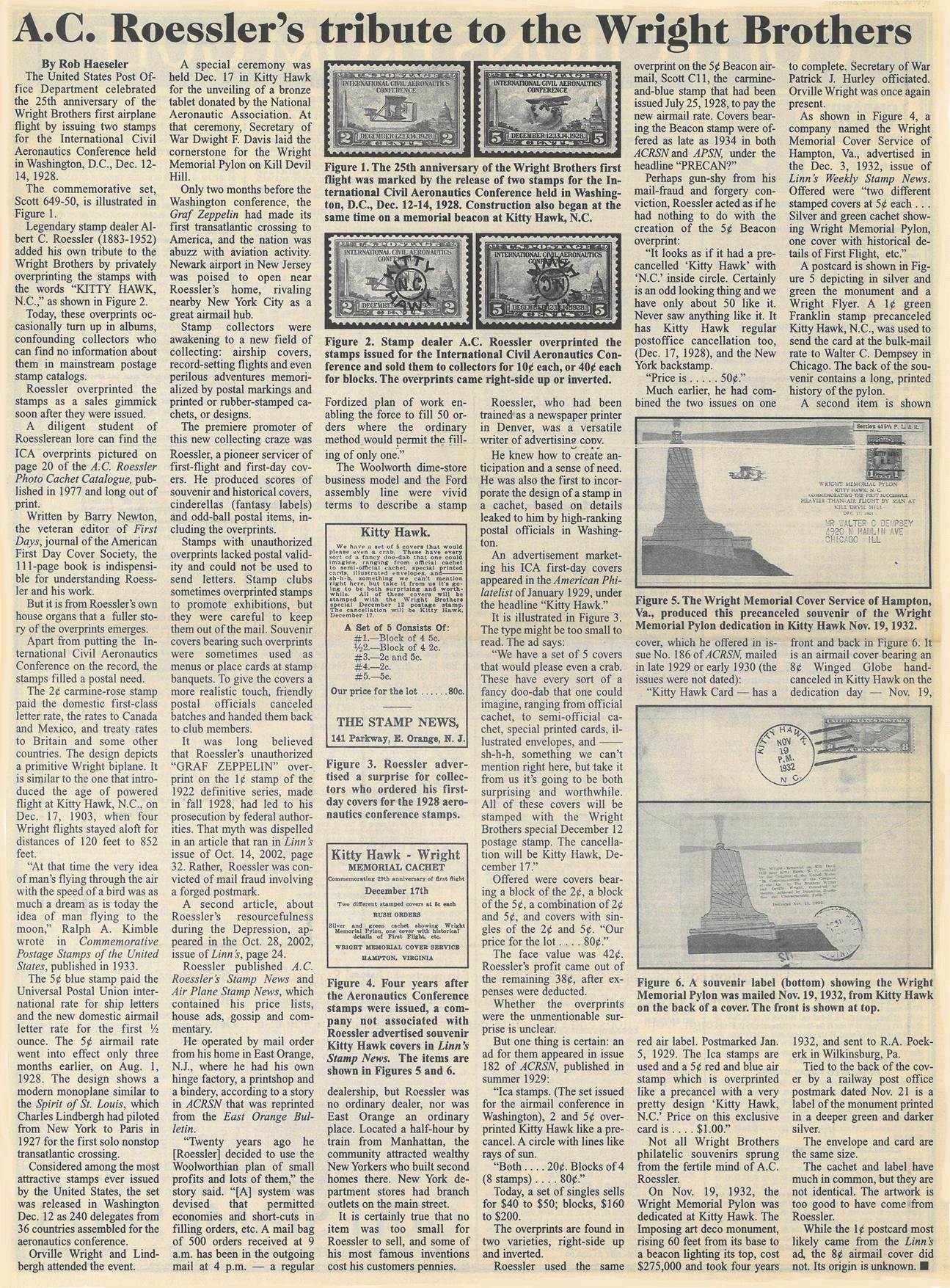
Excerpt from the Linn's Stamp News, 25 November 2002, Page 24
|
|
|
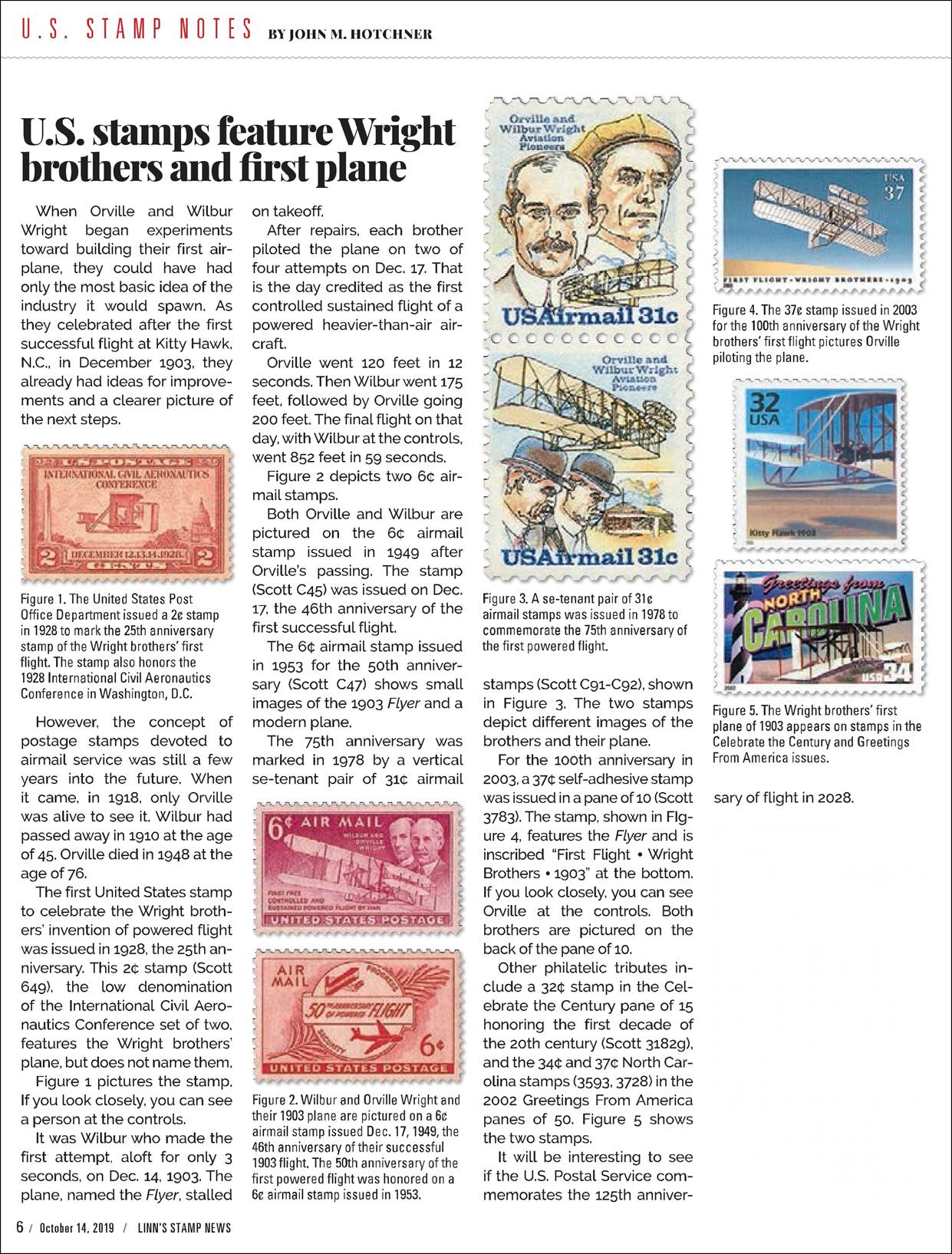
Excerpt from the LINN’S STAMP NEWS, 14 October 2019, Vol. 92, No. 4746, Page 6
|
|
|
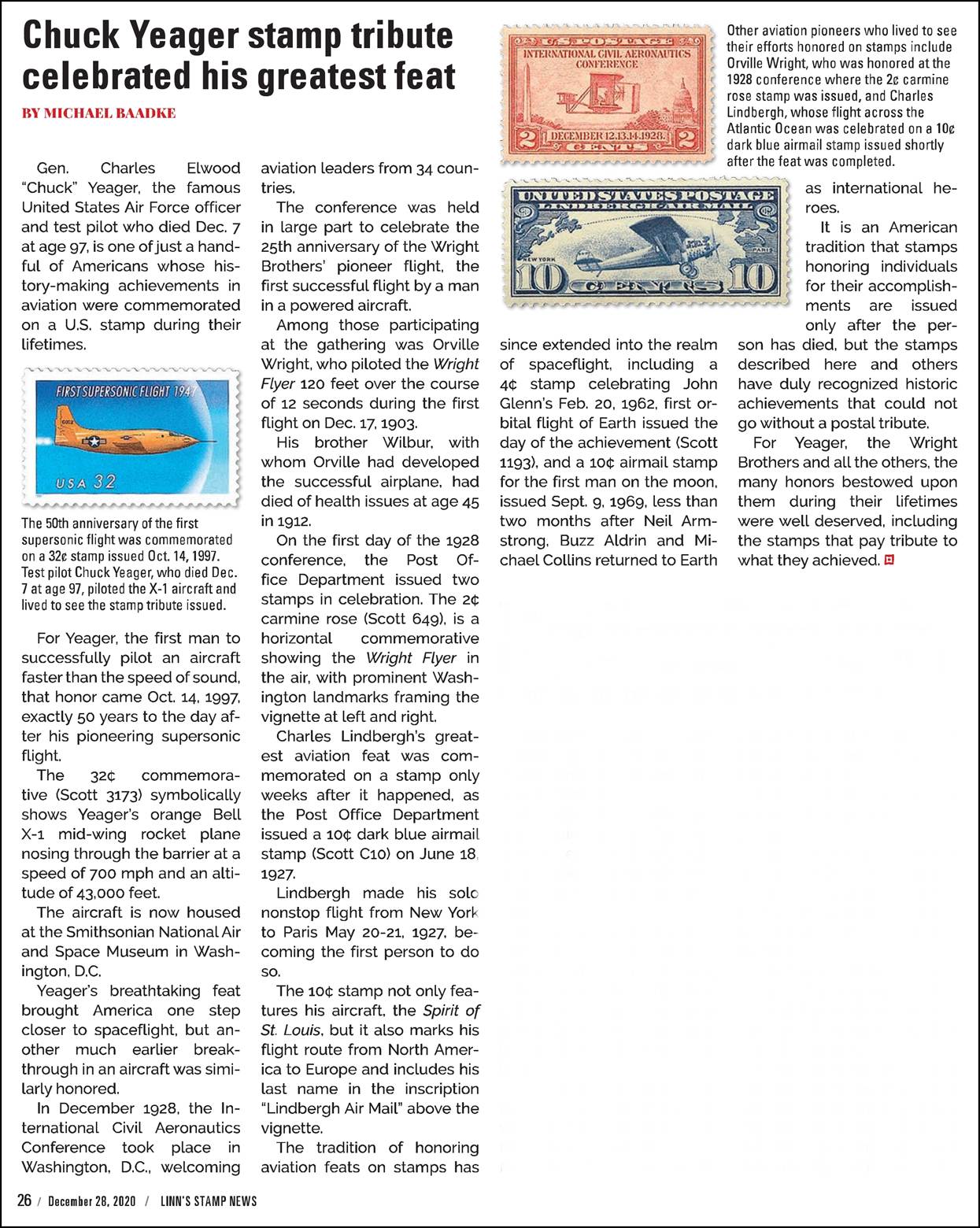
Excerpt from the LINN’S STAMP NEWS, 28 December 2020, Vol. 93, No. 4809, Page 26
|
|
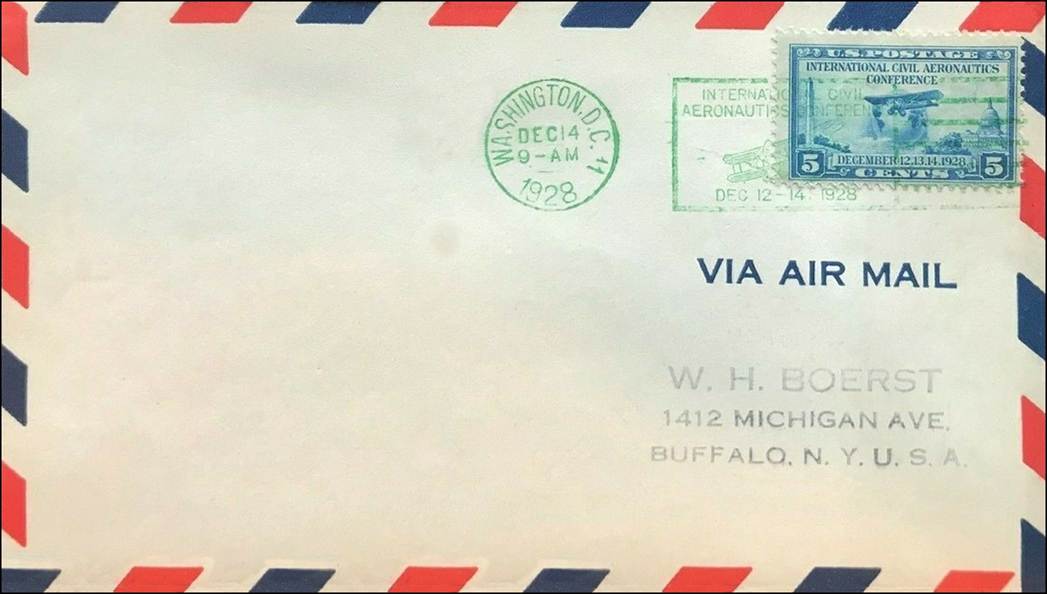
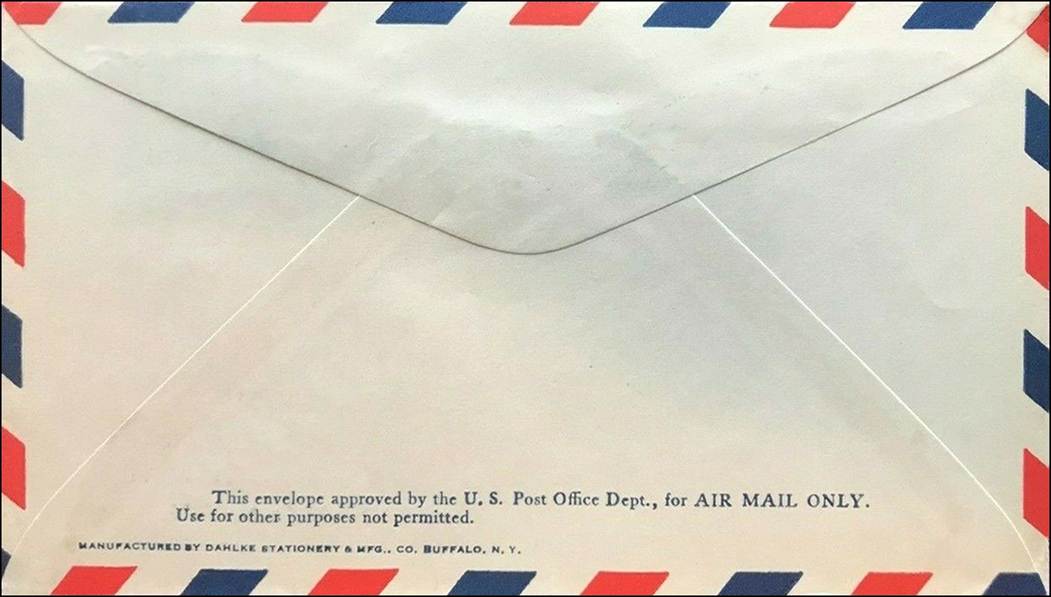
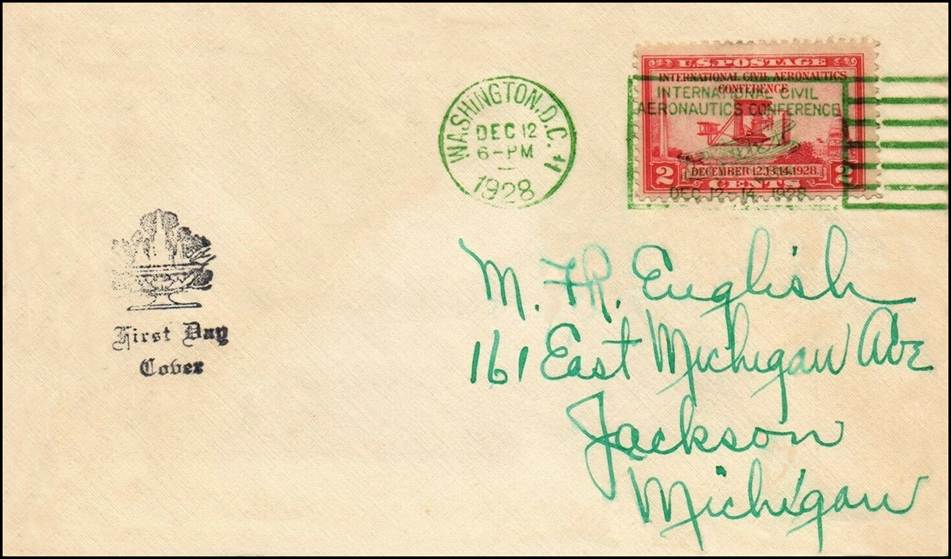
Footnote 1: The official first day of issue was 12 December 1928 in Washington, D.C. Stamp and cover collectors mailed in their request for postmarks before the official release. During the conference, attendees were able to obtain first day postmarks in the United States Chamber of Commerce Building, located across Lafayette Park from the White House. Postmaster General New directed that a special post office station be established in the building to accommodate customers from the conference seeking to purchase the stamps and obtain other postal services. In those days, establishment of a temporary post office station at a non-postal facility was unusual, reflecting the level of interest provided to this event by senior management. Special machine cancellations in green were used during the three days of the conference. This was the first time an ink other than black was used for a first day machine cancellation. |
_________________________