|
|
1. |
General questions about a market-based measure (MBM) and CORSIA |
|
none | 1 | ||||||||||||||||||||||||||||||||||||
| 1.1 | What is a market-based measure (MBM)? |
A market-based measure (MBM) is a policy tool that is designed to achieve environmental goals at a lower cost and in a more flexible manner than traditional regulatory measures. Examples of MBMs include levies, emissions trading systems, and carbon offsetting. |
table-row | 2 | |||||||||||||||||||||||||||||||||||||
| 1.2 | What is the contribution of aviation to global greenhouse gas emissions? |
Aviation (domestic and international) accounts for approximately 2 per cent of global CO₂ emissions produced by human activity, according to the information contained in relevant documents of the Intergovernmental Panel on Climate Change (IPCC), namely: IPCC Special Report on Aviation and the Global Atmosphere (p. 6); IPCC AR4 Climate Change 2007: Mitigation of Climate Change (p.49); and IPCC AR6 Climate Change 2022: Mitigation of Climate Change (p.1086). In 2018, approximately 65 per cent of global aviation fuel consumption was from international aviation (see ICAO 2022 Environmental Report, p.24); applying this share to CO₂ emissions, international aviation is responsible for approximately 1.3 per cent of global CO₂ emissions.
|
table-row | 3 | |||||||||||||||||||||||||||||||||||||
| 1.3 | Why does the Paris Agreement not include international aviation emissions? |
The Paris Agreement under the United Nations Framework Convention on Climate Change (UNFCCC) is an international treaty that was agreed in December 2015 and entered into force in November 2016 to enhance the implementation of the UNFCCC. Its aim is “to strengthen the global response to the threat of climate change” by establishing specific goals for “holding the increase in the global average temperature to well below 2°C above pre-industrial levels and pursuing efforts to limit the temperature increase to 1.5°C”.
The Paris Agreement, adopted under the UNFCCC, addresses sectors and related greenhouse gas emissions following an approach similar to that of its overarching Convention. Specifically, governments working under the auspices of the UNFCCC have agreed that while all domestic GHG emissions are dealt with under the UNFCCC, GHG emissions associated with international aviation and maritime transport are to be dealt with under ICAO and International Maritime Organization (IMO), respectively. This approach is consistent with similar UNFCCC decisions that also apply to the Kyoto Protocol.
In this regard, GHG emissions from domestic aviation, as per other domestic sources, are calculated as part of the UNFCCC national GHG inventories and are included in national totals (part of the Nationally Determined Contributions (NDCs) of the Paris Agreement), while GHG emissions from international aviation are reported separately and are not included in NDCs.
ICAO, as a specialized UN agency to address all matters related to international civil aviation, including environmental protection, has been diligently addressing GHG emissions from international aviation. The ICAO agreement on carbon neutral growth and CORSIA complements the ambition of the Paris Agreement and constitutes the most significant international climate-related agreement since its adoption.
|
table-row | 5 | |||||||||||||||||||||||||||||||||||||
| 1.4 | Why did ICAO decide to develop a global MBM scheme for international aviation? |
The ICAO Assembly has resolved that ICAO and its Member States, with relevant organizations, would work together to strive to achieve a collective medium term global aspirational goal of keeping the global net CO₂ emissions from international aviation from 2020 at the same level (so-called "carbon neutral growth from 2020").
The Assembly also defined a basket of measures designed to help achieve the ICAO's global aspirational goal. This basket includes aircraft technologies such as lighter airframes, higher engine performance and new certification standards, operational improvements (e.g., improved ground operations and air traffic management), sustainable aviation fuels, and market-based measures (MBMs).
Based on the environmental trend assessment by the ICAO Council's Committee on Aviation Environmental Protection (CAEP), international aviation fuel consumption is estimated to grow by between 1.9 and 2.6 times by 2050 compared to the 2018 levels, depending on the technology and Air Traffic Management scenario considered (for further details on the CAEP assessment, please refer to Assembly Working Paper A41-WP/93 presented to the 41th Session of the ICAO Assembly). Comparing with the previous CO₂ trends, the current assessment shows in 2040 approximately 15% lower CO₂ emissions for the base scenario with technology freeze and no operational improvements.
The aggregate environmental benefits achieved by non-MBMs measures will not be sufficient for the international aviation sector to reach its aspirational goal. According to the CAEP analysis, international aviation emissions are forecasted to grow in the coming decades, as the projected annual improvements in aircraft fuel efficiency of around 1 to 2 per cent (as result of technological and operational measures), and the reductions from the use of sustainable aviation fuels in the short- to medium-term are expected to be largely surpassed by the forecasted traffic growth of around 5 per cent per year.
A global MBM scheme can help fill the emissions reductions gap, while further advancements in key technologies (e.g., engines, fuels) may result in further CO₂ emissions reductions in the future. The global MBM scheme is the preferred approach compared to having a patchwork of regional and local measures.
The Figure below illustrates the estimated contribution of CORSIA for reducing international aviation CO₂ emissions.
 |
table-row | 4 | |||||||||||||||||||||||||||||||||||||
| 1.5 | What ICAO process was followed to develop CORSIA? |
Discussions on the application of MBMs as a means to limit or reduce CO₂ emissions from international civil aviation had taken place prior to the 37th Session of the Assembly in 2010, which adopted Assembly Resolution A37-19: Consolidated statement of continuing ICAO policies and practices related to environmental protection — Climate change. Assembly Resolution A37-19 requested the Council, with the support of Member States and international organizations, to continue to explore the feasibility of a global MBM scheme by undertaking further studies on the technical aspects, environmental benefits, economic impacts and the modalities of such a scheme, taking into account the outcome of the negotiations under the United Nations Framework Convention on Climate Change (UNFCCC) and other international developments, as appropriate, and report the progress for consideration by the 38th Session of the ICAO Assembly in 2013.
The 37th Session of the Assembly also adopted global aspirational goals for the international aviation sector of annual average fuel efficiency improvement of 2 per cent, and keeping the global net carbon emissions from 2020 at the same level (also referred to as carbon neutral growth from 2020).
The work requested by Resolution A37-19 focused on the qualitative and quantitative assessments of potential options for a global MBM scheme for international aviation. Building on this work, the 38th Session of the ICAO Assembly in 2013, through Resolution A38-18: Consolidated statement of continuing ICAO policies and practices related to environmental protection — Climate change, decided to develop a global MBM scheme for international aviation, and requested the Council, with the support of Member States, to finalize the work on the technical aspects, environmental and economic impacts and modalities of the possible options for a global MBM scheme, including on its feasibility and practicability, taking into account the need for development of international aviation, the proposal of the aviation industry and other international developments, as appropriate, and without prejudice to the negotiations under the UNFCCC.
Assembly Resolution A38-18 further requested the Council to identify the major issues and problems, including those for Member States, and make a recommendation on a global MBM scheme that appropriately addresses them and key design elements, including a means to take into account special circumstances and respective capabilities of ICAO Member States. The Council was also requested to identify the mechanisms for the implementation of the scheme from 2020 as part of a basket of measures that also include technologies, operational improvements and sustainable aviation fuels to achieve ICAO’s global aspirational goals.
Following the 38th Session of the Assembly, the 200th Session of the Council in November 2013 supported that the Committee on Aviation Environmental Protection (CAEP) would continue to undertake technical tasks related to the development of a global MBM scheme, as requested by Resolution A38-18. The Council also decided upon the establishment of an Environment Advisory Group of the Council (EAG), which was mandated to oversee all the work related to the development of a global MBM scheme and make recommendations to the Council.
The EAG focused its work on a mandatory carbon offsetting approach as the basis for a global MBM scheme for international aviation. The EAG/15 meeting in January 2016 considered a draft Assembly Resolution text on a global MBM scheme, which was further refined throughout 2016 by two meetings of a High-level Group on a Global MBM Scheme in February and April 2016, a High-level Meeting on a Global MBM Scheme in May 2016 and a Friends of the President Informal Meeting in August 2016.
The Assembly, by adopting Resolution A39-3, agreed to implement a global MBM scheme in the form of CORSIA. It also requested the Council, with the technical contribution of CAEP, to develop the SARPs and related guidance material for the implementation of the Monitoring, Reporting and Verification (MRV) system under the CORSIA.
The CAEP developed SARPs for the CORSIA and, after amendment following the consultation with the Member States, the first edition of Annex 16, Volume IV was adopted by the Council at its 214th Session (11 – 29 June 2018), and became applicable on 1 January 2019.
The Assembly, at its 40th Session in 2019, acknowledged the progress made by ICAO and its Member States in taking the necessary steps towards implementation of CORSIA, and established a series of requests to the Council in order to ensure that CORSIA implementation would continue to be on track. This was reflected in the adoption of Assembly Resolution A40-19, which superseded Resolution A39-3.
The 41st Session of the ICAO Assembly (27 September – 7 October 2022) adopted Resolution A41-22 (Consolidated statement of continuing ICAO policies and practices related to environmental protection - Carbon Offsetting and Reduction Scheme for International Aviation (CORSIA)), which superceeds Resolution A40-19.
The Council, at its 228th Session (13 – 31 March 2023), adopted Amendment 1 to Annex 16, Volume IV, resulting from proposed amendments by CAEP and from the outcome of the 2022 CORSIA periodic review. The resulting second edition of Annex 16, Volume IV became applicable on 1 January 2024.
|
table-row | 6 | |||||||||||||||||||||||||||||||||||||
| 1.6 |
What is CORSIA and how does it work, in general? |
The CORSIA has been adopted as complementary to the broader package of measures to help ICAO achieve its aspirational goal of carbon-neutral growth from 2020 onwards. CORSIA relies on the use of eligible emissions units from the carbon market to offset the amount of CO₂ emissions that cannot be reduced through the use of technological and operational improvements, and CORSIA eligible fuels.
The approach for CORSIA is based on comparing the total CO₂ emissions for a year (from 2021 onwards) against a baseline level of CO₂ emissions.
The ICAO Assembly, having considered the recommendations from the Council arising from the 2022 CORSIA periodic review (see question 2.28), adopted Resolution A41-22, which establishes adjustments to the definition of the CORSIA baseline as follows (Assembly Resolution A41-22, paragraph 11 b)):
See question 2.17 for more details on CORSIA’s baseline.
For any year from 2021 onwards, the international aviation CO₂ emissions covered by CORSIA that exceed the baseline level represent the sector's offsetting requirements for that year (see graph below for an illustrative example for a future year 20XX).
 The sectoral offsetting requirements are shared among aeroplane operators covered under CORSIA based on the sector's growth factor and the individual CO₂ emissions of the operators. For more details on calculating offsetting requirements, please see question 2.15.
CORSIA will be implemented in three phases, as follows:
It is important to note that all States whose aeroplane operator undertakes international flights need to develop a monitoring, reporting and verification (MRV) system for CO₂ emissions from international flights starting from 1 January 2019. The requirement to monitor, report and verify CO₂ emissions from international aviation is independent from the offsetting requirements, and the data reported by States will be used for the calculation of the CORSIA's baseline, as well as for the basis of calculating aeroplane operators offsetting requirements, where applicable. See section 3 of these FAQs for more information on CORSIA MRV system.
|
table-row | 7 | |||||||||||||||||||||||||||||||||||||
| 2. | Questions about CORSIA’s key design elements | none | 8 | ||||||||||||||||||||||||||||||||||||||
| Key design element 1: Phased implementation of CORSIA |
|
none | |||||||||||||||||||||||||||||||||||||||
| 2.1 | What is the rationale for the phased implementation of CORSIA? |
Paragraph 9 of the Assembly Resolution A41-22 determines the phased implementation of the CORSIA, and the participation of States in the CORSIA offsetting. According to this paragraph, phased implementation of CORSIA intends to accommodate “the special circumstances and respective capabilities of States, in particular developing States, while minimizing market distortion.”
|
table-row | 9 | |||||||||||||||||||||||||||||||||||||
| 2.2 | What are the different phases? |
The CORSIA has three phases: a pilot phase (2021 – 2023); a first phase (2024 – 2026); and a second phase (2027 – 2035).
The difference between the phases is that the participation of States in the CORSIA offsetting in the pilot phase and in the first phase is voluntary, whereas the second phase is determined using criteria that are based on the 2018 RTK data and voluntary participation (See also questions 2.3 and 2.4 for details).
States that voluntarily decide to participate in CORSIA offsetting may join the scheme from the beginning of a given year, and should notify ICAO of their decision to join by June 30 of the preceding year.
The figure below illustrates the different phases of CORSIA.
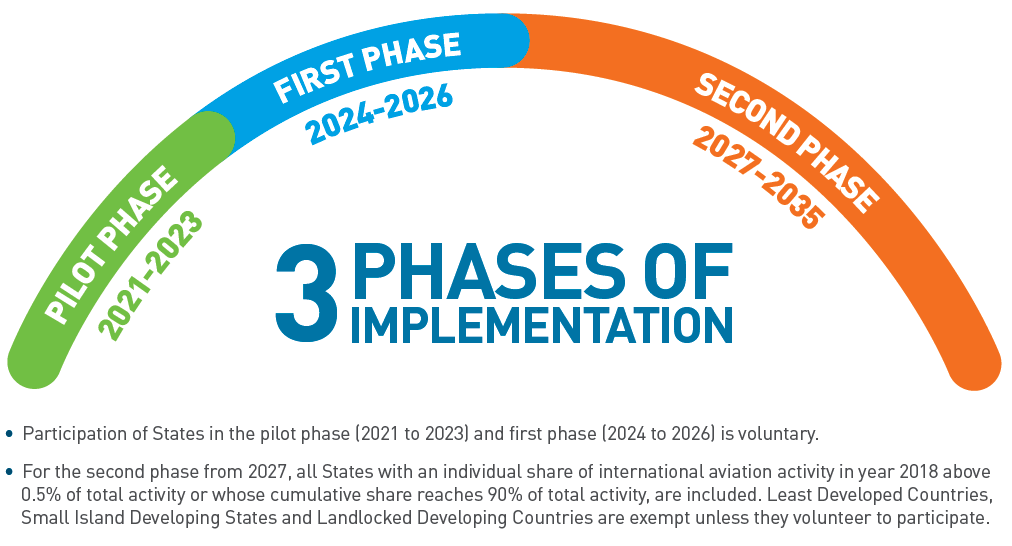 |
table-row | 10 | |||||||||||||||||||||||||||||||||||||
| 2.3 | What is the difference between the pilot phase (from 2021 through 2023) and the first phase (from 2024 through 2026)? |
The requirements for the two phases are identical except for how the aeroplane operator’s offsetting requirements are determined by the State. Specifically:
• For the first phase, the calculation to determine an aeroplane operator’s offsetting requirements is based on the emissions in a given year (i.e. 2024, 2025 and 2026). |
table-row | 11 | |||||||||||||||||||||||||||||||||||||
| 2.4 | Which criteria determine the participation or exemption of States from CORSIA offsetting in its second phase from 2027 to 2035? |
Unlike the voluntary participation of States in the CORSIA offsetting in the pilot and first phases from 2021 to 2026, the second phase of the CORSIA from 2027 to 2035 applies to all Member States. There are, however, two categories of exemptions based on aviation-related and socio-economic criteria. These criteria for the exemption of States from the CORSIA offsetting requirements in the second phase are defined in A41-22 paragraph 9 e).
For aviation-related criteria, there are two thresholds:
|
table-row | 12 | |||||||||||||||||||||||||||||||||||||
| 2.5 | What is a “RTK”? |
Revenue Tonne Kilometers or RTKs is the utilised (or sold) capacity for passengers and cargo expressed in metric tonnes, multiplied by the distance flown. In other words the RTK levels correspond to the volume of air transport activity. As an aeroplane operator carries more passengers and cargo over a longer distance, the RTK levels of the operator increase.
A State’s RTK represents the total RTK levels of all aeroplane operators registered to that State. Annual RTK data is being reported from Member States to ICAO as part of the ICAO Statistics Programme, and published in the Annual Report of the ICAO Council.
RTK data for the year 2018 will be used for the purposes of determining the participation of States in the second phase of the CORSIA (see question 2.4).
|
table-row | 13 | |||||||||||||||||||||||||||||||||||||
| 2.6 | How are RTK shares calculated? |
A State’s individual RTK share is calculated by dividing the State’s RTKs by the total RTKs of all States.
The cumulative RTK share is calculated by sorting the individual RTK shares from the highest to lowest, then successively increasing the value by summing the RTK shares from highest to lowest until the value reaches 90%. The values of all States are considered for this calculation, regardless of whether a State is exempted or not from offsetting requirements under the CORSIA.
|
table-row | 14 | |||||||||||||||||||||||||||||||||||||
| Key design element 2: Route-based approach of CORSIA | none | ||||||||||||||||||||||||||||||||||||||||
| 2.7 | What is the route-based approach of CORSIA? |
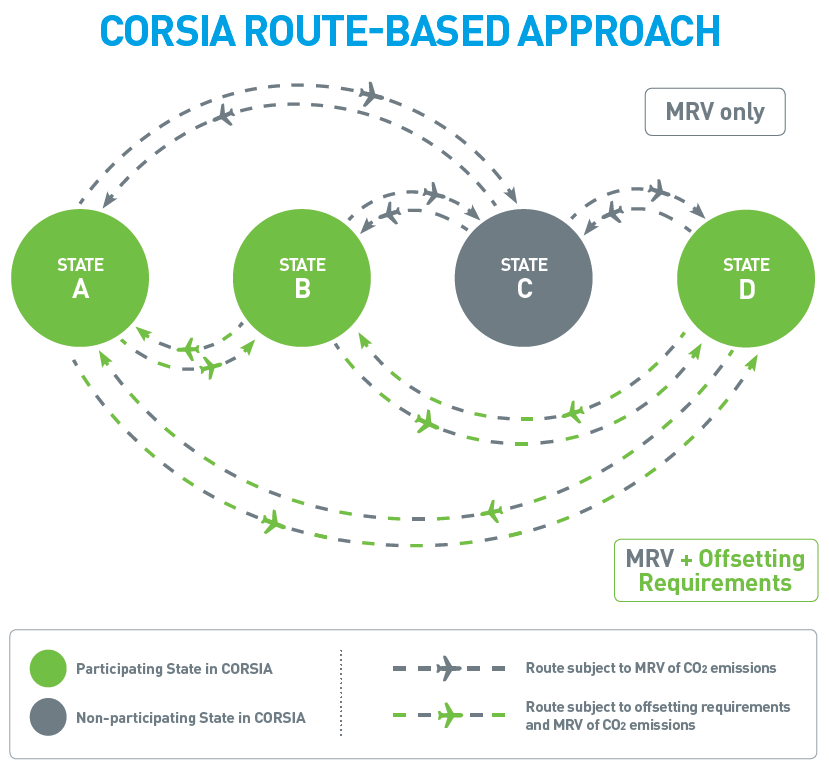
Paragraph 10 of the Assembly Resolution A41-22 defines the coverage of the CORSIA offsetting on the basis of routes between States, with a view to minimizing market distortions between aeroplane operators on the same routes. For this purpose, the approach is to provide equal treatment of all aeroplane operators on a given route. Specifically:
|
table-row | 15 | |||||||||||||||||||||||||||||||||||||
| 2.8 | What does “participation of States to CORSIA offsetting” mean for the route-based approach? |
The term “participation of States to CORSIA offsetting” means that if a State participates in CORSIA offsetting, then all routes between this State and all other States participating in CORSIA offsetting are covered by offsetting requirements.
Please see questions 2.2 and 2.4 for details on how the participation to CORSIA offsetting is being determined in different phases.
|
table-row | 16 | |||||||||||||||||||||||||||||||||||||
| 2.9 | Can the characterisation of a route as “covered” or “not covered” by the CORSIA offsetting change over time? |
Paragraph 10 of the Assembly Resolution A41-22 determines the characterisation of a route as “covered” or “not covered” by the CORSIA offsetting requirements, on the basis of whether the States connecting the route participate in CORSIA offsetting.
The voluntary participation of States in different phases of the CORSIA will determine the overall coverage of the scheme.
To give certainty on the routes to be covered by the CORSIA offsetting requirements every year, the Assembly Resolution A41-22 sets a deadline by 30 June of the preceding year for States to notify ICAO of their intention to voluntarily participate in the scheme, or discontinue their participation, from 1 January of the following year.
|
table-row | 17 | |||||||||||||||||||||||||||||||||||||
| 2.10 | Do States and aeroplane operators that do not participate in the CORSIA offsetting have any requirements under CORSIA? |
The CORSIA MRV requirements are applicable to all aeroplane operators that produce annual CO₂ emissions greater than 10 000 tonnes from the use of aeroplane(s) with a maximum certificated take-off mass greater than 5 700 kg conducting international flights. The requirement to monitor, report and verify CO₂ emissions from international aviation is thus independent from the generation of offsetting requirements, and applies to the said aeroplane operators from 1 January 2019.
From the start of CORSIA's pilot phase on 1 January 2021, all international flights between two States not participating in CORSIA for offsetting purposes are exempted from the offsetting requirements of CORSIA, while retaining simplified reporting requirements. The same applies to international flights between a State participating in CORSIA for offsetting purposes and another State not participating in CORSIA for offsetting purposes (Assembly Resolution A41-22, paragraph 10).
|
table-row | 18 | |||||||||||||||||||||||||||||||||||||
| 2.11 | Can an aeroplane operator have offsetting requirements, even if its State of registration does not participate in CORSIA offsetting? |
Yes. Because of the CORSIA’s route-based approach, an operator operating on routes between participating States would be subject to the offsetting requirements under the CORSIA, no matter whether its State of registration participates in CORSIA offsetting or not.
|
table-row | 140 | |||||||||||||||||||||||||||||||||||||
| 2.12 | What would happen to the CORSIA emissions coverage if an operator of a non-participating State flies on the routes between participating States (e.g. fifth-freedom traffic right)? |
Because of the CORSIA’s route-based approach, these routes between participating States would be subject to the coverage of emissions offsetting requirements under the CORSIA. Thus, an operator of a non-participating State would be subject to offsetting requirements if it had a flight between two participating States, and emissions from such flights would be added to the coverage of CORSIA’s offsetting requirements.
|
table-row | 19 | |||||||||||||||||||||||||||||||||||||
| 2.13 | What would happen to the CORSIA emissions coverage if a State without an operator undertaking international flights decides to participate in the CORSIA offsetting? |
States without an operator flying international flights are encouraged to participate in all phases of the CORSIA. If such a State decides to participate, international flights to and from that State to other participating States are additionally included for the CORSIA’s offsetting requirements, due to the route-based approach. The total international emissions covered by CORSIA offsetting would ultimately increase.
|
table-row | 20 | |||||||||||||||||||||||||||||||||||||
| Key design element 3: CORSIA offsetting requirements and eligible emissions units | none | ||||||||||||||||||||||||||||||||||||||||
| 2.14 | What is offsetting and how does it work, in general? |
In general, offsetting is done through the purchase and cancellation of emissions units (see question 4.24), arising from different sources of emissions reductions achieved through mechanisms, programmes or projects. The buying and selling of eligible emissions units happens through the carbon market. The price of the emissions units in the carbon market is influenced by the law of supply (availability of emissions units) and demand (level of offsetting requirements).
“Cancelling” means the permanent removal and single use of an emissions unit so that the same emissions unit cannot be used more than once. This is done after an aeroplane operator has purchased emissions units from the carbon market. For CORSIA, an aeroplane operator is required to meet its offsetting requirements by cancelling CORSIA Eligible Emissions Units in a quantity equal to its total final offsetting requirements for a given compliance period. CORSIA Eligible Emissions Units are to be determined by the ICAO Council, and up-to-date information on eligible units is made available on the ICAO CORSIA website (see question 4.25). |
table-row | 21 | |||||||||||||||||||||||||||||||||||||
| 2.15 | How are an aeroplane operator’s offsetting requirements calculated? |
Paragraph 11 of the Assembly Resolution A41-22 addresses the distribution of the total amount of CO₂ emissions to be offset in a given year among individual aeroplane operators. This is accomplished by introducing a dynamic approach for the distribution of offsetting requirements, which takes into account:
The figure below describes the calculation of an aeroplane operator's offsetting requirements.
 |
table-row | 22 | |||||||||||||||||||||||||||||||||||||
| 2.16 | What are CORSIA’s compliance periods? |
Paragraph 15 of the Assembly Resolution A41-22 determines that CORSIA has three-years compliance cycles (also referred to as a compliance period), for which the operators need to reconcile their offsetting requirements. The compliance periods are:
It should be noted that an operator will report its CO₂ emissions on an annual basis, corresponding to calendar years. See question 3.71 for more information on the relationship between CORSIA’s compliance periods and reporting periods. |
table-row | 23 | |||||||||||||||||||||||||||||||||||||
| 2.17 | What are CORSIA’s baseline emissions? |
The ICAO Assembly, having considered the recommendations from the Council arising from the 2022 CORSIA periodic review (see question 2.29), adopted Resolution A41-22, which establishes adjustments to the definition of the CORSIA baseline as follows (Assembly Resolution A41-22, paragraph 11 b)):
|
table-row | 24 | |||||||||||||||||||||||||||||||||||||
| 2.18 | What is the difference between the Sector’s Growth Factor used by the formula under CORSIA and the generally-used term “emissions growth rate”? |
In general, the term “emissions growth rate” refers to the percentage increase in the amount of emissions from the baseline to a given year from 2021, compared to the baseline emissions.
For the purposes of CORSIA, the Sector’s Growth Factor is defined as the percentage increase in the amount of emissions from the baseline to a given year from 2021, compared to the emissions in that given year. |
table-row | 25 | |||||||||||||||||||||||||||||||||||||
| 2.19 | How are CORSIA Eligible Fuels accounted for in the calculation of offsetting requirements? |
From 2021 onwards, operators can reduce their CORSIA offsetting requirements by claiming emissions reductions from CORSIA Eligible Fuels. In order to do this, the operator will:
|
table-row | 26 | |||||||||||||||||||||||||||||||||||||
| 2.20 | Can an aeroplane operator address its offsetting requirements accrued in CORSIA both through CORSIA Eligible Emissions Units and CORSIA Eligible Fuels? |
Yes. For a given compliance period, the operator has the capacity to reduce its total final offsetting requirements by claiming emissions reductions from CORSIA Eligible Fuels (see question 2.19). By doing so, the operator could in principle reduce its total final offsetting requirements to zero, provided that emissions reductions claims are large enough to counter-balance the offsetting requirements accrued in the given compliance period.
If the operator's total final offsetting requirements for a given compliance period have not been reduced to zero through the claiming of emissions reductions from CORSIA Eligible Fuels (either because the operator chooses not to report such claims, or because the reported emissions reductions claims are not large enough), the operator will need to cancel CORSIA Eligible Emissions Units in a quantity equivalent to the value of the total final offsetting requirements for that compliance period (see question 2.14).
Therefore, CORSIA provides operators with two distinct ways of addressing its offsetting requirements in CORSIA. The operator's choice of strategy (use of CORSIA Eligible Fuels; use of CORSIA Eligible Emissions Units; or a combination of both) will be determined on the basis of a variety of factors, including cost considerations related to both CORSIA Eligible Fuels and CORSIA Eligible Emissions Units.
|
table-row | 234 | |||||||||||||||||||||||||||||||||||||
| 2.21 | Can an aeroplane operator’s CO₂ offsetting requirements be negative? |
Compliance periods for offsetting requirements are every 3 years, with the first period starting on 1 January 2021 and ending on 31 December 2023 (see also question 2.16).
If, as a result of the calculation described in questions 2.15 and 2.19, an aeroplane operator’s total final offsetting requirements during a compliance period are negative (e.g., the verified emissions reductions claimed by an operator from the use of CORSIA Eligible Fuels are more than its offsetting requirements), the operator has no offsetting requirements for the compliance period.
Negative offsetting requirements will not be carried forward to a subsequent three-year compliance period. However, if an operator’s offsetting requirements in a given year within a compliance period are negative, the operator reduces its total final offsetting requirement for the three-year compliance period.
|
table-row | 27 | |||||||||||||||||||||||||||||||||||||
| 2.22 | Will an aeroplane operator, which reduces its emissions compared to the baseline, have any offsetting requirements? |
If an operator’s emissions do not increase or decrease compared to the baseline emissions, there will still be offsetting requirements for the operator, as long as the global emissions covered by CORSIA increase above the global baseline emissions (i.e. the Sector’s Growth Factor is positive).
Potential efforts of such an operator to renew its fleet and improve its operational efficiency will not be ignored, as the calculation of CORSIA offsetting requirements for the operator will be done by multiplying the Sector’s Growth Factor with the operator’s emissions covered by CORSIA offsetting requirements in a given year. Such efforts are reflected in the operator’s level of emissions, and offsetting requirements would be smaller than using the operator’s emissions without fleet renewal or operational improvements in the calculation. Therefore, the CORSIA maintains incentives for individual operators to make efforts to improve their fuel efficiency.
The incentive for individual aeroplane operators to reduce their emissions is further strengthened starting from 2033, when an individual aeroplane operator’s Growth Factor will be added to the offsetting requirements calculation formula. The individual Growth Factor represents an individual operator’s Growth Factor of emissions in a given year, and the weight of this factor in the formula of calculating the offsetting requirements has been set to 15 per cent for the years 2033-2035, following the adjustments made by the 41st Session of the ICAO Assembly to the CORSIA design elements, in line with the recommendations by the Council arising from the 2022 CORSIA periodic review. Please see question 2.15 for more information.
|
table-row | 28 | |||||||||||||||||||||||||||||||||||||
| Key design element 4: Exemptions and new entrants | none | ||||||||||||||||||||||||||||||||||||||||
| 2.23 | Does the CORSIA include provisions to exempt very low international aviation activities? |
Paragraph 13 of the Assembly Resolution A41-22 provides the following exemptions from the CORSIA offsetting requirements for the purposes of avoiding an administrative burden from the application of CORSIA due to low levels of international aviation activities:
|
table-row | 29 | |||||||||||||||||||||||||||||||||||||
| 2.24 | How will the CORSIA apply to new operators that will initiate activities after the entry into force of the scheme (a so-called “new entrant”)? |
Paragraph 12 of the Assembly Resolution A41-22 refers to “new entrants” as aeroplane operators that commence an aviation activity falling within the scope of the CORSIA. This paragraph outlines criteria to determine when “new entrants” should start participating in the CORSIA offsetting, with the exemption period being the earliest out of the following two:
In other words, a new entrant is exempted from the application of the CORSIA offsetting requirements for the first 3 years, or until its annual emissions exceed 0.1% of total 2019 emissions from the international aviation sector. The condition that applies earlier will determine when a new entrant’s emissions are subject to the offsetting requirements.
It is important to note that the CO₂ emissions of a new entrant are still to be reported from the year after the new entrant falls under the applicability of CORSIA MRV requirements (also see question 3.19), regardless of the exemptions from the CORSIA offsetting requirements.
In the example below, operators A and B start operations in year 2022 as shown in the table. According to the Assembly Resolution A41-22, operator A will have offsetting requirements starting in 2025, and operator B in 2024. However, both operators will need to comply with the MRV requirements from 2023 onwards, assuming that they are within the CORSIA MRV applicability.

1 The ICAO Assembly, having considered the recommendations from the Council arising from the 2022 CORSIA periodic review (see question 2.28), adopted Resolution A41-22, in which 2019 replaces 2020 for the definition of the new entrant threshold (Assembly Resolution A41-22, paragraph 12).
|
table-row | 32 | |||||||||||||||||||||||||||||||||||||
| 2.25 | Will a new entrant operator affect the CORSIA baseline? |
In line with the amendments to the CORSIA design elements agreed upon by the ICAO Assembly through adoption of Resolution A41-22, only CO₂ emissions corresponding to year 2019 are relevant for the purpose of defining CORSIA's baseline (see question 2.17 for more details on CORSIA's baseline).
The CO₂ emissions of a new entrant are to be reported from the year after the CORSIA MRV system begins to apply to the operator (see question 2.24). This means that the soonest that a new entrant could fall within the applicability of CORSIA MRV requirements would be in 2020. Therefore, any new entrant will not affect the CORSIA baseline, as the new entrant's CO₂ emissions in year 2019 would not be monitored and reported under CORSIA. CAEP work is ongoing to produce recommendations for how to determine individual baseline emissions for new entrant aeroplane operators. |
table-row | 33 | |||||||||||||||||||||||||||||||||||||
| 2.26 | If an aeroplane operator, which (in the past) had domestic operations only, establishes international routes, will it be considered a new entrant? |
According to the guidance provided in the Environmental Technical Manual, Volume IV, for an aeroplane operator to qualify as a new entrant, both the following conditions should be met:
This could be interpreted in a way that an aeroplane operator does not actually need to be a newly created entity. Indeed, the entity can exist since many years without having operated any or a sufficient (in terms of CO₂ emissions on international routes) number of international flights. This would be the case for instance of a well-established aeroplane operator flying only domestic routes and then starting to operate on international routes. |
table-row | 30 | |||||||||||||||||||||||||||||||||||||
| Key design element 5: Review process | none | ||||||||||||||||||||||||||||||||||||||||
| 2.27 | Does the CORSIA include provisions to review its implementation and to make adjustments if needed? |
Paragraph 9 g) of the Assembly Resolution A41-22 includes a provision that the ICAO Council will conduct a review of the implementation of the CORSIA every three years, starting in 2022. This review will include an assessment of the impact of the CORSIA on the growth of international aviation. The results of this assessment will serve as an important basis for the Council to consider adjustments and make recommendations to the Assembly for decisions about the next implementation phase or compliance period, as appropriate.
In addition, as elaborated in paragraph 17 of the Assembly Resolution A41-22 - the purpose of the periodic review is to contribute to the sustainable development of the international aviation sector and to the effectiveness of the scheme. The review will assess, inter alia: the progress towards achieving ICAO’s global aspirational goal, the scheme’s market and cost impact on States and aeroplane operators and on international aviation, and the functioning of the scheme’s design elements. The review will also involve consideration of the scheme’s improvements that would support the purpose of the Paris Agreement or simply result in better design. The Assembly requested the Council to develop a methodology and timeline to conduct such reviews in the future.
A special review will be performed by the end of 2032 regarding the termination of the scheme, its extension or any other post-2035 improvements. The sequence of the phases of the CORSIA, compliance periods, periodic reviews, special review and ICAO Assemblies is summarized in the figure below.  |
table-row | 34 | |||||||||||||||||||||||||||||||||||||
| 2.28 | What was the methodology followed to undertake the 2022 CORSIA periodic review? |
In March 2021, the ICAO Council agreed on the process and Terms of Reference for the 2022 CORSIA periodic review, including a series of requests to CAEP for providing inputs and analyses to support the Council's subsequent work on this topic.
In accordance with the agreed process for the 2022 CORSIA periodic review, a State letter consultation process also took place to collect input from States on their experiences regarding CORSIA implementation (State letter ENV 6/6 –21/33, issued on 7 May 2021). These States' inputs were considered by the Council in the context of its work on the 2022 CORSIA periodic review.
The various inputs provided by CAEP throughout the 2022 CORSIA periodic review were made publicly available in the ICAO CORSIA webpage upon Council's consideration.
|
table-row | 31 | |||||||||||||||||||||||||||||||||||||
| 2.29 | What was the outcome of the 2022 CORSIA periodic review? |
The Council, at its 226th Session in August 2022, finalized its work on the 2022 CORSIA periodic review with the consideration of the requested CAEP inputs.
The Council agreed on its recommendations arising from the 2022 CORSIA periodic review, for consideration by the 41st Session of the ICAO Assembly, including the following adjustments to the CORSIA design features:
|
table-row | 231 | |||||||||||||||||||||||||||||||||||||
| 2.30 | What will be the methodology applied for future CORSIA periodic reviews? |
The 41st Session of the ICAO Assembly requested the Council to develop a methodology and timeline to conduct future CORSIA periodic reviews (paragraph 17 of Assembly Resolution A41-22). The outcome of Council’s work on this matter will be applied at the 2025 CORSIA periodic review and at subsequent reviews.
|
table-row | 232 | |||||||||||||||||||||||||||||||||||||
| 3. | Questions about Annex 16, Volume IV - CORSIA | none | 35 | ||||||||||||||||||||||||||||||||||||||
| General questions related to Annex 16, Volume IV | none | ||||||||||||||||||||||||||||||||||||||||
| 3.1 | What are the differences between: Annex 16, Volume IV; Environmental Technical Manual, Volume IV; and CORSIA Implementation Elements? |
Annex 16, Volume IV and Environmental Technical Manual (ETM), Volume IV follow a similar structure to that of the Annex 16, Volumes I, II and III. This is the traditional ICAO Standards and Recommended Practices (SARPs) approach, where the implementation of the SARPs is supported by guidance material.
The SARPs of Annex 16, Volume IV provide the necessary actions by States or operators (the “what” and “when”) to implement CORSIA, whereas the Environmental Technical Manual (ETM), Volume IV provides the guidance on the process (the “how”) to implement CORSIA.
Due to CORSIA’s specific characteristics, CORSIA Implementation Elements have been developed. The Implementation Elements are reflected in 14 ICAO documents, which are directly referenced in the SARPs and contain essential information for the implementation of CORSIA. These ICAO documents are made available on the ICAO CORSIA website, once approved by the ICAO Council, and may only be amended by the ICAO Council.
The table below provides information on the linkages each of the ICAO CORSIA Implementation Elements and the corresponding ICAO documents. Please refer to section 4 of these FAQs for more information on CORSIA Implementation Elements and corresponding ICAO documents.
|
table-row | 36 | |||||||||||||||||||||||||||||||||||||
| 3.2 | What ICAO process was followed to develop Annex 16, Volume IV? |
Following the adoption of Assembly Resolution A39-3, the ICAO Council in November 2016 endorsed the overall plan of CORSIA preparatory activities on the development of CORSIA-related SARPs and guidance. The Council also established an Advisory Group on CORSIA (AGC) to serve as an advisory body to the Council. CAEP was tasked to develop recommendations for CORSIA-related SARPs and guidance.
Following CAEP’s recommendation, preliminary reviews by the AGC and ICAO’s Air Navigation Commission (ANC), consultation with Member States, and the final reviews by AGC and ANC, the CORSIA-related SARPs were adopted by the Council on 27 June 2018 in the form of the first edition of Annex 16 - Environmental Protection to the Convention on International Civil Aviation, Volume IV — Carbon Offsetting and Reduction Scheme for International Aviation (CORSIA). The first edition of Annex 16, Volume IV became applicable on 1 January 2019.
The Council, at its 228th Session (13 – 31 March 2023), adopted Amendment 1 to Annex 16, Volume IV, resulting from proposed amendments by CAEP and from the outcome of the 2022 CORSIA periodic review, and having undertaken preliminary and final reviews by ANC and consultation with Member States. The resulting second edition of Annex 16, Volume IV became applicable on 1 January 2024.
|
table-row | 37 | |||||||||||||||||||||||||||||||||||||
| Administrative aspects | none | ||||||||||||||||||||||||||||||||||||||||
| 3.3 | What is the definition of international flight for CORSIA purposes? |
Reference in Annex 16, Volume IV: Part II, Chapter 1, 1.1.2.
For the purposes of CORSIA, an international flight is defined as the operation of an aircraft from take-off at an aerodrome of a State or its territories, and landing at an aerodrome of another State or its territories.
|
table-row | 38 | |||||||||||||||||||||||||||||||||||||
| 3.4 | What guidance should be followed to determine whether a flight is international or domestic? |
Reference in Annex 16, Volume IV: Part II, Chapter 2, 2.1.2.
For the purposes of CORSIA, an international flight is defined as the operation of an aircraft from take-off at an aerodrome of a State or its territories, and landing at an aerodrome of another State or its territories (see also question 3.3).
When considering whether a flight is international or domestic for the purposes of CORSIA, an aeroplane operator and a State should use Doc 7910 — Location Indicators, which contains a list of aerodromes and the State they are attributed to.
|
table-row | 141 | |||||||||||||||||||||||||||||||||||||
| 3.5 | Does CORSIA apply to international flights to/from non-ICAO States? |
Reference: Environmental Technical Manual, Volume IV, Chapter 2, 2.1.1
CORSIA is implemented through Annex 16, Volume IV to the Convention on International Civil Aviation (Chicago Convention), which applies to Contracting States of the Convention. Flights taking off from or landing at an aerodrome of a State, or one of its territories, which is not an ICAO Member State are not considered to fall within the applicability scope of Annex 16, Volume IV.
|
table-row | 142 | |||||||||||||||||||||||||||||||||||||
| 3.6 | What is the definition of an "aeroplane" in CORSIA? How does this definition differ from the definition of an “aircraft”? |
Reference in Annex 16, Volume IV: Part I, Chapter 1, Definitions.
The following definition of “an aeroplane” is included in the Annex 16, Volume IV: Aeroplane. A power-driven heavier-than-air aircraft, deriving its lift in flight chiefly from aerodynamic reactions on surfaces which remain fixed under given conditions of flight.
Regarding the difference between the definitions of an aircraft and an aeroplane, Annex 2 to the Convention on International Civil Aviation offers the following definition for “an aircraft”:
Aircraft. Any machine that can derive support in the atmosphere from the reactions of the air other than the reactions of the air against the earth’s surface.
Under CORSIA, only aeroplane operators will have compliance requirements (see also question 3.26).
|
table-row | 143 | |||||||||||||||||||||||||||||||||||||
| 3.7 | What is the definition of “an aerodrome” in CORSIA? |
Reference in Annex 16, Volume IV: Part I, Chapter 1, Definitions.
Annex 16, Volume IV offers the following definition for “an aerodrome”: Aerodrome. A defined area on land or water (including any buildings, installations and equipment) intended to be used either wholly or in part for the arrival, departure and surface movement of aircraft.
|
table-row | 144 | |||||||||||||||||||||||||||||||||||||
| 3.8 | How are diverted flights handled in CORSIA? |
Reference in Annex 16, Volume IV: Part II, Chapter 2, 2.1.
Diversion of flights can lead to any of the following scenarios:
a) A flight originally subject to MRV requirements, which continues to be subject to such requirements as a result of the diversion; b) A flight originally not subject to MRV requirements, which continues not to be subject to such requirements as a result of the diversion; c) A flight originally subject to MRV requirements, which is no longer subject to such requirements as a result of the diversion; or d) A flight originally not subject to MRV requirements, which is no longer subject to such requirements as a result of the diversion.
Under CORSIA, in any of the scenarios listed above, the actual aerodromes of departure and arrival for a flight, rather than the scheduled ones, will be taken as a reference to determine whether or not that flight is subject to MRV requirements. See also question 3.31.
|
table-row | 39 | |||||||||||||||||||||||||||||||||||||
| 3.9 | What does a “State pair” mean? Is it uni- or bidirectional? |
Reference in Annex 16, Volume IV: Part I, Chapter 1 – Definitions.
In CORSIA, State pair is being defined as a group of two States composed of a departing State or its territories and an arrival State or its territories. For example, when reporting CO₂ emissions from international flights between States A and B, an aeroplane operator will report both directions as separate State pairs (A-B and B-A).
|
table-row | 40 | |||||||||||||||||||||||||||||||||||||
| 3.10 | Who will ensure that aeroplane operators comply with the requirements of Annex 16, Volume IV? |
Reference in Annex 16, Volume IV: Part II, Chapter 1, 1.3.1.
According to Assembly Resolution A41-22, paragraph 19 f), ICAO Member States will take necessary action to ensure that the national policies and regulatory framework be established for the compliance and enforcement of CORSIA.
As per Annex 16, Volume IV, an aeroplane operator will be attributed to a State for administering CORSIA based on the rules for attribution (see question 3.12). The State is primarily responsible for ensuring that the aeroplane operator complies with the CORSIA requirements.
|
table-row | 41 | |||||||||||||||||||||||||||||||||||||
| 3.11 | How is an international flight being attributed to a single aeroplane operator? |
Reference in Annex 16, Volume IV: Part II, Chapter 1, 1.1.3.
It is important to identify all applicable international flights so that the CO₂ emissions from these flights are monitored and reported. Also, each international flight should be allocated to a single aeroplane operator. In order to achieve this, the following information will be used for attributing international flights to an aeroplane operator:
|
table-row | 42 | |||||||||||||||||||||||||||||||||||||
| 3.12 | How is an aeroplane operator being attributed to a single State? |
Reference in Annex 16, Volume IV: Part II, Chapter 1, 1.2.
Under CORSIA, each aeroplane operator will report its CO₂ emissions to a single State. The rules for attributing an aeroplane operator to a State are based on:
The State is required to ensure the correct attribution of an aeroplane operator to it. In order to determine which aeroplane operators fall under its administration, the State should take the following steps: review operators' possible communications indicating that are likely to be administered by the State, review the contents of Doc 8585 — Designators for Aircraft Operating Agencies, Aeronautical Authorities and Services, and identify those operators that are notified by the State, review AOCs issued by that State, and review of registered entities within that particular State (e.g., from the State's company register).
It should be noted that the "place of juridical registration" refers to the State in which the entity (company or person) is legally registered. The purpose is to have jurisdictional clarity in cases of enforcement, such as international court measures. The place of juridical registration may differ from the principal place of business.
Regarding the use of the expression "AOC (or equivalent)", the wording "or equivalent" is used because in some States the AOC is named differently. The "AOC" refers to an official document issued by a State that gives an aeroplane operator license to operate and that contains the identification of the aircraft operator and may also contain aircraft registration marks. The use of general aviation operating certificates and other certificates permitting non-commercial air transport could thus be appropriate as long as these certificates are issued/approved by a State.
After identifying the aeroplane operators under its administration, the State is required to submit to ICAO information of those aeroplane operators that are attributed to it, and ICAO will publish a list of aeroplane operators and the States attributions on the ICAO CORSIA website, as a part of the ICAO document entitled "CORSIA Central Registry (CCR): Information and Data for Transparency".
|
table-row | 43 | |||||||||||||||||||||||||||||||||||||
| 3.13 | Can an aeroplane operator delegate its administrative requirements? |
Reference in Annex 16, Volume IV: Part II, Chapter 1, 1.1.5.
Yes, an aeroplane operator can delegate its CORSIA administrative requirements to a third party. However, this third party cannot be the same entity as the verification body. Also, liability for compliance with the CORSIA requirements will remain with the aeroplane operator.
|
table-row | 44 | |||||||||||||||||||||||||||||||||||||
| 3.14 | Can an aeroplane operator report together with one or more of its subsidiaries? |
Reference in Annex 16, Volume IV: Part II, Chapter 1, 1.2.6.
An aeroplane operator can report together with a subsidiary company, if the subsidiary is:
If two aeroplane operators are treated as a single consolidated aeroplane operator, the two operators will be administered as a single entity, and their emissions aggregated. Therefore, the applicability of the requirements of Annex 16, Volume IV will be based on their aggregated emissions.
|
table-row | 45 | |||||||||||||||||||||||||||||||||||||
| 3.15 | Who is responsible for reporting emissions from flights operated with leased aeroplanes? |
Reference in Annex 16, Volume IV: Part II, Chapter 1, 1.1.2.
According to Annex 16, Volume IV, the attribution of international flights to an operator is based on the Flight Plan, Item 7, which means that the operating entity (i.e. in a case of wet-lease arrangement, the lessee) is responsible for the international flights (under the lessee’s ICAO Designator) and therefore responsible for compliance of the international flights attributed to the lessee.
In addition, the State of the lessee is responsible for administrative tasks related to lessee, for example approval of the lessee’s Emissions Monitoring Plan and Emissions Report.
|
table-row | 145 | |||||||||||||||||||||||||||||||||||||
| 3.16 | Can a State delegate its administration processes under the CORSIA to another State? |
Reference in Annex 16, Volume IV: Part II, Chapter 1, 1.3.2.
Yes, a State may delegate administration processes of CORSIA to another State through an administrative partnership based on a bilateral agreement between the respective States. Nevertheless, the State shall not delegate enforcement of CORSIA requirements, or its administrative tasks towards ICAO, to another State.
If such an arrangement is agreed upon, the State receiving capacity support must ensure that aeroplane operators attributed to that State are advised of the administrative arrangements.
|
table-row | 46 | |||||||||||||||||||||||||||||||||||||
| 3.17 | How long does a State and an aeroplane operator need to keep CORSIA-related records? What is included in those records? |
Reference in Annex 16, Volume IV: Part II, Chapter 1, 1.4, and Appendix 4.
An aeroplane operator is required to keep records relevant to demonstrating compliance with the requirements of Chapters 2, 3, and 4 of Annex 16, Volume IV, Part II, for a period of 10 years. It is also recommended that an aeroplane operator keep records relevant to its CO₂ emissions per State pair during the 2019-2020 period in order to allow the operator to cross-check its offsetting requirements calculated by the State during the 2030-2035 compliance periods.
An operator is required to include a documentation and record keeping plan in its Emissions Monitoring Plan for the approval by the State. This plan will specify how (e.g., by using an IT system), and where the operator will store CORSIA-relevant information.
The State shall keep records relevant to the aeroplane operator's CO₂ emissions per State pair during the period of 2019-2020 in order to calculate the aeroplane operator's offsetting requirements during the 2030-2035 compliance periods.
|
table-row | 47 | |||||||||||||||||||||||||||||||||||||
| Monitoring, reporting and verification (MRV) | none | ||||||||||||||||||||||||||||||||||||||||
| 3.18 | What are the components of the CORSIA MRV system? |
Reference in Annex 16, Volume IV: Part II, Chapter 2.
CORSIA’s MRV (Monitoring, Reporting and Verification) system consists of three components:
|
table-row | 48 | |||||||||||||||||||||||||||||||||||||
| 3.19 | What is the applicability of the CORSIA MRV requirements? Are they any exemptions? |
Reference in Annex 16, Volume IV: Part II, Chapter 2, 2.1.
All aeroplane operators conducting international flights are required to monitor, report and verify CO₂ emissions from these flights from 1 January 2019 until 31 December 2035. It should be noted that the requirement for the MRV of CO₂ emissions is independent from participation in CORSIA offsetting.
As per Annex 16, Volume IV, the MRV requirements do not apply to:
|
table-row | 49 | |||||||||||||||||||||||||||||||||||||
| 3.20 | In view of the decisions made by the ICAO Council in order to safeguard against inappropriate economic burden on aeroplane operators due to the COVID-19 pandemic, did aeroplane operators have to undertake the monitoring, reporting and verification of CO₂ emissions from international flights operated in 2020? |
The decisions made by the Council at its 220th Session did not bring a change to the provisions of Annex 16, Volume IV or to the then-applicable Assembly Resolution A40-19.
Consequently, the monitoring, reporting and verification of CO₂ emissions from international flights operated in 2020 had to be undertaken as per the requirements in Annex 16, Volume IV.
|
table-row | 50 | |||||||||||||||||||||||||||||||||||||
| 3.21 | Can an aeroplane operator with emissions of less than 10 000 tonnes of CO₂ per year be included in CORSIA? |
Reference in Annex 16, Volume IV: Part II, Chapter 1, 1.2.6, Chapter 2, 2.1.
An aeroplane operator that produces annual CO₂ emissions from international flights less than or equal to 10 000 tonnes is not subject to the requirements of Annex 16, Volume IV (see also question 3.19).
However, if an aeroplane operator below the threshold of 10 000 tonnes of CO₂ is wholly-owned by and legally registered in the same State as another aeroplane operator, the two aeroplane operators can request to be treated as a single operator (see question 3.14). In this case the combined emissions of both aeroplane operators could exceed this threshold and become subject to the applicability of the MRV requirements of CORSIA.
|
table-row | 132 | |||||||||||||||||||||||||||||||||||||
| 3.22 | What are the actions for an aeroplane operator, who has been covered by CORSIA, but now drops below the 10 000 tonnes of CO₂ threshold? |
Reference in Annex 16, Volume IV: Part II, Chapter 2, 2.1.
If an aeroplane operator falls below the 10 000 tonnes threshold in a given year, then it falls outside the scope of applicability of Annex 16, Volume IV and would not have any requirements in that year. In such an instance, it is suggested the aeroplane operator contact its State of attribution to inform them that they are below the threshold. The State may choose to engage with the operator to confirm that the aeroplane operator is out of the scope of applicability.
|
table-row | 147 | |||||||||||||||||||||||||||||||||||||
| 3.23 | How to address aeroplane operators with annual CO₂ emissions close to the 10 000 tonnes threshold? |
Reference in Annex 16, Volume IV: Part II, Chapter 2, 2.1.
If an aeroplane operator is close to the 10 000 tonnes threshold of annual CO₂ emissions, it should consider engaging with the State for guidance. Likewise, the State should carry out oversight of the aeroplane operators attributed to it, and engage with any that it considers may be close to or above the threshold. The aeroplane operator with annual CO₂ emissions below the threshold may also choose to voluntarily engage with the State to which it is attributed (e.g. to declare that the operator’s emissions are below the threshold).
|
table-row | 51 | |||||||||||||||||||||||||||||||||||||
| 3.24 | Are aeroplane manufacturers or airports subject to any requirements under Annex 16, Volume IV? |
No, aeroplane manufacturers and airports do not have requirements under Annex 16, Volume IV, unless those entities operate international flights themselves, and thus become aeroplane operators as defined in Annex 16, Volume IV.
|
table-row | 52 | |||||||||||||||||||||||||||||||||||||
| 3.25 | Is a re-positioning flight before or after an exempted humanitarian, medical or firefighting flight exempt? |
Reference in Annex 16, Volume IV: Part II, Chapter 2, 2.1.
Yes. Flights preceding or following humanitarian, medical or firefighting flights are also exempt if they were required to accomplish the humanitarian, medical or firefighting activities or to reposition the aeroplane thereafter. The operator will have to be able to provide evidence of the nature of the flight. See also question 3.19. |
table-row | 53 | |||||||||||||||||||||||||||||||||||||
| 3.26 | Are helicopter operations covered by the CORSIA MRV system? |
Reference in Annex 16, Volume IV: Part II, Chapter 2, 2.1.
No. The applicability of the CORSIA MRV requirements covers aeroplanes, and helicopter operations are outside of the scope of applicability of CORSIA. See also question 3.6. |
table-row | 54 | |||||||||||||||||||||||||||||||||||||
| 3.27 | Are international flights by police, military, customs or State aircraft within the scope of applicability of the CORSIA MRV system? |
Reference in Annex 16, Volume IV: Part II, Chapter 2, 2.1.
No, Annex 16, Volume IV only applies to international civil aviation; international flights from police, military, customs and State aircraft are excluded from the Chicago Convention as per Article 3, and thus are excluded from the scope of CORSIA. |
table-row | 148 | |||||||||||||||||||||||||||||||||||||
| 3.28 | How can humanitarian, medical, firefighting, police, military, customs and State aircraft flights be identified? |
Reference: Environmental Technical Manual, Volume IV, Chapter 2, 2.1.4.
An aeroplane operator should provide evidence to the State to which it has been attributed to prove that an operation was a humanitarian, medical, firefighting, military or State aeroplane flight. Information included in Item 8 (flight rules and type of flight) of the flight plan can be used to demonstrate the nature of a flight, and the ETM, Volume IV provides examples of specific marks that can be included in the Flight Plan in this regard, as per Doc 4444 — Procedures for Air Navigation Services — Air Traffic Management. It should be noted that a State might have in place specific procedures and practices to demonstrate humanitarian, medical, firefighting, police, military, customs and State aircraft flights. The decision to interpret whether a flight is under the applicability of Annex 16, Volume IV is on the State Authority. Procedures for identifying international flights that are exempted from CORSIA’s applicability should be provided within the Emissions Monitoring Plan approved by the State Authority. |
table-row | 149 | |||||||||||||||||||||||||||||||||||||
| 3.29 | Are Search and Rescue (SAR) flights exempted from CORSIA? |
Reference in Annex 16, Volume IV: Part II, Chapter 2, 2.2.5.
|
table-row | 133 | |||||||||||||||||||||||||||||||||||||
| 3.30 | Are repatriation flights operated under specific situations (e.g. COVID-19 pandemic) identified as humanitarian flights in the context of CORSIA implementation? |
The Standards and Recommended Practices in Annex 16, Volume IV do not address the question of defining humanitarian, medical and firefighting flights, but rather the treatment to which these types of flights are subject under CORSIA, as reflected in Annex 16, Volume IV, Part II, Chapter 2, 2.1.1 and 2.1.3.
On the matter of identifying humanitarian, medical and firefighting flights, the following has to be noted:
Therefore, it corresponds to the aeroplane operator to identify a given flight as humanitarian, medical or firefighting, and to provide evidence to the State to prove that such qualification is correct, in line with the established provisions relating to flight plans. If the State considers that such qualification is correct, then the provisions of Annex 16, Volume IV related to humanitarian, medical and firefighting flights will apply.
|
table-row | 55 | |||||||||||||||||||||||||||||||||||||
| 3.31 | How are diversions handled in CORSIA? |
Reference in Annex 16, Volume IV: Part II, Chapter 1, 1.1.2; Chapter 2, 2.1; Chapter 2, 2.2.1.3.3.
A flight should be considered to be diverted when it makes an unplanned landing at an aerodrome different from the destination aerodrome indicated by the aeroplane operator in the last approved flight plan filed prior to the flight departure.
A diverted flight and the subsequent flight are to be treated as two consecutive and separate flights operating, respectively, to and from the aerodrome the diverted flight actually landed at, rather than that which was originally planned.
A diversion is by its nature unplanned. However, according to the rules of CORSIA, whether a flight is international, or subject to offsetting requirements, is based on where it actually went, not where it meant to go.
If in a given year an aeroplane operator is subject to the CORSIA offsetting requirements only because of diverted or subsequent flights (all other flights being operated on routes not subject to offsetting), the aeroplane operator will still be required to offset the emissions of those flights.
Should an aeroplane operator that is approved to use the ICAO CORSIA CERT exceed in a given year the threshold of 50 000 tonnes of CO₂ on the routes subject to offsetting requirements due to diverted or subsequent flights, then the operator will still be permitted to use the ICAO CORSIA CERT in that year and the following year (year y+1). However, if the operator also exceeds the 50 000 tonnes threshold in that following year (year y+1), then it would be required to submit a new Emissions Monitoring Plan by 30th September in (Year y+2) and begin using a Fuel Use Monitoring Method from 1st January in Year y+3.
|
table-row | 56 | |||||||||||||||||||||||||||||||||||||
| Emissions Monitoring Plan | none | ||||||||||||||||||||||||||||||||||||||||
| 3.32 | What is an Emissions Monitoring Plan and why is it needed? |
Reference in Annex 16, Volume IV: Part II, Chapter 2, 2.2.2 and Appendix 4.
An aeroplane operator falling under the applicability of CORSIA MRV requirements is required to submit an Emissions Monitoring Plan to the State Authority for approval. An Emissions Monitoring Plan is a collaborative tool between the State and the aeroplane operator that identifies the most appropriate means and methods for CO₂ emissions monitoring on an operator-specific basis, and also facilitates the reporting of required information to the State. During the development and approval process of the Emissions Monitoring Plan, the State Authority and aeroplane operator should maintain clear and open communication. Working collaboratively for CORSIA preparation and implementation reduces potential errors and increases effectiveness of the CO₂ emissions monitoring. |
table-row | 57 | |||||||||||||||||||||||||||||||||||||
| 3.33 | What are the contents of an Emissions Monitoring Plan? |
Reference in Annex 16, Volume IV: Part II, Chapter 2, 2.2.2 and Appendix 4.
|
table-row | 58 | |||||||||||||||||||||||||||||||||||||
| 3.34 | Is there a standardised template for an Emissions Monitoring Plan? |
A template for an Emissions Monitoring Plan is provided in the Environmental Technical Manual (Doc 9501), Volume IV – Procedures for demonstrating compliance with the Carbon Offsetting and Reduction Scheme for International Aviation (CORSIA).
The template is also available on the ICAO CORSIA webpage. |
table-row | 59 | |||||||||||||||||||||||||||||||||||||
| 3.35 | When should an aeroplane operator submit an Emissions Monitoring Plan to the State? |
Reference in Annex 16, Volume IV: Part II, Chapter 2, 2.2.2 and Appendix 1.
In line with the provisions in Annex 16, Volume IV, aeroplane operators that fell within the scope of applicability of MRV requirements at the time when these became applicable (i.e. 1 January 2019) were required to submit their Emissions Monitoring Plan to their State for approval by 28 February 2019. A new entrant aeroplane operator shall submit an Emissions Monitoring Plan to the State to which it is attributed within three months of falling within the scope of applicability of MRV requirements.
An aeroplane operator that falls within the scope of applicability of MRV requirements after 1 January 2021 for the first time without qualifying as a new entrant shall submit an Emissions Monitoring Plan within three months of falling within the scope of applicability.
|
table-row | 60 | |||||||||||||||||||||||||||||||||||||
| 3.36 | When will the Emissions Monitoring Plan be approved by the State? |
Reference in Annex 16, Volume IV: Part II, Chapter 2, 2.2.2 and Appendix 1.
After receiving the Emissions Monitoring Plan from the aeroplane operator, the State Authority will review the plan. If the plan meets the requirements of Annex 16, Volume IV, then the State Authority will approve the Emissions Monitoring Plan. Guidance for the review and approval of an Emissions Monitoring Plan is included in the Environmental Technical Manual (Doc 9501), Volume IV – Procedures for demonstrating compliance with the Carbon Offsetting and Reduction Scheme for International Aviation (CORSIA).
|
table-row | 61 | |||||||||||||||||||||||||||||||||||||
| 3.37 | Does the third-party verification body need to review the Emission Monitoring Plan prior to its review and approval by the State? |
Reference in Annex 16, Volume IV: Part I, Chapter 2, 2.2.2.
No. An Emissions Monitoring Plan is a tool to facilitate CORSIA-related communication between an aeroplane operator and a State Authority, and it does not need to be verified by a third-party verification body. A verification body is required to conduct the verification of an Emissions Report that the aeroplane operator develops in accordance with the approved Emissions Monitoring Plan. |
table-row | 62 | |||||||||||||||||||||||||||||||||||||
| 3.38 | Does the Emissions Monitoring Plan have to be submitted annually? |
Reference in Annex 16, Volume IV: Part II, Chapter 2, 2.2.2.
No. The Emissions Monitoring Plan has to be submitted only once unless there are material changes to the operator’s procedures in which case the operator will have to re-submit the Emissions Monitoring Plan to the State Authority for approval. |
table-row | 63 | |||||||||||||||||||||||||||||||||||||
| 3.39 | What happens if there are changes to the information contained in an Emissions Monitoring Plan? |
Reference in Annex 16, Volume IV: Part II, Chapter 2, 2.2.2.
In general, an Emissions Monitoring Plan should reflect the current status of an aeroplane operator’s operations. An operator is required to resubmit the Plan for review and approval by the State if a “material change” is made to the information contained within the Plan. Examples of a material change include:
The aeroplane operator is also required to inform the State of changes that would affect the State’s oversight. This applies even if the changes do not fall within the definition of a material change. Examples of such changes include a change in corporate name or address, or a change in the contact information for a person responsible for the operator’s Emissions Monitoring Plan.
Guidance on identifying material changes to an Emissions Monitoring Plan is provided in the Environmental Technical Manual (Doc 9501), Volume IV – Procedures for demonstrating compliance with the Carbon Offsetting and Reduction Scheme for International Aviation (CORSIA).
|
table-row | 150 | |||||||||||||||||||||||||||||||||||||
| 3.40 | How should non-material changes to an Emissions Monitoring Plan be communicated to the State? |
Reference in Annex 16, Volume IV: Part II, Chapter 2, 2.2.2.
An aeroplane operator is required to inform the State of changes that would affect the State’s oversight, including changes that do not fall within the definition of a material change (see question 3.39). As per Annex 16, Volume IV, the operator shall include as a part of its Emissions Monitoring Plan the procedures for providing notice in the Emissions Report of non-material changes that require the attention of the State. Guidance on identifying material and non-material changes to an Emissions Monitoring Plan is provided in the Environmental Technical Manual (Doc 9501), Volume IV – Procedures for demonstrating compliance with the Carbon Offsetting and Reduction Scheme for International Aviation (CORSIA). |
table-row | 64 | |||||||||||||||||||||||||||||||||||||
| Monitoring | none | ||||||||||||||||||||||||||||||||||||||||
| 3.41 | How does an aeroplane operator monitor its fuel use and CO₂ emissions? |
Reference in Annex 16, Volume IV: Part II, Chapter 2, 2.2.2. Appendix 2, and Appendix 3.
Under CORSIA, there are two possible ways of monitoring the CO₂ emissions: either by tracking the fuel use by applying one of the five Fuel Use Monitoring Methods and then calculating CO₂ emissions from the fuel use, or by using the ICAO CORSIA CO₂ Estimation and Reporting Tool (CERT). Aeroplane operator’s level of activity (see below for the activity thresholds) will determine whether the operator is eligible to use the ICAO CORSIA CERT, or it is required to apply a Fuel Use Monitoring Method. An aeroplane operator will select an appropriate method and include the selection in its Emissions Monitoring Plan, for submission to the State for approval.
An aeroplane operator with annual CO₂ emissions from international flights of less than 500 000 tonnes during the period of 2019-2020 can use the ICAO CORSIA CERT for estimating and reporting its CO₂ emissions under CORSIA (see question 3.43 for more information about the ICAO CORSIA CERT).
An aeroplane operator with annual CO₂ emissions from international flights of more than or equal to 500 000 tonnes during the period of 2019-2020 is required to choose one of the five eligible “Fuel Use Monitoring Methods”. The five Eligible Fuel Use Methods are described more in details in Annex 16, Volume IV, Appendix 2 (see also question 3.46).
For the period of 2021-2035, the eligibility threshold for the use of the ICAO CORSIA CERT changes. For this period, an aeroplane operator can use ICAO CORSIA CERT to estimate and report its annual CO₂ emissions, if the operator’s emissions from international flights subject to offsetting requirements are less than 50 000 tonnes. Also, an operator can still use the ICAO CORSIA CERT to estimate and report those CO₂ emissions from international flights not covered by offsetting requirements.
|
table-row | 151 | |||||||||||||||||||||||||||||||||||||
| 3.42 | Who approves the monitoring method for an aeroplane operator? |
Reference in Annex 16, Volume IV: Part II, Chapter 2, 2.2.1.
An aeroplane operator shall monitor and record its fuel use from international flights in accordance with an eligible monitoring method, and as approved by the State to which it is attributed. It is the responsibility of the State to approve an appropriate monitoring method for an operator, as a part of the approval of the operator’s Emissions Monitoring Plan. |
table-row | 152 | |||||||||||||||||||||||||||||||||||||
| 3.43 | Who are eligible to use the ICAO CORSIA CO₂ Estimation and Reporting Tool (CERT)? |
Reference in Annex 16, Volume IV: Part II, Chapter 2, 2.2.2, and Appendix 3.
Assembly Resolution A39-3 requested the development of simplified MRV procedures as a part of the CORSIA MRV system. ICAO CORSIA CERT is a simplified tool that is designed to help aeroplane operators to estimate and report their international aviation emissions. All aeroplane operators can use the ICAO CORSIA CERT for a preliminary CO₂ assessment to support the determination of an appropriate eligible method for the monitoring of the CO₂ emissions. Eligible aeroplane operators can use ICAO CORSIA CERT for estimating and reporting of their annual CO₂ emissions (see question 3.41 for the eligibility criteria for using the ICAO CORSIA CERT). |
table-row | 66 | |||||||||||||||||||||||||||||||||||||
| 3.44 | Where can one access the ICAO CORSIA CERT? |
ICAO CORSIA CERT is available free of charge on the ICAO CORSIA webpage.
|
table-row | 153 | |||||||||||||||||||||||||||||||||||||
| 3.45 | Where can one find more information about ICAO CORSIA CERT? |
The ICAO CORSIA webpage contains detailed information on the ICAO CORSIA CERT, namely: a document containing technical details on the development and use of the ICAO CORSIA CERT; a Frequently Asked Questions document; and a tutorial.
Please also refer to section 4 of these FAQs for more information on ICAO CORSIA CERT. |
table-row | 67 | |||||||||||||||||||||||||||||||||||||
| 3.46 | What are the five eligible Fuel Use Monitoring Methods? Are they different from ICAO CORSIA CERT? |
Reference in Annex 16, Volume IV: Part II, Chapter 2, 2.2.2, and Appendix 2.
Not all aeroplane operators are eligible to use the ICAO CORSIA CERT for estimating and reporting their annual CO₂ emissions (see question 3.41). Operators which are ineligible to use the ICAO CORSIA CERT shall select and use one of the five eligible Fuel Use Monitoring Methods.
The five methods are entitled as “Method A”; “Method B”; “Block-off / Block-on”; “Fuel Uplift”; and “Fuel Allocation with Block Hour”, and are described in details in Annex 16, Volume IV, Appendix 2, as well as in the Environmental Technical Manual (Doc 9501), Volume IV - Procedures for demonstrating compliance with the Carbon Offsetting and Reduction Scheme for International Aviation (CORSIA). These five methods represent the most accurate established practices and are equivalent (i.e. there is no hierarchy for selecting one method). Providing five methods allows for flexibility for the operator to choose a method that best fits its existing fuel use tracking procedures.
The differences in results between the five Fuel Use Monitoring Methods are not significant, in particular over a full reporting period. A comparison of the methods performed by CAEP experts demonstrated that there are no major differences between the results of the methods for the purpose of CORSIA. An aeroplane operator can use a different Fuel Use Monitoring Method for different aeroplane types included in its fleet.
The aeroplane operator is required to specify in its Emissions Monitoring Plan which method it will apply to which aeroplane type. Aeroplane types are included in Doc 8643 — Aircraft Type Designators (https://www.icao.int/publications/DOC8643/Pages/Search.aspx).
It should be noted that if the aeroplane operator wants to change its monitoring method, this change must be reflected in the Emissions Monitoring Plan, and approved by the State Authority before the operator can start applying the new monitoring method (also see question 3.39).
The difference between a Fuel Use Monitoring Method and the ICAO CORSIA CERT is that a Fuel Use Monitoring Method tracks the quantity of fuel for each flight, whereas the ICAO CORSIA CERT is an emissions estimation tool to calculate CO₂ emissions based on the aeroplane type and aerodromes of origin and destination.
|
table-row | 68 | |||||||||||||||||||||||||||||||||||||
| 3.47 | Is it necessary to describe all five Fuel Use Monitoring Methods in the Emissions Monitoring Plan, even if not all are used? |
No, an operator needs to describe only those methods that it will use for the fuel use monitoring; there’s no need to describe all five methods in the Emissions Monitoring Plan (also see question 3.46).
|
table-row | 69 | |||||||||||||||||||||||||||||||||||||
| 3.48 | Is it possible to use a Fuel Use Monitoring Method for reporting that is different to the method(s) described in the approved Emissions Monitoring Plan? |
.Reference in Annex 16, Volume IV: Part II, Chapter 2, 2.2.2.
An Emissions Monitoring Plan should reflect the current status of an aeroplane operator’s operations, including the current monitoring method. If there is a change to the monitoring method, this would constitute a “material change” to the Emissions Monitoring Plan, and the operator would be required to resubmit the Plan for review and approval by the State (also see question 3.46). |
table-row | 70 | |||||||||||||||||||||||||||||||||||||
| 3.49 | Can an aeroplane operator change its Fuel Use Monitoring Method? |
Reference in Annex 16, Volume IV: Part II, Chapter 2, 2.2.1.1.
Yes. An aeroplane operator can change its fuel monitoring method. However, an operator must use the same eligible monitoring method for the entire compliance period.
If an operator changes a monitoring method, this constitutes a material change to the Emissions Monitoring Plan, and the operator will need to submit a revised Emissions Monitoring Plan to the State for approval (also see question 3.46).
|
table-row | 81 | |||||||||||||||||||||||||||||||||||||
| 3.50 | What are the circumstances in which an aeroplane operator may change monitoring methods within a compliance period? |
Reference in Annex 16, Volume IV: Part II, Chapter 2, 2.2.1.1, 2.2.1.3.
According to Annex 16, Volume IV, Part II, Chapter 2, paragraph 2.2.1.1, “the aeroplane operator shall use the same eligible monitoring method for the entire compliance period”. This is intended to be generally applied for consistency and data quality purposes, and to avoid the errors and inconsistencies which may arise from and aeroplane operator changing monitoring methods within a compliance cycle.
One exception to the stipulations in paragraph 2.2.1.1 is the situation specified in paragraphs 2.2.1.3.3 and 2.2.1.3.4, whereby an aeroplane operator crosses above, or falls below, the threshold of 50 000 tonnes of annual CO₂ emissions from international flights subject to offsetting requirements in two consecutive years. This threshold determines the aeroplane operator’s eligibility to use the ICAO CORSIA CO₂ Estimation and Reporting Tool (CERT). In this case an aeroplane operator that is above the 50 000 tonnes threshold for two consecutive years shall change to a Fuel Use Monitoring Method on 1 January of year (y+3). An aeroplane operator that is below the 50 000-tonne threshold for two consecutive years may change monitoring method on 1 January of year (y+3), including use of the ICAO CORSIA CERT. |
table-row | 235 | |||||||||||||||||||||||||||||||||||||
| 3.51 | Can an aeroplane operator use several different Fuel Use Monitoring Methods? |
Reference in Annex 16, Volume IV: Part II, Chapter 2, 2.2.1.3, and Appendix 4.
An aeroplane operator can use different Fuel Use Monitoring Methods for different aeroplane types included in the operator’s fleet. If different methods are to be used for different aeroplane types, then the operator shall specify in its Emissions Monitoring Plan which method applies to which aeroplane type. Approving appropriate monitoring method(s) for an operator is the responsibility of the State, as a part of the approval of the operator’s Emissions Monitoring Plan. Also, during the period of 2021 – 2035, an aeroplane operator is entitled to use either a Fuel Use Monitoring Method or the ICAO CORSIA CERT for international flights not subject to offsetting requirements. This might lead into a situation where the operator is using a Fuel Use Monitoring Method for international flights subject to offsetting requirements, and ICAO CORSIA CERT for international flights not subject to offsetting requirements (also see questions 3.41 and 3.46). |
table-row | 71 | |||||||||||||||||||||||||||||||||||||
| 3.52 | Can an operator with annual CO₂ emissions from international flights subject to offsetting requirements of less than 50 000 tonnes use the CERT for emissions subject to offsetting requirements but use a Fuel Use Monitoring Method for emissions not subject to offsetting? |
Reference in Annex 16, Volume IV: Part II, Chapter 2, 2.2.1.3.
Annex 16, Volume IV, Part II, Chapter 2, 2.2.1.3.1 gives aeroplane operators the option of using either a Fuel Use Monitoring Method, or the ICAO CORSIA CO₂ Estimation and Reporting Tool (CERT) for international flights (as defined in Annex 16, Volume IV, Part II, 1.1.2 and 2.1) not subject to offsetting requirements (as defined in Annex 16, Volume IV, Part II, 3.1). According to Annex 16, Volume IV, Part II, Chapter 2, 2.2.1.3.2 “The aeroplane operator, with annual CO₂ emissions from international flights subject to offsetting requirements, as defined in 1.1.2 and 3.1, of less than 50 000 tonnes, shall use either a Fuel Use Monitoring Method or the ICAO CORSIA CO₂ Estimation and Reporting Tool (CERT) as described in Appendices 2 and 3 respectively.” The intention of these stipulations was to enable aeroplane operators with annual CO₂ emissions from international flights subject to offsetting requirements of less than 50 000 tonnes to use a Fuel Use Monitoring Method or the CERT for emissions subject to offsetting requirements and to use the CERT for emissions not subject to offsetting requirements for efficiency and simplicity. It also allows aeroplane operators in this category the possibility to apply the same monitoring method to flights with and without offsetting requirements According to these provisions it is implicitly possible for an aeroplane operator with annual CO₂ emissions from international flights subject to offsetting requirements of less than 50 000 tonnes to use the CERT for calculating and reporting these emissions, and to use a Fuel Use Monitoring Method for determining emissions not subject to offsetting, although this is not explicitly stated in Annex 16, Volume IV or in the ETM, Volume IV. However, as situations may arise whereby the combination of methods proposed by the aeroplane operator is not optimal from a reporting and verification perspective, the aeroplane operator should contact the State and engage in dialogue as part of the Emissions Monitoring Plan approval or reapproval process to reach a suitable solution acceptable to both. |
table-row | 236 | |||||||||||||||||||||||||||||||||||||
| 3.53 | How should an aeroplane operator complete its Emissions Monitoring Plan when using the ICAO CORSIA CERT on emissions subject to offsetting requirements and a Fuel Use Monitoring Method on emissions not subject to offsetting requirements? |
While aeroplane operators with annual CO₂ emissions subject to offsetting requirements of less than 50 000 tonnes per annum may use the ICAO CORSIA CERT or a Fuel Use Monitoring Method to monitor their emissions, they are not prohibited from using one eligible monitoring method for flights subject to offsetting requirements and a different eligible monitoring method for flights not subject to offsetting requirements, though this is likely to be more complex in most cases.
For an aeroplane operator with annual CO₂ emissions subject to offsetting requirements of less than 50 000 tonnes per annum that chooses to use the ICAO CORSIA CERT on emissions subject to offsetting requirements and a Fuel Use Monitoring Method on emissions not subject to offsetting requirements, the Emissions Monitoring Plan template (ETM, Volume IV, Appendix 1.1) should be completed as follows:
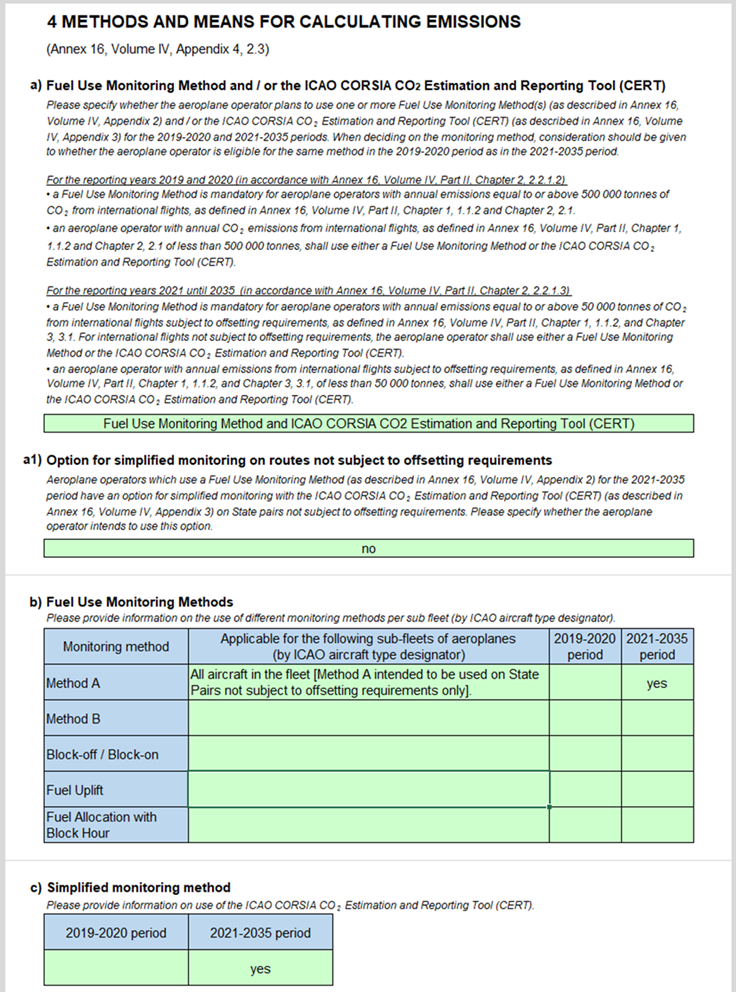 |
table-row | 237 | |||||||||||||||||||||||||||||||||||||
| 3.54 | How is “Block-off” and “Block-on” defined in Fuel Use Monitoring Method “Block-off / Block-on”? |
Reference in Annex 16, Volume IV: Appendix 2, 2.4.
Block-off: any time between last door closed and first engine on. Any deviation to this definition should be in accordance with the aeroplane operator’s existing operational practices as defined in the Emissions Monitoring Plan. The aeroplane operator shall state in its Emissions Monitoring Plan the points at which block-off measurements will be taken, with a reference to the relevant aeroplane operator documentation, to be approved by the State Authority. Block-on: any time between last engine out and first door open. Any deviation to this definition should be in accordance with the aeroplane operator’s existing operational practices as defined in the Emissions Monitoring Plan. The aeroplane operator shall state in its Emissions Monitoring Plan the points at which block-on measurements will be taken, with a reference to the relevant aeroplane operator documentation, to be approved by the State Authority. |
table-row | 72 | |||||||||||||||||||||||||||||||||||||
| 3.55 | What are the data requirements for the Fuel Use Monitoring Method “Fuel Allocation with Block Hour”? |
Reference in Annex 16, Volume IV: Appendix 2, 2.6.
Fuel Use Monitoring Method “Fuel Allocation with Block Hour” requires data from all flights of each aeroplane type for the reporting year. This method requires data on block hour of the flight under consideration (BH) and data from other flights of the same aircraft type (ICAO aircraft type designator level) in the same year.
There are two ways to implement the method:
The average fuel burn ratios (AFBR) are computed for each aeroplane operator and aeroplane type used. The computation of average fuel burn ratios is done using the formula in Annex 16, Volume IV, Appendix 2, 2.6.1; the computation of fuel use for individual flights is defined in Annex 16, Volume IV, Appendix 2, 2.6.1 and 2.6.2.
An illustrative calculation is provided in the Environmental Technical Manual (Doc 9501), Volume IV – Procedures for demonstrating compliance with the Carbon Offsetting and Reduction Scheme for International Aviation (CORSIA), Table 3-7 for the Fuel Allocation with Block Hour Method. The assumed average fuel burn (AFBR) in the illustration is 7 270 tonnes/h.
|
table-row | 134 | |||||||||||||||||||||||||||||||||||||
| 3.56 | How should missing data under the Fuel Use Monitoring Method “Fuel Allocation with Block Hour” be handled? |
Reference in Annex 16, Volume IV: Part II, 2.5.1; Appendix 2, 2.6.
The fuel allocation with block hour method requires the collection of block time and fuel uplift data to calculate the average fuel burn ratio in a given year for a given aeroplane type. In the case where no primary and secondary data sources are available to determine the block time and/or fuel uplift for one or more flights (i.e. there are data gaps), the aeroplane operator will use the ICAO CORSIA CERT to estimate and report CO₂ emissions for each flight with data gaps. For all remaining flights (i.e., excluding flights with data gaps), the aeroplane operator will apply the fuel allocation with block hour for the respective aeroplane(s) in accordance with Annex 16, Volume IV, Appendix 2, section 2.6. The average fuel burn ratio should be computed without consideration of the flights for which a data gap occurred. The average fuel burn ratio is not to be applied on flights with data gaps. |
table-row | 73 | |||||||||||||||||||||||||||||||||||||
| 3.57 | What will happen if an aeroplane operator exceeds the eligibility threshold to use ICAO CORSIA CERT during a given year? |
Reference in Annex 16, Volume IV: Part II, Chapter 2, 2.2.1.3.
If the emissions of an aeroplane operator increase above the 500 000 tonnes threshold during the 2019 – 2020 period, the State may authorise it to continue using the ICAO CORSIA CERT. From 2021 onwards, if an operator’s annual CO₂ emissions from international flights increase above the 50 000 tonnes threshold in a given year (y) and stay above the threshold in the following year (y+1), the operator will have to submit a revised Emissions Monitoring Plan by 30 September of the subsequent year (y + 2) and start monitoring actual fuel use thereafter (from 1 January of year y+3).
|
table-row | 74 | |||||||||||||||||||||||||||||||||||||
| 3.58 | How is fuel use treated while performing non-commercial activities (e.g., APU fuel use during maintenance)? |
Reference in Annex 16, Volume IV: Appendix 2.
Sometimes an aeroplane does not perform a flight previous or subsequent to the flight for which fuel consumption is being monitored; this could happen, e.g., if the flight under consideration follows a major revision or maintenance. As a result of this, some of the fuel measurement points needed for the application of a certain Fuel Use Monitoring Method might not be available. In such cases the aeroplane operator may substitute the missing fuel measurement point with an alternative fuel measurement point for the flight under consideration, e.g., as recorded in the technical logs. |
table-row | 75 | |||||||||||||||||||||||||||||||||||||
| 3.59 | How are CO₂ emissions calculated from the fuel used? |
Reference in Annex 16, Volume IV: Part II, Chapter 2, 2.2.3.
After an aeroplane has monitored its fuel use, the operator is required to determine the CO₂ emissions by using the following equation:
Fuel conversion factors are:
After conducting an analysis on the matter, these fuel conversion factors were agreed by the CAEP as the appropriate factor to be used at a global level. The analysis took into consideration the work of the IPCC, information from petroleum quality surveys, information from national GHG inventories, other emissions trading schemes, worldwide and regional values for the CO₂ fuel conversion factor, as well as methods that are based on measuring hydrogen and sulphur contents to calculate carbon content.
If an aeroplane operator is using the ICAO CORSIA CERT for CO₂ emissions monitoring, the tool automatically estimates the CO₂ emissions, and no separate calculation of emissions is needed.
|
table-row | 76 | |||||||||||||||||||||||||||||||||||||
| 3.60 | Why do we need to know total CO₂ emissions from international aviation? |
Knowing the total emissions from international aviation is important for several reasons:
1 The ICAO Assembly, having considered the recommendations from the Council arising from the 2022 CORSIA periodic review (see question 2.29), adopted Resolution A41-22, in which 2019 replaces 2020 for the definition of the new entrant threshold (Assembly Resolution A41-22, paragraph 12).
|
table-row | 77 | |||||||||||||||||||||||||||||||||||||
| 3.61 | What are the requirements for fuel density? |
Reference in Annex 16, Volume IV: Part II, Chapter 2, 2.2.3.
If fuel quantities are measured in units of volume instead of units of mass, then an aeroplane operator is required to convert the fuel volume into fuel mass by applying a fuel density value that is used for operational and safety reasons. For CORSIA purposes, the operator shall either use an actual density value, or a standard density value (0.8 kg/litre). The operator shall detail the procedure for using actual or standard density in its Emissions Monitoring Plan.
|
table-row | 78 | |||||||||||||||||||||||||||||||||||||
| 3.62 | What is the standard fuel density? |
Reference in Annex 16, Volume IV: Part II, Chapter 2, 2.2.3.
A standard density value of 0.8 kg per litre is being used under CORSIA. |
table-row | 79 | |||||||||||||||||||||||||||||||||||||
| 3.63 | How to account for the use of CORSIA Eligible Fuels in the CORSIA MRV system? |
Reference in Annex 16, Volume IV: Part II, Chapter 2, 2.2.4.
Claims of emissions reductions from the use of CORSIA Eligible Fuels by an aeroplane operator are based on mass of CORSIA Eligible Fuels according to purchasing and blending records. For the purposes of the CORSIA MRV system, an aeroplane operator, that intends to claim for emissions reductions from the use of CORSIA Eligible Fuels, shall use a CORSIA Eligible Fuel that meets the CORSIA Sustainability Criteria. Also, only CORSIA Eligible Fuels from fuel producers that are certified by an approved Sustainability Certification Scheme are allowed under CORSIA. Such certification schemes need to meet specific requirements developed by ICAO. The emissions reductions from the use of a CORSIA Eligible Fuel are calculated in the context of reducing the operator’s CO₂ offsetting requirements (see also question 2.19). These calculations use the approved life cycle emissions values for the CORSIA Eligible Fuels. All the relevant documentation on CORSIA Eligible Fuels is available on the ICAO CORSIA website (also see questions 4.11 to 4.23). |
table-row | 83 | |||||||||||||||||||||||||||||||||||||
| Reporting | none | ||||||||||||||||||||||||||||||||||||||||
| 3.64 | What is the timeline for reporting of CO₂ emissions, and who will report to whom? |
Reference in Annex 16, Volume IV: Part II, Chapter 2, 2.3. and Appendix 1.
|
table-row | 84 | |||||||||||||||||||||||||||||||||||||
| 3.65 | Do all international routes have to be included in the Emissions Report, or only the international routes with the States that participate in the CORSIA offsetting? |
Reference in Annex 16, Volume IV: Appendix 5.
All international routes need to be included for reporting. Appendix 5 of Annex 16, Volume IV includes the content of an Emissions Report from aeroplane operator to State. From 2021, information to be reported includes the total CO₂ emissions from flights subject to offsetting requirements, and the total CO₂ emissions from international flights, that are not subject to offsetting requirements. |
table-row | 154 | |||||||||||||||||||||||||||||||||||||
| 3.66 | Who decides on the selection of aggregation level for the CO₂ emissions data (State pair or aerodrome pair)? |
.Reference in Annex 16, Volume IV: Part II, Chapter 2, 2.3.1.
According to the Annex 16, Volume IV, the State shall decide on the level of aggregation (i.e., State pair or aerodrome pair) for which an aeroplane operator attributed to it shall report the number of international flights and CO₂ emissions. The State shall inform the operator whether the operator’s annual Emissions Report shall include State pair or aerodrome pair level information during the approval process of the Emissions Monitoring Plan. |
table-row | 85 | |||||||||||||||||||||||||||||||||||||
| 3.67 | What is the level of aggregation of the CO₂ emissions information that will be reported to States, and to ICAO? |
Reference in Annex 16, Volume IV: Part II, Chapter 2, 2.3. and Appendix 5.
|
table-row | 155 | |||||||||||||||||||||||||||||||||||||
| 3.68 | What is the ICAO tool to facilitate reporting of the necessary information from States to ICAO? |
The CORSIA Central Registry (CCR), developed by ICAO, provides a tool for States to submit data and information to ICAO.
|
table-row | 156 | |||||||||||||||||||||||||||||||||||||
| 3.69 | Where can one find more information about the CORSIA Central Registry CCR? |
Please refer to section 4 of these FAQs for more information about the CCR.
|
table-row | 90 | |||||||||||||||||||||||||||||||||||||
| 3.70 | Are there any provisions regarding the confidentiality of data if a route is only operated by one operator? |
Reference in Annex 16, Volume IV: Part II, Chapter 2, 2.3.
When an aeroplane operator operates a very limited number of State pairs that are subject to offsetting requirements, and/or a very limited number of State pairs that are not subject to offsetting requirements, it may request to the State that such data not be published at the aeroplane operator level. The same applies when aggregated State pair data may be attributed to an identified aeroplane operator as a result of a very limited number of aeroplane operators conducting flights between that State pair. Based on the request, the State shall determine whether this data is confidential. All data recognised as confidential by States will be aggregated and published by ICAO without attribution to a specific aeroplane operator, or to a specific State pair. There will be a distinction between State pairs subject to offsetting requirements, and those not subject to offsetting requirements (see also question 4.45). |
table-row | 91 | |||||||||||||||||||||||||||||||||||||
| 3.71 | Are the reporting periods and compliance periods the same for all operators? |
Reference in Annex 16, Volume IV: Appendix 1.
Yes. All aeroplane operators are subject to the same reporting and compliance periods. Reporting periods are annual and correspond to calendar years. Compliance periods for offsetting requirements are 3-year periods, with the first period starting on 1 January 2021 and ending on 31 December 2023. |
table-row | 92 | |||||||||||||||||||||||||||||||||||||
| 3.72 | Is there an established template for reporting annual CO₂ emissions from an aeroplane operator to the State, and from the State to ICAO? |
Reference in Annex 16, Volume IV: Part II, Chapter 2, 2.3.
It is recommended that an aeroplane operator uses the standardised Emissions Report template provided in the Environmental Technical Manual (Doc 9501), Volume IV – Procedures for demonstrating compliance with the Carbon Offsetting and Reduction Scheme for International Aviation (CORSIA). The template is also available on the ICAO CORSIA webpage. Regarding the reporting from a State to ICAO, the CCR provides a standardised format and means to submit the CORSIA specific data from a State to ICAO, and also allows ICAO to consolidate and develop the necessary reports for CORSIA. |
table-row | 93 | |||||||||||||||||||||||||||||||||||||
| 3.73 | What if there are gaps identified in the reported data? |
Reference in Annex 16, Volume IV: Part II, Chapter 2, 2.5.1.
Data gaps may occur as a result of an aeroplane operator missing data that are needed for the determination of its fuel use on one or more international flights. In a case of a data gap, an aeroplane operator is required to correct issues identified with the data and information management system in a timely manner to mitigate ongoing data gaps and system weaknesses. As a part of its Emissions Monitoring Plan, an aeroplane operator has to identify secondary data sources to prevent data gaps. For example, if an aeroplane operator normally uses ACARS data and, due to a problem, is missing this data for a flight, it may still be able to source actual fuel data from fuel invoices or technical logs as the secondary sources. |
table-row | 135 | |||||||||||||||||||||||||||||||||||||
| 3.74 | What constitutes a data gap? How can such data gaps be addressed? |
Reference in Annex 16, Volume IV: Part II, Chapter 2, 2.5.
Data gaps occur when an aeroplane operator is missing data relevant for the determination of its fuel use for one or more international flights. Gaps in emissions-related data can occur due to various reasons, including irregular operations, data feed issues or system failures. For example, a missing Block-off value, a missing fuel invoice, or a missing fuel density measurement, and no secondary source is available. It may, on occasion, include information about the actual flight itself, such as aerodrome of departure or aerodrome of destination incorrectly recorded, or unavailable from, on board system.
When data from a primary source is missing but an agreed secondary source can be used instead, as detailed and approved in the aeroplane operator’s Emissions Monitoring Plan, this is sufficient to provide the information and it is not considered a data gap. The primary data source refers to the electronic or paper process and documentation which are used by default by the operator to record fuel data measurements. A secondary data source is any other process and documentation which can be used by the operator to record fuel data measurements required for the application of the approved fuel monitoring method. The secondary data source must provide a fuel data measurement and cannot be estimated or statistically reconstructed. The measurement must be equivalent to the measurement which would have been obtained through the primary source, and it should not be measured at a materially different point in time. Such secondary sources may include, for example, the technical log or a fuel invoice.
Using a data source from an equivalent point in time as the missing measurement allows the approved monitoring method to be completed so as to achieve the measurement of fuel for the flight in question according to the requirements of that monitoring method. To use a simple example, the secondary data source for block-off / block-on provides a recorded measurement of block-off fuel at an equivalent time to when the regular block-off measurement would be taken and/or it provides a recorded measurement of block-on fuel at an equivalent time to when the regular block-on measurement would be taken. If such a data source is not available, it is not permitted, for example, to use the fuel uplift method instead for that flight but the CO₂ emissions for the flight in question should be estimated with the ICAO CORSIA CERT.
A data gap occurs when approved primary and secondary data are not available (i.e., the data is incomplete to calculate the emissions for the flight) and, as a result, the approved Fuel Use Monitoring Method cannot be applied to determine fuel use. In this case, the emissions for the flight in questions will be estimated using the ICAO CORSIA CERT.
|
table-row | 94 | |||||||||||||||||||||||||||||||||||||
| 3.75 | What is the threshold for using ICAO CORSIA CERT to fill data gaps? |
Reference in Annex 16, Volume IV: Part II, Chapter 2, 2.5.1.
If the data gap does not exceed 5 per cent of international flights for the 2019-2020 period, or 5 per cent of international flights subject to offsetting requirements for the 2021-2035 period, an aeroplane operator using a Fuel Use Monitoring Method is required to fill data gaps by using the ICAO CORSIA CERT. If there are data gaps that exceed a 5 per cent threshold of total international flights, the operator is responsible for stating the percentage of data gaps, and for engaging with the State in order to address the issue. |
table-row | 95 | |||||||||||||||||||||||||||||||||||||
| 3.76 | Is the 5 per cent data gap threshold based on CO₂ emissions or number of flights? |
Reference in Annex 16, Volume IV: Part II, Chapter 2, 2.5.1.
The 5 per cent threshold refers to the number of international flights (and not to the amount of CO₂ emissions). Please also refer to question 3.75 for precise definitions of the data gap thresholds. |
table-row | 96 | |||||||||||||||||||||||||||||||||||||
| 3.77 | Is an alternative estimation approach (instead of using the ICAO CORSIA CERT) possible for addressing data gaps? |
Reference in Annex 16, Volume IV: Part II, Chapter 2, 2.5.1.
If an aeroplane operator has data gaps and system weaknesses that exceed the 5 per cent threshold, the operator shall engage with the State to address the issue. The operator shall also state the percentage of international flights that had data gaps, and provide an explanation to the State in the Emissions Report. The operator is required to fill all data gaps and correct systematic errors and misstatements prior to the submission of the Emissions Report. Alternative data sources, such as air traffic control (ATC) records, flight logs, flight plans, etc., are also possible for addressing data gaps and for estimating CO₂ emissions in such cases, however, Annex 16, Volume IV is clear in that an aeroplane operator using a Fuel Use Monitoring Method, shall fill data gaps using the ICAO CORSIA CERT, provided that the data gaps during a compliance period do not exceed the data gap thresholds (see also question 3.75). |
table-row | 97 | |||||||||||||||||||||||||||||||||||||
| 3.78 | Will CORSIA’s baseline emissions be affected due to an error correction to the Emissions Report? |
Reference in Annex 16, Volume IV: Part II, Chapter 2, 2.6.
Once a State has reported to ICAO, through the CORSIA Central Registry (CCR), information on the annual CO₂ emissions from international flights performed by aeroplane operators attributed to the State, it is possible that the State identifies an error in the reported CO₂ emissions data. Such an error can be identified by the State itself, or be reported to the State by either the relevant aeroplane operator or by the verification body that has undertaken the verification of the operator’s Emissions Report. In such a situation, the State needs to correct the annual CO₂ emissions data affected by the identified error, and update the information reported to ICAO through the CCR. It is important that the State undertakes these actions as soon as practicable once the error has been identified, as the affected CO₂ emissions data will be used for the calculation of CORSIA’s baseline emissions and, from 2021, for the calculation of the annual Sector’s Growth Factor (SGF). If, despite all efforts made by a State to correct an identified error in a timely manner, such correction (and related reporting to ICAO through the CCR) took place after publication of the relevant ICAO documents containing information on the total sectoral CO₂ emissions or the Sector’s Growth Factor calculated on the basis of the corrected data (i.e. ICAO documents “CORSIA 2020 emissions” and “CORSIA Annual Sector’s Growth Factor (SGF)”), no adjustment would be made to the values published in these ICAO documents. |
table-row | 98 | |||||||||||||||||||||||||||||||||||||
| 3.79 | What happens in case of late reporting or no reporting by an aeroplane operator or a State? |
Reference in Annex 16, Volume IV: Part II, Chapter 2, 2.5.2.
If an aeroplane operator does not provide its annual Emissions Report in accordance with the reporting timeline, the State is required to take action and to engage with the aeroplane operator to clarify the situation. If this proves unsuccessful, then the State shall estimate the aeroplane operator’s annual emissions using the best available information and tools, such as the ICAO CORSIA CERT. In a case where the State does not provide its annual Emissions Report to ICAO in accordance with the reporting timeline, then the data provided by ICAO shall be used to fill the missing information and to make relevant calculations. The State is required to take necessary action to ensure that the necessary national policies and regulatory framework be established for the compliance and enforcement of CORSIA (see also question 3.10). |
table-row | 157 | |||||||||||||||||||||||||||||||||||||
| 3.80 | Who reports emissions from an aeroplane operator that has gone bankrupt during a reporting year? |
Reference in Annex 16, Volume IV: Part II, Chapter 2, 2.5.2.
If an aeroplane operator’s CO₂ emissions exceed 10 000 tonnes CO₂ for the year when the bankruptcy takes place, the operator falls within the applicability of CORSIA MRV requirements, and is required to submit an Emissions Report to the State Authority. If the operator fails to submit an Emissions Report in such a situation, and the State is not able to obtain necessary information from the operator, then the State shall estimate the operator’s annual emissions by using the best available information and tools, such as the ICAO CORSIA CERT. |
table-row | 158 | |||||||||||||||||||||||||||||||||||||
| 3.81 | Why does a State need to provide State pair data to ICAO, even if this data has been identified as confidential? |
Reference in Annex 16, Volume IV: Appendix 5.
State-pair level data will define the CORSIA baseline emissions for each State pair, which will be compared against the annual emissions from 2021 onwards from those State pairs that are subject to offsetting requirements, in order for ICAO to calculate the Sector’s Growth Factor (see question 2.15). Any disaggregated data that has been determined as confidential by the State and informed to ICAO accordingly, will not be disclosed to the public by ICAO (also see question 3.70). |
table-row | 99 | |||||||||||||||||||||||||||||||||||||
| 3.82 | How does an aeroplane operator report the use of CORSIA Eligible Fuels? |
Reference in Annex 16, Volume IV: Part II, Chapter 2, 2.3 and Appendix 5.
An aeroplane operator shall report the use of CORSIA Eligible Fuels as a part of its annual Emissions Report. In addition, in order to claim emissions reductions from the use of such fuels, the operator will provide supplementary information to the Emissions Report, which includes the details of the CORSIA Eligible Fuels and associated emissions reductions. A template of a CORSIA Eligible Fuels supplementary information to the Emissions Report is provided in the Environmental Technical Manual (Doc 9501), Volume IV – Procedures for demonstrating compliance with the Carbon Offsetting and Reduction Scheme for International Aviation (CORSIA), and is also available on the ICAO CORSIA website. All the relevant documentation on CORSIA Eligible Fuels is available on the ICAO CORSIA website (also see questions 4.11 to 4.23). |
table-row | 159 | |||||||||||||||||||||||||||||||||||||
| 3.83 | Why should an aeroplane operator report CORSIA Eligible Fuels every year while the compliance cycle is three years? |
Reference in Annex 16, Volume IV: Part II, Chapter 2, 2.3.3.
Annex 16, Volume IV includes a recommendation for an aeroplane operator to make CORSIA Eligible Fuel claims on an annual basis, in order to ensure all documentation is dealt with in a timely manner. However, the aeroplane operator also has the option to make a CORSIA Eligible Fuel claim by the end of a given compliance period for all CORSIA Eligible Fuel received by a blender within that compliance period (also see question 2.19). |
table-row | 100 | |||||||||||||||||||||||||||||||||||||
| 3.84 | What will be the process of reporting of emissions unit cancellations? |
Reference in Annex 16, Volume IV: Part II, Chapter 4, 4.3.
An aeroplane operator is required to report to the State the cancellation of CORSIA Eligible Emissions Units to meet its total final offsetting requirements for a given compliance period. The operator will do this by submitting to the State a copy of the verified Emissions Unit Cancellation Report and a copy of the associated Verification Report. The first deadline for reporting of emissions unit cancellations will be on 30 April 2025. By that time an aeroplane operator and the verification body are required to submit to the State Authority the verified Emissions Unit Cancellation Report and associated Verification Report for the 2021-2023 compliance period (also see question 3.93). The State shall report to ICAO aggregated information on the cancellations of emissions units by the operators attributed to the State. This report shall contain the information as defined in Annex 16, Volume IV, Appendix 5, Table A5-8 (see also question 4.46). It is recommended that an aeroplane operator uses the standarized template for an Emissions Units Cancellation Report from aeroplane operators to States provided in the Environmental Technical Manual (Doc 9501), Volume IV – Procedures for demonstrating compliance with the Carbon Offsetting and Reduction Scheme for International Aviation (CORSIA). The template is also available on the ICAO CORSIA website. |
table-row | 160 | |||||||||||||||||||||||||||||||||||||
| Verification | none | ||||||||||||||||||||||||||||||||||||||||
| 3.85 | How does the verification of CO₂ emissions work in CORSIA? Who will do the verification? |
Reference in Annex 16, Volume IV: Part II, Chapter 2, 2.4. and Appendix 6.
Verification on emissions data intends to ensure the consistency of information, and to identify any potential errors in the aeroplane operator’s annual Emissions Report. CORSIA foresees a three-step verification pathway:
|
table-row | 104 | |||||||||||||||||||||||||||||||||||||
| 3.86 | Is third-party verification a requirement under Annex 16, Volume IV? |
Yes, the third-party verification is a requirement under Annex 16, Volume IV.
Annex 16, Volume IV, Part II, Chapter 2, 2.4.1.1 states: The aeroplane operator shall engage a verification body for the verification of its annual Emissions Report. |
table-row | 105 | |||||||||||||||||||||||||||||||||||||
| 3.87 | Did travel restrictions linked to the COVID-19 pandemic pose an exception to third-party verification requirements in CORSIA? |
Travel restrictions linked to the COVID-19 pandemic did not pose an exception to third-party verification requirements in CORSIA.
The ICAO Council, at its 220th Session (June 2020), encouraged States to make all the efforts to meet the deadline of 31 August 2020 to report on their respective CO₂ emissions data corresponding to year 2019, as per the timeline reflected in Annex 16, Volume IV, Appendix 1, and requested the Secretariat to work flexibly to accommodate late submissions of 2019 data by States, as appropriate.
In doing so, the Council reiterated the importance of the third-party verification requirements in Annex 16, Volume IV, and advocated for more flexibility in the reporting timeline and related deadlines in 2020 (i.e. Appendix 1 of Annex 16, Volume IV) rather than for more flexibility regarding the verification requirements as such (i.e. Annex 16, Volume IV, Part II, Chapter 2, 2.4 and related Appendix 6).
|
table-row | 106 | |||||||||||||||||||||||||||||||||||||
| 3.88 | Is it necessary for an aeroplane operator to perform an internal pre-verification of its Emissions Report, prior to the third-party verification? |
Reference in Annex 16, Volume IV: Part II, Chapter 4, 2.4.1.3.
Voluntary pre-verification is a recommended practice for an aeroplane operator. Pre-verification will provide the operator with an opportunity to identify potential irregularities and take corrective actions prior to third-party verification, thereby having a potential to save time and resources later on in the process. The Environmental Technical Manual (Doc 9501), Volume IV – Procedures for demonstrating compliance with the Carbon Offsetting and Reduction Scheme for International Aviation (CORSIA) provides a recommended checklist approach for the internal pre-verification. |
table-row | 108 | |||||||||||||||||||||||||||||||||||||
| 3.89 | Does the voluntary pre-verification by an aeroplane operator substitute the third-party verification? |
Reference in Annex 16, Volume IV: Part II, Chapter 4, 2.4.1.3.
No. The voluntary pre-verification does not substitute the third-party verification. Voluntary pre-verification is not a requirement, although aeroplane operators are recommended to conduct a pre-verification as a preparatory activity for the third-party verification process (see also question 3.88). |
table-row | 161 | |||||||||||||||||||||||||||||||||||||
| 3.90 | Is a third-party verification needed when an aeroplane operator uses the ICAO CORSIA CERT? |
Reference in Annex 16, Volume IV: Part II, Chapter 4, 2.4.1.
Yes, an aeroplane operator shall engage a third-party verification body for the verification of its annual Emissions Report also when the ICAO CORSIA CERT has been used for generating an Emissions Report (see also question 3.43). |
table-row | 107 | |||||||||||||||||||||||||||||||||||||
| 3.91 | What are the requirements to be accredited as a verification body to conduct the third-party verification? |
Reference in Annex 16, Volume IV: Part II, Chapter 2, 2.4. and Appendix 6.
In order to be eligible to verify the Emissions Report of the aeroplane operator under CORSIA, a verification body must be accredited to ISO/IEC 17029:2019 (Conformity assessment — General principles and requirements for validation and verification bodies), ISO 14065:2020 (General principles and requirements for bodies validating and verifying environmental information), and to the relevant requirements described in Annex 16, Volume IV, Appendix 6.
Once accredited, the verification body is required to conduct the verification according to ISO 14064-3:2019 (Greenhouse gases — Part 3: Specification with guidance for the verification and validation of greenhouse gas statements), and to the relevant requirements in Annex 16, Volume IV, Appendix 6.
|
table-row | 112 | |||||||||||||||||||||||||||||||||||||
| 3.92 | Are the references to ISO standards included in Annex 16, Volume IV linked to specific versions of the standards, or will the latest version of these ISO standards automatically apply? |
The ISO standards referred to in the second edition of Annex 16, Volume IV are:
|
table-row | 113 | |||||||||||||||||||||||||||||||||||||
| 3.93 | What are the requirements for the verification of an Emissions Unit Cancellation Report? |
Reference in Annex 16, Volume IV: Part II, Chapter 4, 4.4 and Appendix 6.
Verification of an Emissions Unit Cancellation Report follows very similar process and requirements as the verification of an annual Emissions Report (see question 3.85). In order to be eligible to verify the Emissions Unit Cancellation Report of the aeroplane operator under CORSIA, a verification body must be accredited to ISO/IEC 17029:2019 (Conformity assessment — General principles and requirements for validation and verification bodies), ISO 14065:2020 (General principles and requirements for bodies validating and verifying environmental information), and to the relevant requirements described in Annex 16, Volume IV, Appendix 6. Accreditations are granted by national accreditation bodies. National accreditation bodies are required to work in accordance with ISO/IEC 17011:2017 (Conformity assessment — Requirements for accreditation bodies accrediting conformity assessment bodies).
Once accredited, the verification body is required to conduct the verification according to ISO 14064-3:2019 (Greenhouse gases — Part 3: Specification with guidance for the verification and validation of greenhouse gas statements), and in accordance with the relevant requirements in Annex 16, Volume IV, Appendix 6.
It should be noted that an aeroplane operator may choose to use the same verification body for the verification of an Emissions Units Cancellation Report as it has engaged for the verification of the Emissions Report, although the operator is not obligated to do so.
Guidance on the verification of the Emissions Units Cancellation Report is included in the Environmental Technical Manual (Doc 9501), Volume IV – Procedures for demonstrating compliance with the Carbon Offsetting and Reduction Scheme for International Aviation (CORSIA).
|
table-row | 109 | |||||||||||||||||||||||||||||||||||||
| 3.94 | How much time is normally required for the third-party verification process? |
The time required for the verification process will vary on a case by case basis. The time required relates to, e.g., the size of the operator and whether simplified procedures, such as the ICAO CORSIA CERT, have been used.
|
table-row | 162 | |||||||||||||||||||||||||||||||||||||
| 3.95 | Who pays for the third-party verification and what will be the price? Is a price list included in the list of verification bodies to be compiled by ICAO? |
An aeroplane operator will be responsible for covering the cost of the third-party verification of its Emissions Reports and Emissions Unit Cancellation Reports. Details of the verification (including the price of the verification service) will be agreed and included in the contract between an aeroplane operator and a verification body.
|
table-row | 111 | |||||||||||||||||||||||||||||||||||||
| 3.96 | Who accredits the verification body? |
Reference in Annex 16, Volume IV: Part II, Chapter 2, 2.4; Part II, Chapter 4, 4.4; and Appendix 6.
Accreditations are granted by national accreditation bodies. National accreditation bodies are required to work in accordance with ISO/IEC 17011:2017 (Conformity assessment — Requirements for accreditation bodies accrediting conformity assessment bodies) and the relevant requirements in Annex 16, Volume IV, Appendix 6.
|
table-row | 114 | |||||||||||||||||||||||||||||||||||||
| 3.97 | Is there any requirement for a verification body to be accredited by the National Accreditation Body (NAB) of the State it is registered in? |
Reference in Annex 16, Volume IV: Part II, Chapter 2, 2.4.2.1; and Part II, Chapter 4, 4.4.2.
According to Annex 16, Volume IV, Part II, Chapter 2, 2.4.2 and Chapter 4, 4.4.2, a verification body shall be accredited to ISO/IEC 17029:2019, ISO 14065:2020 and the relevant requirements in Appendix 6, Section 2 by a national accreditation body. Additional requirements or conditions for NABs to accredit verification bodies, including the accreditation of a foreign verification bodies, are within the purview of the NABs of each State. According to the Notes under Annex 16, Volume IV, Part II, Chapter 2, 2.4.2.1, and Part II, Chapter 4, 4.4.2.1, an aeroplane operator may engage a verification body accredited in another State, subject to rules and regulations affecting the provision of verification services in the State to which the aeroplane operator is attributed. |
table-row | 115 | |||||||||||||||||||||||||||||||||||||
| 3.98 | Can a verification body be accredited by several National Accreditation Bodies (NABs)? |
Yes, a verification body can seek accreditation by NABs in more than one State.
|
table-row | 116 | |||||||||||||||||||||||||||||||||||||
| 3.99 | Can a Civil Aviation Authority accredit verification bodies? |
No; according to Annex 16, Volume IV, Part II, Chapter 2, 2.4.2, and Part II, Chapter 4, 4.4.2, accreditation is granted by a National Accreditation Body (NAB) working in accordance with ISO/IEC 17011:2017 (Conformity assessment — Requirements for accreditation bodies accrediting conformity assessment bodies).
In case there is no NAB, a State may notify aeroplane operators to engage verification bodies accredited in another State. The list of accredited verification bodies accredited in States for CORSIA is included in the ICAO document “CORSIA Central Registry (CCR): Information and Data for Transparency”, available on the ICAO CORSIA website. |
table-row | 131 | |||||||||||||||||||||||||||||||||||||
| 3.100 | Can an aeroplane operator become a verification body? |
Reference in Annex 16, Volume IV: Part II, Chapter 2, 2.4.; Part II, chapter 4, 4.4; and Appendix 6.
No. The verification body is required to be accredited to ISO/IEC 17029:2019 and ISO 14065:2020, but not the aeroplane operator. The verification body must be independent from the aeroplane operator, so even if an operator were to be certified to ISO/IEC 17029:2019 and ISO 14065:2020, it could not undertake the verification of its own Emissions Report. |
table-row | 117 | |||||||||||||||||||||||||||||||||||||
| 3.101 | How can an aeroplane operator identify an accredited verification body? |
Reference in Annex 16, Volume IV: Part II, Chapter 1, 1.3.7.
The State is required to submit to ICAO a list of nationally-accredited verification bodies. ICAO will compile this information, and make available a list of verification bodies accredited in each State as a part of the ICAO document entitled “CORSIA Central Registry (CCR): Information and Data for Transparency”, in order to facilitate the identification of an accredited verification body by an aeroplane operator (also see question 4.42). This ICAO document is regularly updated, on the basis of the information submitted by States. Once approved by the ICAO Council, the latest version of this ICAO document is available for download on the ICAO CORSIA webpage. An aeroplane operator may consult this list in order to identify and contract a verification body for the verification of the Emissions Report. See question 3.102 for further guidance on the recommended steps to be taken by an aeroplane operator in order to identify an eligible verification body. |
table-row | 118 | |||||||||||||||||||||||||||||||||||||
| 3.102 | What are the recommended steps to be taken by an aeroplane operator in order to identify an eligible verification body? |
Detailed guidance to aeroplane operators on steps to be taken to identify an eligible verification body is included in the Environmental Technical Manual (Doc 9501), Volume IV – Procedures for demonstrating compliance with the Carbon Offsetting and Reduction Scheme for International Aviation (CORSIA), Chapter 3, 3.3.2.6.
|
table-row | 163 | |||||||||||||||||||||||||||||||||||||
| 3.103 | Should an aeroplane operator submit a copy of the accreditation certificate of the verification body to States along with the Emissions Report? |
No; according to the Annex 16, Volume IV, there is no such requirement for aeroplane operators to submit a copy of accreditation certificate to the States.
|
table-row | 120 | |||||||||||||||||||||||||||||||||||||
| 3.104 | What can States do to check the accreditation status of verification bodies referred in the Emissions Report? |
According to the Environmental Technical Manual (Doc 9501), Volume IV – Procedures for demonstrating compliance with the Carbon Offsetting and Reduction Scheme for International Aviation (CORSIA), Chapter 3, 3.3.4.4, Table 3-11 (State order of magnitude checklist for Emissions Report), the State is encouraged to consult the list of accredited verification bodies in the ICAO document “CORSIA Central Registry (CCR): Information and Data for Transparency”, available on the ICAO CORSIA website, considering also the information made available by the accrediting NAB. The State is also encourage to review the accreditation certificate of the verification body. More information on this review is included in the ETM, Volume IV, Chapter 3, 3.3.2.6.
|
table-row | 137 | |||||||||||||||||||||||||||||||||||||
| 3.105 | Does the verification body have to be from the administrating State of an aeroplane operator? |
Reference in Annex 16, Volume IV: Part II, Chapter 2, 2.4.2.; and Part II, Chapter 4, 4.4.2.
An aeroplane operator may engage a verification body accredited in another State, as long as the State in which the aeroplane operator has been attributed to recognises this accreditation. |
table-row | 138 | |||||||||||||||||||||||||||||||||||||
| 3.106 | What if there is no accredited verification body in a State? |
Reference in Annex 16, Volume IV: Part II, Chapter 2, 2.4; and Part II Chapter 4, 4.4.
An aeroplane operator may engage a verification body accredited in another State, subject to rules and regulations affecting the provision of verification services in the State to which the aeroplane operator is attributed. |
table-row | 164 | |||||||||||||||||||||||||||||||||||||
| 3.107 | What can a State do if it has limited accreditation structure in place to support the verification process? |
Reference in Annex 16, Volume IV: Appendix 6
Detailed guidance on this matter can be found in section 3.3.2.3 of the Environmental Technical Manual (Doc 9501), Volume IV – Procedures for demonstrating compliance with the Carbon Offsetting and Reduction Scheme for International Aviation (CORSIA). |
table-row | 166 | |||||||||||||||||||||||||||||||||||||
| 3.108 | Must a State ensure to have accredited verification bodies through its national accreditation body? |
Reference in Annex 16, Volume IV: Part II, Chapter 1, 1.3.7; and Appendix 1.
No. States are asked to submit a list of verification bodies accredited in the State to ICAO, if any, at least once a year. The first time this was requested was by 30 April 2019. In addition, a State may submit updates to this list on a more frequent basis as needed through the CCR. |
table-row | 167 | |||||||||||||||||||||||||||||||||||||
| 3.109 | What may a witness audit involve during the accreditation process of a verification body? |
Reference in Annex 16, Volume IV: Appendix 6, 2.9.
Detailed guidance on this matter can be found in section 3.3.2.5 of the Environmental Technical Manual (Doc 9501), Volume IV – Procedures for demonstrating compliance with the Carbon Offsetting and Reduction Scheme for International Aviation (CORSIA). |
table-row | 168 | |||||||||||||||||||||||||||||||||||||
| 3.110 | How does a verification team meet the knowledge requirements? |
Reference in Annex 16, Volume IV: Appendix 6, 2.5.
Note: The information contained in the answer to this question is of primary interest to verification bodies. Detailed guidance on this matter can be found in section 3.3.2.2 of the Environmental Technical Manual (Doc 9501), Volume IV – Procedures for demonstrating compliance with the Carbon Offsetting and Reduction Scheme for International Aviation (CORSIA) (section “Personnel and team competency”, subsection “a) Knowledge requirements for verification teams (Annex 16, Volume IV, Appendix 6, 2.5)”. |
table-row | 169 | |||||||||||||||||||||||||||||||||||||
| 3.111 | How does a verification team meet the technical expertise requirements? |
Reference in Annex 16, Volume IV: Appendix 6, 2.6.
Note: The information contained in the answer to this question is of primary interest to verification bodies.
Detailed guidance on this matter can be found in section 3.3.2.2 of the Environmental Technical Manual (Doc 9501), Volume IV – Procedures for demonstrating compliance with the Carbon Offsetting and Reduction Scheme for International Aviation (CORSIA) (section “Personnel and team competency”, subsection “b) Technical expertise requirements for verification teams (Annex 16, Volume IV, Appendix 6, 2.6)”. |
table-row | 170 | |||||||||||||||||||||||||||||||||||||
| 3.112 | How does an independent reviewer meet the knowledge and technical expertise requirements? |
Reference in Annex 16, Volume IV: Appendix 6, 2.5 and 2.6.
Note: The information contained in the answer to this question is of primary interest to verification bodies. Detailed guidance on this matter can be found in section 3.3.2.2 of the Environmental Technical Manual (Doc 9501), Volume IV – Procedures for demonstrating compliance with the Carbon Offsetting and Reduction Scheme for International Aviation (CORSIA) (section “Personnel and team competency”, subsection “c) Knowledge requirements and the technical expertise requirements for independent reviewers (Annex 16, Volume IV, Appendix 6, 2.5 and 2.6)”. |
table-row | 171 | |||||||||||||||||||||||||||||||||||||
| 3.113 | To avoid conflicts of interest, the leader of the verification team cannot undertake more than six verifications without a three consecutive year break. What if the leader performs three verifications, stops for one year, and then performs another three verifications? |
Reference in Annex 16, Volume IV: Appendix 6, 2.2.
The requirement to take a three consecutive year break also applies in cases where the six annual verifications are not consecutive. Therefore, a three consecutive year break will still be required if the leader performs three verifications, stops for one year, and then performs another three verifications. |
table-row | 216 | |||||||||||||||||||||||||||||||||||||
| 3.114 | What are the contents of a Verification Report? |
Reference in Annex 16, Volume IV: Appendix 6, 3.11.
According to Annex 16, Volume IV, a verification body shall submit a copy of a Verification Report to the aeroplane operator. Upon authorisation by the operator, the verification body shall forward a copy of the Verification Report together with the Emissions Report, the Emissions Unit Cancellation Report, or both, to the State. Contents of a Verification Report are outlined in Appendix 6 of Annex 16, Volume IV. |
table-row | 217 | |||||||||||||||||||||||||||||||||||||
| 3.115 | Is there a template for a Verification Report? |
A Verification Report template is provided in the Environmental Technical Manual (Doc 9501), Volume IV – Procedures for demonstrating compliance with the Carbon Offsetting and Reduction Scheme for International Aviation (CORSIA).
The template is also available on the ICAO CORSIA webpage. |
table-row | 218 | |||||||||||||||||||||||||||||||||||||
| 3.116 | What does “materiality” mean in connection to the verification of CO₂ emissions? |
Reference in Annex 16, Volume IV: Appendix 6, 3.5.
|
table-row | 219 | |||||||||||||||||||||||||||||||||||||
| 3.117 | Does the verification body need to include non-material misstatements and non-conformities as a part of the Verification Report? |
Reference in Annex 16, Volume IV: Appendix 6, 3.11.
Yes. A verification body is required to include non-conformities and misstatements identified during the verification into the Verification Report, including a description of how these have been resolved (also see question 3.116).
|
table-row | 220 | |||||||||||||||||||||||||||||||||||||
| 3.118 | Is a non-conformity acceptable if it does not lead to a material discrepancy? |
Reference in Annex 16, Volume IV: Appendix 6, 3.10.
Yes. If the Emissions Report includes non-material misstatement and/or non-material non-conformities, the verification body will verify the Emissions Report as ‘verified as satisfactory with comments’, specifying the misstatements and non-conformities. The verification body must exercise professional judgment when evaluating the significance of issues with regards to misstatements, non-conformities and their impact on materiality.
Also note that an aeroplane operator is required to fill all data gaps and correct systematic errors and misstatements prior to the submission of the Emissions Report. |
table-row | 221 | |||||||||||||||||||||||||||||||||||||
| 3.119 | Is a site visit a requirement under Annex 16, Volume IV for the verification process in CORSIA? |
No, site visits are not a requirement under Annex 16, Volume IV on CORSIA.
The Environmental Technical Manual (Doc 9501), Volume IV – Procedures for demonstrating compliance with the Carbon Offsetting and Reduction Scheme for International Aviation (CORSIA), Chapter 3, 3.3.4 recommends site visits to take place as an essential means for the verification team to collect sufficient and appropriate evidence to confirm whether the aeroplane operator’s Emissions Report is free from material misstatements and non-conformities. Whether site visits take place is dependent on the result of the risk analysis prior to the verification activities.
ETM, Volume IV provides flexibility to replace a site visit with an equivalent approach when the verification risk is determined to be low, and also recommends to clearly mention in the Verification Report whether a site visit has been replaced and the reasoning for the decision. The verification body should coordinate with the State of the aeroplane operator before replacing the site visit with an alternative approach. |
table-row | 222 | |||||||||||||||||||||||||||||||||||||
| 3.120 | How can verification bodies conduct site visits in the event of travel restrictions caused by exceptional situations such as the COVID-19 pandemic? |
In the event of restrictions and measures imposed for exceptional situations such as the COVID-19 pandemic, National Accreditation Bodies (NABs), in close coordination with the Civil Aviation Authorities, may guide their verification bodies whether a general remote assessment would be accepted as a measure to address the current situation.
Some States have taken such an approach and have provided their accredited verification bodies with guidance on this matter (see questions 3.121 for guidance to States on remote verification under the CORSIA MRV system).
|
table-row | 223 | |||||||||||||||||||||||||||||||||||||
| 3.121 | What should a State generally consider when coordinating with a verification body on a remote verification approach for Emissions Reports? |
Guidance on this matter was developed as part of ICAO’s response to the concerns from States and aeroplane operators in terms of their capacity to meet the 2020 CORSIA reporting requirements and timelines in light of the COVID-19 pandemic. This guidance is available in the Environmental Technical Manual (Doc 9501), Volume IV – Procedures for demonstrating compliance with the Carbon Offsetting and Reduction Scheme for International Aviation (CORSIA), Chapter 3, 3.3.2.7
|
table-row | 225 | |||||||||||||||||||||||||||||||||||||
| 3.122 | What is the CORSIA-specific guidance available for verification bodies in order for them to undertake the remote verification of CORSIA Emissions Reports? |
Guidance on this matter has been developed as part of ICAO’s response to the concerns from States and aeroplane operators in terms of their capacity to meet the 2020 CORSIA reporting requirements and timelines in light of the COVID-19 pandemic. This guidance is available in the Environmental Technical Manual (Doc 9501), Volume IV – Procedures for demonstrating compliance with the Carbon Offsetting and Reduction Scheme for International Aviation (CORSIA), Chapter 3, 3.3.4.3.
|
table-row | 230 | |||||||||||||||||||||||||||||||||||||
| 3.123 | Does the order of magnitude check by States require specific training, or is it enough to follow the checklist included in the ETM, Volume IV? |
The order of magnitude check by States does not require special training.
The Environmental Technical Manual (Doc 9501), Volume IV – Procedures for demonstrating compliance with the Carbon Offsetting and Reduction Scheme for International Aviation (CORSIA), Chapter 3, 3.3.4.3, contains a checklist for the State’s order of magnitude check of the Emissions Report (Table 3-11), which provides a guide for States to conduct the order of magnitude check.
The State order of magnitude checklist is also available as a standardized template on the ICAO CORSIA webpage. |
table-row | 226 | |||||||||||||||||||||||||||||||||||||
| 3.124 | What are the available sources of information for a State when conducting the order of magnitude check? |
Reference in Annex 16, Volume IV: Part II, Chapter 2, 2.4.1.6.
According to Annex 16, Volume IV, a State will perform an order of magnitude check of the Emissions Report of the aeroplane operator (also see question 3.85). Guidance for the State to conduct the order of magnitude check is included in the form of a checklist in the Environmental Technical Manual (Doc 9501), Volume IV – Procedures for demonstrating compliance with the Carbon Offsetting and Reduction Scheme for International Aviation (CORSIA), in Table 3-11. The State order of magnitude checklist is also available as a standardized template on the ICAO CORSIA webpage.
|
table-row | 227 | |||||||||||||||||||||||||||||||||||||
| 3.125 | Why do both the aeroplane operator and verification body submit Emission Report and Verification Report to the State? |
Reference in Annex 16, Volume IV: Part II, Chapter 2, 2.4.1.5.
Following the verification of the Emissions Report by the verification body, the aeroplane operator and the verification body shall both independently submit, upon authorisation by the aeroplane operator, a copy of the Emissions Report and associated Verification Report to the State (also see question 3.114).
Receiving both reports independently from the operator and verification body provides assurances to the State that the information contained in the reports has been agreed by both stakeholders. The State will then perform an order of magnitude check on the basis of these two reports submitted to the State. |
table-row | 228 | |||||||||||||||||||||||||||||||||||||
| 3.126 | Does ICAO provide training on CORSIA verification requirements? |
Yes. In 2019, ICAO launched a CORSIA Verification Course aimed to provide training on how to verify CO₂ Emissions Reports that have been prepared by aeroplane operators, in accordance with the provisions of the CORSIA SARPs. An online modality of the course was made available in May 2020.
In 2023, the CORSIA Verification Course was updated to provide information on verification requirements as per the second edition of Annex 16, Volume IV, applicable from 1 January 2024.
|
table-row | 229 | |||||||||||||||||||||||||||||||||||||
| 4. | Questions about CORSIA Implementation Elements | none | 173 | ||||||||||||||||||||||||||||||||||||||
| CORSIA States for Chapter 3 State Pairs | none | ||||||||||||||||||||||||||||||||||||||||
| 4.1 | What are "Chapter 3 State Pairs"? |
All routes between States participating in CORSIA offsetting in a given year (starting in 2021) are termed “Chapter 3 State Pairs”, as these routes will be subject to offsetting requirements as per the provisions in Annex 16, Volume IV, Part II, Chapter 3 (see also questions 2.7 and 2.8).
|
table-row | 174 | |||||||||||||||||||||||||||||||||||||
| 4.2 | What is the ICAO document “CORSIA States for Chapter 3 State Pairs”? |
For a given year (starting in 2021), the States included in the ICAO document entitled “CORSIA States for Chapter 3 State Pairs” define the State pairs subject to CO₂ offsetting requirements in CORSIA in that year (see question 3.1). This ICAO document is directly referenced in Annex 16, Volume IV, Part II, Chapter 3.
The list of States included in this document is based on the notifications received by States on their voluntary participation to CORSIA offsetting. States can submit these notifications to ICAO by 30 June of each year for participation from 1 January of the following year, in line with the timelines established in Annex 16, Volume IV, Appendix 1.
This ICAO document is updated annually and is published on the ICAO website following its approval by the ICAO Council.
|
table-row | 175 | |||||||||||||||||||||||||||||||||||||
| 4.3 | Where can the ICAO document “CORSIA States for Chapter 3 State Pairs” be found? |
This ICAO document is available on the ICAO CORSIA webpage.
|
table-row | 176 | |||||||||||||||||||||||||||||||||||||
| ICAO CORSIA CO₂ Estimation and Reporting Tool (CERT) | none | ||||||||||||||||||||||||||||||||||||||||
| 4.4 | What is ICAO CORSIA CERT? |
The ICAO CORSIA CERT is a simplified tool, which is developed for aeroplane operators to support the monitoring and reporting of their CO₂ emissions under CORSIA (please also see questions 3.41 and 3.43). The ICAO CORSIA CERT is one of the five ICAO CORSIA Implementation Elements, and is reflected in the ICAO document entitled "ICAO CORSIA CO₂ Estimation and Reporting Tool", referenced in Annex 16, Volume IV (see question 3.1).
|
table-row | 65 | |||||||||||||||||||||||||||||||||||||
| 4.5 | Why is the ICAO CORSIA CERT updated on an annual basis? |
Annual updates of the ICAO CORSIA CERT allow for the update of the underlying data supporting the tool on the basis of the latest available information. It also allows for the addition of new functionalities to the tool as required by the requirements contained in Annex 16, Volume IV.
Annual updates of the ICAO CORSIA CERT are made available in the ICAO CORSIA website. These versions are identified by a reference year; the version of the ICAO CORSIA CERT corresponding to a given year is the one to be used by an aeroplane operator to support the monitoring and reporting of their CO₂ emissions in that year, in accordance with the requirements from ICAO Annex 16, Volume IV, Part II, Chapter 2, 2.2 and Appendix 3.
|
table-row | 177 | |||||||||||||||||||||||||||||||||||||
| 4.6 | What are the differences among the annual versions of the ICAO CORSIA CERT? |
The 2018 version of the ICAO CORSIA CERT allowed operators to estimate their CO₂ emissions from international flights and assess their eligibility or not for using the ICAO CORSIA CERT as a simplified monitoring method (see question 3.41).
The 2019 and 2020 versions of the ICAO CORSIA CERT included a functionality to not only estimate CO₂ emissions, but also to generate aeroplane operator's annual Emissions Report. Regarding the estimation of the CO₂ emissions, the 2019 and 2020 versions of the tool allowed either estimating CO₂ emissions based on either Great Circle Distance, or on Block Time input.
From 2021 onwards, the annual versions of the ICAO CORSIA CERT are updated by including a list of States Pairs subject to CORSIA offsetting requirement for each year. This allows the tool to define the sub-total of CO₂ emissions for State pairs with offsetting requirements, and the sub-total of CO₂ emissions for State pairs not subject to offsetting requirements (see Annex 16, Volume IV, Chapter 3 for details).
|
table-row | 178 | |||||||||||||||||||||||||||||||||||||
| 4.7 | Can an Emissions Report that was generated by the ICAO CORSIA CERT be submitted from an aeroplane operator to the State? |
The CORSIA Emissions Report template has been embedded into the ICAO CORSIA CERT, and the report generated by the tool can be submitted to the State Authority after third party verification.
|
table-row | 179 | |||||||||||||||||||||||||||||||||||||
| 4.8 | Can the ICAO CORSIA CERT be used for an aeroplane operator’s internal pre-verification? |
In order to prepare for third-party verification, aeroplane operators are recommended to conduct a voluntary internal pre-verification in order to ensure that there will be no large data issues during the verification (also see question 3.85). ICAO CORSIA CERT can support an operator to cross-check CO₂ emissions information during an internal pre-verification.
|
table-row | 180 | |||||||||||||||||||||||||||||||||||||
| 4.9 | Will the third-party verification of an Emissions Report be cheaper when an aeroplane operator has used the ICAO CORSIA CERT for monitoring? |
External third-party verification is still required, also when an aeroplane operator has used ICAO CORSIA CERT for estimating its CO₂ emissions. Details of the verification (including the price of the verification service) will be agreed and included in the contract between an aeroplane operator and a verification body (see also questions 3.90 and 3.95).
|
table-row | 182 | |||||||||||||||||||||||||||||||||||||
| 4.10 | Where can one find more information about the ICAO CORSIA CERT? |
The ICAO CORSIA CERT, technical details on the design, development, and validation of the tool, CORSIA CO₂ Estimation Models, template for importing data into the ICAO CORSIA CERT, as well as a tutorial and separate FAQs and on the tool, can be found on the ICAO CORSIA webpage.
|
table-row | 183 | |||||||||||||||||||||||||||||||||||||
| CORSIA Eligible Fuels | none | ||||||||||||||||||||||||||||||||||||||||
| 4.11 | What is the definition of "CORSIA Eligible Fuels"? |
The ICAO CORSIA Implementation Element "CORSIA Eligible Fuels" is reflected in five ICAO documents referenced in Annex 16, Volume IV (see question 3.1).
Annex 16, Volume IV provides the following definitions in this respect:
|
table-row | 184 | |||||||||||||||||||||||||||||||||||||
| 4.12 | Which sustainability criteria shall be met by CORSIA Eligible Fuels? |
CORSIA allows aircraft operators to reduce their offsetting requirements through the use of CORSIA eligible fuels, which include CORSIA sustainable aviation fuels (SAF) and CORSIA lower carbon aviation fuels (LCAF). To do this, such fuels need be certified by an ICAO-approved Sustainability Certification Scheme (SCS), which ensures that the criteria defined in the ICAO document "CORSIA Sustainability Criteria for CORSIA Eligible Fuels" are met. The first edition of this ICAO document was approved in 2019 and included CO₂-related Sustainability criteria applicable for both SAF and LCAF produced during the CORSIA pilot phase (2021-2023).
In 2021, the Council approved the second edition of this ICAO document, which includes an extended set of Sustainability Criteria encompassing environmental and socio-economic aspects, to be applicable to SAF produced after the CORSIA pilot phase (from 2024 onwards).
Based on the recommendations of the Committee on Aviation Environmental Protection (CAEP) and following the consideration of comments submitted by ICAO Member States through the State letter ENV 6/6 – 22/73, the Council, at its 227th Session (November 2022) approved further amendments to the ICAO document "CORSIA Sustainability Criteria for CORSIA Eligible Fuels", related to the definition of sustainability criteria for CORSIA lower carbon aviation fuels (LCAF) produced after the CORSIA pilot phase (from 2024 onwards). The updated ICAO document on CORSIA sustainability criteria (third edition) is available on the ICAO CORSIA website.
|
table-row | 185 | |||||||||||||||||||||||||||||||||||||
| 4.13 | Which life cycle emissions values will be used for calculating the emissions reductions from CORSIA Eligible Fuels? |
The emissions reductions from the use of CORSIA Eligible Fuels in a given year are based on their life cycle emission values, which depend on the feedstock, conversion process, and region where the fuel was produced.
There are two possibilities to obtain the life cycle emission value of a given CORSIA Eligible Fuel:
An aeroplane operator can use a "default life cycle emissions value" from the ICAO Document entitled "CORSIA Default Life Cycle Emissions Values for CORSIA Eligible Fuels" that will be available on the ICAO CORSIA website; or:
An operator can use an "actual life cycle emissions value", based on the methodologies defined in the ICAO document entitled "CORSIA Methodology for Calculating Actual Life Cycle Emissions Values", which will be available on the ICAO CORSIA website. In this case, an approved Sustainability Certification Scheme shall ensure that the methodology has been applied correctly.
|
table-row | 186 | |||||||||||||||||||||||||||||||||||||
| 4.14 | What constitutes the life cycle emission value of a CORSIA Eligible Fuel? |
The life-cycle emissions values of a CORSIA Eligible Fuel is composed of two main elements:
1) Core Life Cycle Assessment (LCA) emissions, which include the emissions associated with: feedstock cultivation, feedstock harvesting, collection and recovery, feedstock processing and extraction, feedstock transportation to processing and fuel production facilities, feedstock to fuel conversion processes, fuel transportation and distribution, and fuel combustion in an aircraft engine, and 2) Induced land-use change (ILUC) emissions – CORSIA Eligible Fuel production may require some additional land to be used, and generate land use change GHG emissions. These could occur where the new CORSIA Eligible Fuel production is taking place (direct land use change) but also in other locations due to the displacement of crops (or animals) for which the land was previously used (indirect land use change). ILUC emissions assessment accounts for these different effects, by evaluating greenhouse gas released from conversion of natural vegetation (forest, other natural land), soil organic carbon, oxidation of peatlands, and sequestered biomass. The total life cycle emission value (LCEF) value for a given CORSIA Eligible Fuel is the sum of core LCA emission and the ILUC emission. |
table-row | 187 | |||||||||||||||||||||||||||||||||||||
| 4.15 | Who certifies CORSIA Eligible Fuel in order to be used in CORSIA? |
An aeroplane operator that intends to claim for emissions reductions from the use of CORSIA Eligible Fuels shall only use CORSIA Eligible Fuels from fuel producers that are certified by an approved Sustainability Certification Scheme.
|
table-row | 188 | |||||||||||||||||||||||||||||||||||||
| 4.16 | What are the requirements for Sustainability Certification Schemes? |
Sustainability Certification Schemes must meet the requirements included in the ICAO document entitled "CORSIA Eligibility Framework and Requirements for Sustainability Certification Schemes", which will be available on the ICAO CORSIA website once approved by the ICAO Council.
|
table-row | 189 | |||||||||||||||||||||||||||||||||||||
| 4.17 | Where can one find a list of approved Sustainability Certification Schemes? |
Approved Sustainability Certification Schemes will be included in the ICAO document entitled "CORSIA Approved Sustainability Certification Schemes", which will be available on the ICAO CORSIA website once approved by the ICAO Council.
|
table-row | 190 | |||||||||||||||||||||||||||||||||||||
| 4.18 | Can an aeroplane operator claim all the CORSIA Eligible Fuel it has purchased? |
No. An aeroplane operator cannot claim the amount of CORSIA Eligible Fuels that have been sold to a third party or claimed under another greenhouse gas emissions scheme.
The aeroplane operator is required to provide a declaration of all other Greenhouse Gas schemes it participates in where the emissions reductions from the use of CORSIA Eligible Fuels may be claimed, and a declaration that it has not made claims for the same batches of CORSIA Eligible Fuel under these other schemes.
|
table-row | 191 | |||||||||||||||||||||||||||||||||||||
| 4.19 | Can the same emission reduction from a CEF be claimed by the same aeroplane operator in different GHG schemes? |
As per Annex 16, Volume IV, paragraph 2.3.3.2: “The aeroplane operator shall provide a declaration of all other GHG schemes it participates in where the emissions reductions from the use of sustainable aviation fuels may be claimed, and a declaration that it has not made claims for the same batches of sustainable aviation fuel under these other schemes.”
For CORSIA, “other GHG schemes” refers to GHG emission reduction programs other than CORSIA in which the aeroplane operator can reduce its quantified emissions through the use of CEF. |
table-row | 233 | |||||||||||||||||||||||||||||||||||||
| 4.20 | Which measures are put in place to avoid double claiming in relation to CORSIA Eligible Fuels? |
Several measures are in place to avoid double claiming of CORSIA Eligible Fuels. For example, information on CEF claims will be made available in the ICAO document entitled "CORSIA Central Registry (CCR): Information and Data for Transparency", which is available on the ICAO CORSIA website.
Such information will include information related to the CEF claimed, such as production year, producer, production location, type of fuel, feedstock and conversion process, life cycle emission values, batch number and mass.
In addition, information on certified CORSIA Eligible Fuels is available on the CORSIA certified fuels website, based on information provided by the ICAO-approved Sustainability Certification Schemes (SCS). This source of information also serves for the avoidance of double claiming of CEF.
To avoid double claiming of CORSIA Eligible Fuels, the CORSIA Monitoring, Reporting and Verification (MRV) framework also requires that an aeroplane operator provide a declaration of all other GHG schemes it participates in where the emissions reductions from the use of CORSIA Eligible Fuels may be claimed, and a declaration that it has not made claims for the same batches of CEF under such other GHG schemes (see also question 4.19).
In doing so, CORSIA aims to accurately account for emission reductions from CORSIA Eligible Fuels to avoid duplication with national targets or other purposes by implementing a robust MRV process and specific criteria.
|
table-row | 238 | |||||||||||||||||||||||||||||||||||||
| 4.21 | Which date is relevant in order to claim a batch of CORSIA eligible fuel? |
The blending date of the CORSIA eligible fuel is relevant. An aeroplane operator can only claim a reduction to its offsetting requirements from the use of such fuel if it was blended during the associated compliance period. An aeroplane operator may therefore purchase a batch of CORSIA eligible fuel at an earlier date and make the claim in a later compliance period during which the blending occurs.
|
table-row | 82 | |||||||||||||||||||||||||||||||||||||
| 4.22 | Can a fuel producer obtain an ILUC value that is specific for its fuel? |
The ILUC value can be set to zero if the fuel producer uses a feedstock classified by ICAO as a waste, residue or by-product, or uses “low land use change (LUC) risk practices” practices on the feedstock production. These are described in Sections 4 and 5 of the ICAO document “CORSIA Methodology For Calculating Actual Life Cycle Emissions Values”. In any other case, the ILUC value should be published on the ICAO document “CORSIA default life cycle emission values for CORSIA eligible fuels” prior to being used by fuel producers on its sustainability certification processes. Both documents are available on the ICAO CORSIA website.
|
table-row | 239 | |||||||||||||||||||||||||||||||||||||
| 4.23 | What is the process to request the calculation of a new default ILUC or core LCA value? |
Requests for ICAO to consider new default values associated with a conversion process, feedstock, and/or region can be made by ICAO Member States, Observer Organizations, or an approved SCS to the CAEP Secretary in ICAO ([email protected]). The necessary information that should be provided is listed in Part I of the CORSIA Supporting Document “LCA methodologies”; an Excel template for the submission of this information is available on the “CORSIA eligible fuels” website.
|
table-row | 240 | |||||||||||||||||||||||||||||||||||||
| 4.24 | What are emissions units, in general? |
CORSIA calls for international aviation to offset part of its CO₂ emissions through the reduction of emissions elsewhere (outside of the international aviation sector), involving the concept of "emissions units". One emissions unit represents one tonne of CO₂ emissions reduced.
Emissions units are generated when emissions from a specific project or activity are reduced, avoided, or removed, compared to a baseline (or business-as-usual), through the implementation of emission reductions techniques/technologies. These projects or activities can be implemented in various sectors, such as electricity generation, industrial processes, agriculture, forestry, waste management etc. Emissions units are sometimes also referred to as carbon credits.
|
table-row | 192 | |||||||||||||||||||||||||||||||||||||
| CORSIA Eligible Emissions Units | none | ||||||||||||||||||||||||||||||||||||||||
| 4.25 | What are the eligible emissions units to be used under CORSIA? |
The CORSIA Eligible Emissions Units are only those units described in the ICAO document entitled "CORSIA Eligible Emissions Units", which meet the CORSIA Emissions Unit Eligibility Criteria contained in the ICAO document entitled "CORSIA Emissions Unit Eligibility Criteria" (see question 4.26).
The ICAO CORSIA Implementation Element "CORSIA Eligible Fuels" is reflected in two ICAO documents referenced in Annex 16, Volume IV (see question 3.1). These ICAO documents will be available on the ICAO CORSIA website, once finalised and approved by the ICAO Council.
|
table-row | 193 | |||||||||||||||||||||||||||||||||||||
| 4.26 | What are the eligibility criteria for CORSIA Eligible Emissions Units? |
The eligibility criteria for CORSIA Eligible Emissions Units have been approved by the ICAO Council, and are included in the ICAO document entitled "CORSIA Emissions Unit Eligibility Criteria", available on the ICAO CORSIA website.
|
table-row | 194 | |||||||||||||||||||||||||||||||||||||
| 4.27 | Can an aeroplane operator already start purchasing CORSIA Eligible Emissions Units? |
An aeroplane operator can purchase emissions units at any time. However, aeroplane operators should be aware that they can use only eligible emissions units for the purpose of meeting their offsetting requirements under CORSIA.
Paragraph 19 c) of the Assembly Resolution A41-22 requests the ICAO Council to develop and update the ICAO CORSIA document referenced in Annex 16, Volume IV related to the eligible emissions units for use by the CORSIA, considering the recommendations of the Technical Advisory Body (TAB) (see also question 4.32). In this regard, it is important to note that it is not the individual aeroplane operator or individual State who will determine which programmes and emission units are eligible in CORSIA, but the ICAO Council. Once determined by the Council, the CORSIA Eligible Emissions Units are included in the ICAO document entitled "CORSIA Eligible Emissions Units". |
table-row | 195 | |||||||||||||||||||||||||||||||||||||
| 4.28 | Can an aeroplane operator implement a project that generates CORSIA Eligible Emissions Units? |
Yes – an aeroplane operator can implement emissions reduction project that generates emissions units. Equally to any other emissions unit, the emissions units generated from such a project need to be CORSIA Eligible Emissions Units that meet the CORSIA Emissions Unit Eligibility Criteria, if the operator wishes to use the units to fulfil its offsetting requirements under CORSIA.
It should be noted, however, that projects that reduce emissions from international flights would not be eligible to be used under CORSIA as this would result in double counting of emissions reductions. |
table-row | 196 | |||||||||||||||||||||||||||||||||||||
| 4.29 | Can an aeroplane operator cancel CORSIA Eligible Emissions Units prior to having received the total final offsetting requirements from the State at the end of a compliance cycle? |
Yes. An aeroplane operator can purchase and cancel CORSIA Eligible Emissions Units at any time, and does not need to wait until the operator has been notified of its total final offsetting requirements at the end of the compliance period.
|
table-row | 101 | |||||||||||||||||||||||||||||||||||||
| 4.30 | What happens if an operator does not cancel enough CORSIA Eligible Emissions Units to meet its offsetting requirements? |
The State is required to take necessary action to ensure that the necessary national policies and regulatory framework be established for the compliance and enforcement of CORSIA (see also question 3.10).
|
table-row | 102 | |||||||||||||||||||||||||||||||||||||
| 4.31 | Which measures are put in place to avoid double claiming in relation to CORSIA Eligible Emissions Units? |
ICAO has established specific criteria for assessing the eligibility of emissions units for their use in CORSIA, which are approved by the Council and included in the ICAO document "CORSIA Emissions Unit Eligibility Criteria (EUC)".
The criteria ensure that CORSIA Eligible Emissions Units meet rigorous standards to ensure their environmental and social integrity and emphasize robust accounting practices to prevent double counting, such as offset credit issuance and retirement procedures and tracking mechanisms. Programmes that wish to supply CORSIA Eligible Emissions Units need to demonstrate that they fully meet the EUC, including information on how they address double counting, issuance and claiming in the context of evolving national and international regimes for carbon markets and emissions trading.
In the case of double claiming, which could occur if the same emissions unit is counted twice by both the buyer and the seller (i.e., counted towards the climate change mitigation effort of both an airline and the host country of the emissions reduction activity), the CORSIA EUC request programmes to demonstrate that host country agrees to account for any offsets generated and issued within its jurisdiction and double claiming does not occur between the airline and the host country.
One of the key measures that must be in place to avoid double claiming is the Host country attestation to the avoidance of double-claiming (also known as Host country authorization under the UNFCCC Paris Agreement, Article 6). Only emissions units originating in countries that have attested to their intention to properly account for the use of the units toward offsetting requirements under the CORSIA are eligible for use in the CORSIA. Therefore, the eligible programmes should obtain written attestation from the host country's national focal point and the attestation should be made publicly available prior to the use of units in CORSIA.
CORSIA aims to accurately account for CORSIA Eligible Emissions Units to avoid duplication with national targets or other purposes by implementing a robust MRV process and specific criteria.
|
table-row | 241 | |||||||||||||||||||||||||||||||||||||
| 4.32 | What is the "Technical Advisory Board" (TAB)? |
Assembly Resolution A39-3 requested the ICAO Council, with the technical contribution of the ICAO Committee on Aviation Environmental Protection (CAEP), to estaboish a Technical Advisory Board (TAB) which will make recommendations to the Council on eligible emissions units for use by the CORSIA.
The Council, at its 215th Session in November 2018, agreed to initiate a process to establish the TAB. Following this agreement by the Council, a State letter was issued to ICAO's Member States, inviting them to nominate experts to the TAB. At the 216th session in March 2019, the Council reviewed the nominated candidates to the TAB, and approved the TAB membership. At the same session, the Council also approved the TAB Terms of Reference (TOR). The TAB TOR, as well as a list of TAB members, is available on ICAO CORSIA webpage. |
table-row | 197 | |||||||||||||||||||||||||||||||||||||
| 4.33 | What are the tasks of the TAB? Who are the TAB members? |
As requested by the ICAO Assembly since its 39th Session in 2016, and as reaffirmed at the 40th and 41st Sessions in 2019 - 2022 respectively, the mandate of the TAB is to make recommendations to the Council on the eligible emissions units for use by the CORSIA. The TAB Terms of Reference (TOR) reiterate the mandate of the TAB.
|
table-row | 198 | |||||||||||||||||||||||||||||||||||||
| 4.34 | What is the timeline for the work of TAB? |
TAB Work Programme and timeline are available on the ICAO CORSIA webpage.
|
table-row | 199 | |||||||||||||||||||||||||||||||||||||
| 4.35 | How will the TAB adjust to changing contexts, such as decision at the UNFCCC? |
The iterative nature of the TAB process means that new information can be considered during a subsequent TAB assessment. The first two TAB assessments took place during 2019-2020, and thereafter TAB conducts its assessment cycles on an annual basis. Thus, the TAB’s work continues to take into account new information, new programmes and new decisions, including from the UNFCCC process, which may affect the eligibility of emissions units for use under the CORSIA. |
table-row | 200 | |||||||||||||||||||||||||||||||||||||
| 4.36 | Where can one find more information about the TAB? |
More information on TAB can be found on the ICAO CORSIA webpage.
|
table-row | 201 | |||||||||||||||||||||||||||||||||||||
| CORSIA Central Registry (CCR) | none | ||||||||||||||||||||||||||||||||||||||||
| 4.37 | What is the CORSIA Central Registry (CCR)? |
The CCR is one of the five implementation elements of CORSIA (see question 3.1). It is an information management system that allows States to submit CORSIA-related data and information to ICAO in a standardised format. Using the CCR, the ICAO Secretariat stores the submitted information, performs calculations, develops the necessary reports for CORSIA, and makes available the required information for transparency (see question 4.44 for the information to be made publicly available through the CCR).
|
table-row | 202 | |||||||||||||||||||||||||||||||||||||
| 4.38 | Who has access to the CCR? |
Only authorized users have access to the CCR. The CCR requires the official nomination of one CORSIA Focal Point (CFP) per State. A CFP can upload and change State-specific data and is responsible for approving and submitting the information and data to ICAO. If needed, a CFP can nominate one or more State Users (STU), who will help the CFP upload and edit data in the CCR. A STU cannot submit data to ICAO.
|
table-row | 88 | |||||||||||||||||||||||||||||||||||||
| 4.39 | If an aeroplane operator is in a parent-subsidiary relationship, does the State need to list the subsidiary operator on the CCR? |
Information submitted by States will be used to facilitate the compilation and publication of the ICAO document “CORSIA Aeroplane Operator to State Attributions”, which aims to avoid duplications and gaps in attributing aeroplane operators to States, and to promote the highest level of completeness in terms of the aeroplane operators participating in CORSIA. For the purposes of reporting aeroplane operators to ICAO, a State should include both the subsidiary and the parent aeroplane operator in the list, and report information (attribution method, identifier, contact information) separately for each operator.
For other purposes of CORSIA (e.g., for reporting of CO₂ emissions and emissions unit cancellations), and assuming that the State has approved it, the two operators can be treated as a single consolidated aeroplane operator (see also question 3.14). |
table-row | 89 | |||||||||||||||||||||||||||||||||||||
| 4.40 | Should the list of aeroplane operators include operators which do not have any requirements under CORSIA? |
If an aeroplane operator does not have CORSIA requirements, there is no need for the administering State of that operator to include it in the list of operators for the purposes of CORSIA. However, if the operator is close to the threshold of annual CO₂ emissions (10 000 tonnes of CO₂), it should engage with the State to which it is attributed for further guidance. Likewise, the State should maintain oversight of the operators attributed to it, and engage with any of them that may be close to or above the threshold (see also question 3.23).
If a State decides to include an operator close to the annual threshold for CO₂ emissions or likely to exceed the threshold in the future in the list of operators, it can do so (see question 4.39 for the purpose of the list of operators).
|
table-row | 203 | |||||||||||||||||||||||||||||||||||||
| 4.41 | How can a State validate information contained in the list of verification bodies accredited in the State? |
As set out in Appendix 1 of Annex 16, Volume IV, States are required on an annual basis (by 30 November) to submit updates to ICAO on the list of verification bodies accredited in the State, in accordance with Annex 16, Volume IV, Part II, Chapter 1, 1.3.7. The State may also submit updates to this list to ICAO on a more frequent basis.
Identifying updates to the list of verification bodies accredited in the State
Different States will have a different level of interaction with their national accreditation body(ies). States that are working closely with their NABs may have the option to ask them to provide regular updates on the status of the accreditation of their verification bodies. For States without this option, it is recommended that compilation of the list begins at least two months in advance of the ICAO submission deadline. As a first step in compiling the list of verification bodies accredited within the State, the State should search the website of those NAB(s) that offer a CORSIA verification body accreditation programme for an online list of verification bodies that have been accredited. NABs in many States publish such lists either online or in hard copy, and include information about the scope of the accreditation, accreditation status, and contact details for the accredited verification body. Using the published list, the State should determine if there have been any new accreditations since the last ICAO list update, and if the status of any verification bodies already in the State list has changed (if applicable). If such a published list of accredited verification bodies is not readily available, the State should reach out directly to the NAB(s) for information about any new accreditations since the last update, and if the status of any verification bodies already in the State list has changed.
Validating updated information
If there are any updates, the State should seek supporting information about each affected verification body from the NAB. Types of information that should be sought, including directly from the NAB where the information is not publicly available, are set out in Table 1 below. Once compiled, the State should conduct a review of the information for accuracy. Recommended items that should be checked by the State are also included in Table 1.
After the State and the NAB confirm the status of each verification body in question, the State should encourage the NAB to update any of its own public lists of CORSIA verification bodies (e.g. website).
Even where all required information is publicly available, it is recommended that the State confirm the information with the NAB before submitting to ICAO.
Table 1: Types of information to be requested by a State from the national accreditation body
|
table-row | 243 | |||||||||||||||||||||||||||||||||||||
| 4.42 | What is the information that a State submits to ICAO in relation to accredited verification bodies? |
Once the necessary elements are confirmed, the State should compile the complete list of verification bodies accredited in the State at the time of submission to ICAO.
The State should not include in its list to ICAO those verification bodies that are in the process of accreditation, or are not accredited to CORSIA requirements, as specified in Annex 16, Volume IV. In addition, those verification bodies that have lost their accreditation should be marked as “inactive”.
The State list of accredited verification bodies that have an “active” status should then be submitted to ICAO through the CCR by the submission deadline.
|
table-row | 205 | |||||||||||||||||||||||||||||||||||||
| 4.43 | Will the lists of aeroplane operators and accredited verification bodies be updated on a regular basis? |
States are required to provide ICAO with updates to the lists of aeroplane operators and accredited verification bodies annually by 30 November. A State may also submit updates to this information to ICAO on a more frequent basis. ICAO updates the ICAO documents “CORSIA Aeroplane Operator to State Attributions”, and “CORSIA Central Registry (CCR): Information and Data for Transparency” as needed, and once new information has been reported by States.
|
table-row | 206 | |||||||||||||||||||||||||||||||||||||
| 4.44 | What information from the CCR will be made publicly available? |
Information and data relating to CORSIA that has been reported by States to ICAO through the CORSIA Central Registry (CCR) will be published on the ICAO website as five ICAO CORSIA documents. All ICAO CORSIA documents will be published following their approval by the ICAO Council.
The ICAO document “CORSIA Central Registry (CCR): Information and Data for the Implementation of CORSIA” is an umbrella document that provides information to support implementation of CORSIA. It includes the following ICAO documents:
The ICAO document “CORSIA Central Registry (CCR): Information and Data for Transparency” will include the follwoing information:
|
table-row | 207 | |||||||||||||||||||||||||||||||||||||
| 4.45 | What happens to data flagged as confidential by a State when ICAO receives it? |
Data flagged as confidential by States will be treated as such by ICAO. This information will be used for calculations (for example, to determine the Sector’s Growth Factor) but will not be published individually in any ICAO CORSIA document (see question 4.44). Instead, confidential data will be aggregated and published by ICAO without attribution to a specific aeroplane operator or specific State pair.
|
table-row | 86 | |||||||||||||||||||||||||||||||||||||
| 4.46 | How will the reporting of emissions units cancellations from States to ICAO work? |
Similar to the reporting of CO₂ emissions, States will report aggregated information to ICAO through the CCR. This information will include:
The complete list of information to be reported from aeroplane operators to States, and from States to ICAO is included in Annex 16, Volume IV Appendix 5. Also, see question 4.44 for information that will be made available to the public from the CCR. |
table-row | 208 | |||||||||||||||||||||||||||||||||||||
| 5. | Questions about the cost impact of CORSIA | none | 210 | ||||||||||||||||||||||||||||||||||||||
| 5.1 | What is the estimated quantity to be offset under the CORSIA? |
Since the 38th ICAO Assembly, CAEP provided a significant amount of technical analyses regarding the impacts of different approaches for a global MBM scheme' design, as requested by the Council. The analyses included quantification of the total quantities of CO₂ emissions from international aviation based on the CAEP CO₂ trends assessment, and estimation of the total quantities of offsets.
The CAEP analyses presented to the CAEP/11 meeting in February 2019 estimated the total offsetting requirements resulting from CORSIA to be approximately 2.5 billion tonnes of CO₂ from 2021 to 2035.
Since the outbreak of the COVID-19 pandemic in early 2020, and in the context of the work of the ICAO Council on the 2022 CORSIA periodic review, the Council requested CAEP to continuously assess the impact of COVID-19 on various aspects of CORSIA implementation, and to periodically report back to the Council.
The 41st Session of the ICAO Assembly (27 September –7 October 2022) adopted Resolution A41-22 (Consolidated statement of continuing ICAO policies and practices related to environmental protection - Carbon Offsetting and Reduction Scheme for International Aviation (CORSIA)), which incorporates the Council's recommendations arising from the 2022 CORSIA periodic review, including the definition of the CORSIA baseline using 2019 emissions for the pilot phase (2021-2023), and using 85% of 2019 emissions after the pilot phase (2024-2035).
The Council's recommendation that served as the basis for the adoption of Resolution A41-22 by the ICAO Assembly considered an analysis undertaken by CAEP on the impact of various CORSIA baseline options under low, mid and high COVID-19 recovery scenarios, which was presented to the Council at its 226th Session in August 2022. For the CORSIA baseline definition as reflected in Assembly Resolution A41-22, this analysis estimated the total offsetting requirements resulting from CORSIA to range from 0.6 to 2.1 billion tonnes of CO₂ (approximately 1.5 billion tonnes of CO₂ under the mid COVID-19 recovery scenario). The complete CAEP analysis can be found in the ICAO CORSIA webpage.
In the context of CAEP’s work to support the Council in undertaking the 2025 CORSIA periodic review, CAEP will periodically provide the Council with updated estimates on the offsetting requirements resulting from CORSIA implementation; these updated CAEP analyses will be made available in the ICAO CORSIA webpage following Council consideration.
|
table-row | 122 | |||||||||||||||||||||||||||||||||||||
| 5.2 | What is the estimated compliance cost for the CORSIA offsetting requirements by aeroplane operators? |
Prior to the outbreak of the COVID-19 pandemic in early 2020, CAEP analysed possible costs of CORSIA by multiplying the estimated quantities of offsets with the assumed emissions unit prices. It should be noted that the estimate of the total cost impact of offsetting CO₂ emissions in CORSIA is highly influenced by the emissions unit prices taken into consideration.
Since the outbreak of the COVID-19 pandemic in early 2020, and in the context of the work of the ICAO Council on the 2022 CORSIA periodic review, the Council requested CAEP to continuously assess the impact of COVID-19 on various aspects of CORSIA implementation, and to periodically report back to the Council.
In March 2022, CAEP provided the Council with an updated assessment of costs of CORSIA implementation for States and operators. When considering the costs associated to CORSIA offsetting requirements by operators, the analysis focused on the period 2021-2026 (i.e. CORSIA's pilot and first phases), and considered two possible baseline scenarios:
The CAEP analysis concluded that the costs associated to CORSIA offsetting requirements by operators could be significantly lower than the 2016 estimates that served as the basis for the agreement on CORSIA at the 39th Session of the ICAO Assembly. The complete CAEP analysis can be found in the ICAO CORSIA webpage.
It is important to point out that this CAEP analysis was conducted prior to the consideration by the ICAO Council of its final recommendation on the CORSIA baseline, which was incorporated into Assembly Resolution A41-22 (i.e. using 2019 emissions for the pilot phase (2021-2023), and using 85% of 2019 emissions after the pilot phase (2024-2035)). CAEP will undertake an analysis of the costs associated to CORSIA offsetting requirements resulting from baseline agreed by the Assembly as part of its future work. It has to be noted that the agreed baseline represents an intermediate scenario between Scenarios #1 and #2 assessed by CAEP in March 2022; therefore, and without prejudging the outcome of the CAEP analysis, it can be expected that the costs associated to CORSIA offsetting requirements by operators from 2021 to 2026 under the agreed baseline will not fall outside the cost range related to the two assessed scenarios.
In the context of CAEP’s work to support the Council in undertaking the 2025 CORSIA periodic review, CAEP will periodically provide the Council with updated estimates on the compliance cost for aeroplane operators associated to the CORSIA offsetting requirements; these updated CAEP analyses will be made available in the ICAO CORSIA webpage following Council consideration.
|
table-row | 123 | |||||||||||||||||||||||||||||||||||||
| 5.3 | What is the estimated administrative cost for the CORSIA implementation by States, aeroplane operators and ICAO. |
Prior to the outbreak of the COVID-19 pandemic in early 2020, the CAEP analysis concluded that the vast majority (i.e., 98%) of the total cost resulting from CORSIA was comprised of costs from offsetting requirements by operators, and that these costs represented a small fraction of total operating costs or revenue from international aviation. According to the pre-COVID-19 CAEP analysis, the cost for the implementation of the MRV system and Registry were borne by aeroplane operators, ICAO Member States and ICAO, and represented approximately 1.4%; 0.5%; and 0.02% of total cost from the CORSIA respectively.
Since the outbreak of the COVID-19 pandemic in early 2020, and in the context of the work of the ICAO Council on the 2022 CORSIA periodic review, the Council requested CAEP to continuously assess the impact of COVID-19 on various aspects of CORSIA implementation, and to periodically report back to the Council.
In March 2022, CAEP provided the Council with an updated assessment of costs of CORSIA implementation for States and operators. The main conclusions of this analysis with regards to administrative costs of CORSIA implementation are as follows:
In the context of CAEP’s work to support the Council in undertaking the 2025 CORSIA periodic review, CAEP will periodically provide the Council with updated estimates on the administrative cost for the CORSIA implementation by States, aeroplane operators and ICAO; these updated CAEP analyses will be made available in the ICAO CORSIA webpage following Council consideration.
|
table-row | 211 | |||||||||||||||||||||||||||||||||||||
| 6. | Questions about capacity-building and assistance for CORSIA implementation. | none | 212 | ||||||||||||||||||||||||||||||||||||||
| 6.1 | What is ICAO "ACT CORSIA"? |
The ICAO Assistance, Capacity building and Training programme on CORSIA (ACT-CORSIA) is aimed at supporting Member States to implement CORSIA requirements as per Annex 16, Volume IV.
ACT-CORSIA, which was officially launched during the ICAO Seminar on CORSIA (Montréal, Canada, 2-3 July 2018), responds to ICAO Council’s endorsement of the Secretariat plan for the CORSIA-related outreach and capacity building activities under ICAO coordinated approach. It is designed to harmonize and bring together all relevant actions, promoting coherence to CORSIA capacity building efforts, and includes a number of activities and products, namely: CORSIA buddy partnerships; model regulations; frequently asked questions (FAQs); brochures and leaflets; videos; seminars and related materials; online tutorials; and other background information. All information on ACT-CORSIA is accessible through the ICAO CORSIA website. |
table-row | 213 | |||||||||||||||||||||||||||||||||||||
| 6.2 | What are the activities covered under the ACT-CORSIA? |
ICAO ACT-CORSIA includes a number of activities and products, namely: CORSIA buddy partnerships; example regulatory framework; frequently asked questions (FAQs); brochures and leaflets; videos; seminars and related materials; online tutorials; and other background information.
|
table-row | 127 | |||||||||||||||||||||||||||||||||||||
| 6.3 | What are CORSIA Buddy Partnerships? |
CORSIA Buddy Partnerships are a cornerstone of ICAO’s plan to support States to prepare for CORSIA implementation. Under the partnerships, technical experts provided by supporting States are working together with the CORSIA Focal Points of requesting States to provide on-site training on various aspects of CORSIA implementation, in close coordination with the ICAO Secretariat.
|
table-row | 128 | |||||||||||||||||||||||||||||||||||||
| 6.4 | How many CORSIA Buddy Partnerships have been established under the ICAO ACT-CORSIA programme? |
As of April 2024, a total of 17 States are providing support to 119 requesting States under the ACT-CORSIA Buddy Partnerships.
The most up-to-date information on established partnerships is available on the ICAO CORSIA webpage. |
table-row | 214 | |||||||||||||||||||||||||||||||||||||
| 6.5 | What is ICAO's plan for continued capacity-building for CORSIA implementation? |
Recognising the need for continuous capacity-building in implementing CORSIA, the ACT-CORSIA Buddy Partnerships have been structured in phases whose contents relate to the successive steps of CORSIA implementation:
|
table-row | 215 | |||||||||||||||||||||||||||||||||||||
| 6.6 | How can my State contribute to ACT-CORSIA ? |
All ICAO States are encouraged to inform the ICAO Secretariat of their assistance needs, as well as of their offers to support other States. States in a position to do so are encouraged to contribute additional resources through voluntary funding and/or other in-kind contributions to ICAO ACT-CORSIA.
|
table-row | 129 |