
  • English
User account menu
  • Log in
Home
International Civil Aviation Organization
ICAO store
User account menu
  • Log in
Seach MENU
About ICAO

About ICAO

  • Overview
  • Strategic Plan 2026-2050
  • Latest News and Highlights
  • FAQs
  • List - ICAO Member States
  • ICAO Museum
  • ICAO Carbon Calculator
  • Report Misconduct
  • Contact ICAO

Diplomatic Bodies

  • ICAO Assembly (193 States)
  • Sessions of the Assembly
  • Resolutions in Force
  • ICAO Council (36 States)
  • President of the Council
  • Sessions of the Council
  • Council State Representatives
  • Air Navigation Commission

ICAO Secretariat

  • Secretary General
  • Air Navigation Bureau
  • Air Transport Bureau
  • Capacity Development and Implementation Bureau
  • Legal Affairs and External Relations Bureau
  • Administration Bureau
  • Regional Offices
Global Priorities

Strategic goals

  • Every Flight is Safe and Secure
  • Aviation is Environmentally Sustainable
  • • CORSIA
  • • State Action Plans for Aviation CO2 Reduction
  • • Finvest Hub
  • Seamless, Accessible, and Reliable Mobility
  • No Country Left Behind
  • • Capacity Development and Implementation Support
  • Comprehensive Legal Framework
  • Economic Development

Enablers

  • ICAO Continuous Improvement
  • Innovation in Aviation
  • Next Generation Aviation Professionals
  • Gender Equality
  • ICAO Global Ambassadors Programme
  • ICAO Training
  • Partnerships and Resource Mobilization
Events

Featured Events

  • ICAO/AWG Joint Regional Workshop on Cross-Border Transferability of Aircraft (XBT) and Compliance with the Cape Town Convention (CTC)
  • ICAO Global Implementation Support Symposium 2026
  • Fourteenth Meeting of the Facilitation Panel (FALP/14)
  • 4th Civil Aviation Legal Advisers Forum (CALAF/4)
  • View the Full List of Coming and Past meetings and Events
  • Host your event at ICAO
Resources

Resources

  • ICAO E-Library
  • Publications
  • Annual Reports of the Council
  • Safety Audit Results - Interactive
  • Aviation Benefits Report
  • Economic Facts and Figures
  • Global Aviation Safety Plan
  • Safety Reports
  • Global Air Navigation Plan
  • Air Navigation Reports
  • ICAO Partnership Programme
  • ICAO API Data Service
  • ICAO Data+
  • ICAO iSTARS
  • Air Transport Monthly Monitor
  • Compendium: Competition Policies/Practices
  • Economic Analyses and Forecasting
  • Databases and Studies
  • Environment Reports
  • Environment Publications
  • ICAO TRIP Strategy Compendium
  • Unmanned Aviation
  • ICAO GIS Aviation Data
Careers
Featured Articles
ICAO TV
Subscribe
About ICAO
About ICAO
  • Overview
  • Strategic Plan 2026-2050
  • Latest News and Highlights
  • FAQs
  • List - ICAO Member States
  • ICAO Museum
  • ICAO Carbon Calculator
  • Report Misconduct
  • Contact ICAO
Diplomatic Bodies
  • ICAO Assembly (193 States)
  • Sessions of the Assembly
  • Resolutions in Force
  • ICAO Council (36 States)
  • President of the Council
  • Sessions of the Council
  • Council State Representatives
  • Air Navigation Commission
ICAO Secretariat
  • Secretary General
  • Air Navigation Bureau
  • Air Transport Bureau
  • Capacity Development and Implementation Bureau
  • Legal Affairs and External Relations Bureau
  • Administration Bureau
  • Regional Offices
Global Priorities
Strategic Goals
  • Every Flight is Safe and Secure
  • Aviation is Environmentally Sustainable
  • • CORSIA
  • • State Action Plans for Aviation CO2 Reduction
  • • Finvest Hub
  • Seamless, Accessible, and Reliable Mobility
  • No Country Left Behind
  • • Capacity Development and Implementation Support
  • Comprehensive Legal Framework
  • Economic Development
Enablers
  • ICAO Continuous Improvement
  • Innovation in Aviation
  • Next Generation Aviation Professionals
  • Gender Equality
  • ICAO Global Ambassadors Programme
  • ICAO Training
  • Partnerships and Resource Mobilization
Events
Featured Events
  • ICAO/AWG Joint Regional Workshop on Cross-Border Transferability of Aircraft (XBT) and Compliance with the Cape Town Convention (CTC)
  • ICAO Global Implementation Support Symposium 2026
  • Fourteenth Meeting of the Facilitation Panel (FALP/14)
  • 4th Civil Aviation Legal Advisers Forum (CALAF/4)
  • View the Full List of Coming and Past meetings and Events
  • Host your event at ICAO
Resources
Resources
  • ICAO E-Library
  • Publications
  • Annual Reports of the Council
  • Safety Audit Results - Interactive
  • Aviation Benefits Report
  • Economic Facts and Figures
  • Global Aviation Safety Plan
  • Safety Reports
  • Global Air Navigation Plan
  • Air Navigation Reports
  • ICAO Partnership Programme
  • ICAO API Data Service
  • ICAO Data+
  • ICAO iSTARS
  • Air Transport Monthly Monitor
  • Compendium: Competition Policies/Practices
  • Economic Analyses and Forecasting
  • Databases and Studies
  • Environment Reports
  • Environment Publications
  • ICAO TRIP Strategy Compendium
  • Unmanned Aviation
  • ICAO GIS Aviation Data
Careers
Featured Articles
ICAO TV
ICAO store
Subscribe
  • English

Breadcrumb

  1. Homepage
  2. Regional Aviation Safety Group – Pan America (RASG-PA)
  • About
  • Meetings and Events
  • Annual Safety Report
  • Safety Advisories
  • Turbulence Toolkit
  • Safety Partners
  • Library
  • Members

Regional Aviation Safety Group – Pan America (RASG-PA)

Image Caption
Resume


Page Content


The Regional Aviation Safety Group – Pan America (RASG-PA) was established in November 2008 to use the framework provided by the ICAO Global Aviation Safety Plan (GASP) and the Global Aviation Safety Roadmap (GASR) to support the establishment and operation of a performance based aviation safety system in the Pan American Region.
 

RASG-PA supports implementation of the ICAO GASP and complies with ICAO Council approval of Regional Aviation Safety Groups (RASGs) with the objective to address global aviation safety matters from a regional perspective. Further, the RASG-PA supports the NACC and SAM Regions in establishing objectives, priorities, indicators and the setting of measurable targets to address safety-related deficiencies in each region while ensuring consistency of action and coordination of efforts.

RASG-PA serves as regional cooperative for integrating global, regional, national, and industry efforts in continuing to enhance aviation safety in the Region. RASG-PA eliminates duplication of effort through the establishment of cooperative regional safety initiatives and activities. This coordinated approach significantly reduces both financial and human resource burdens on States and allows for the delivery of measurable safety improvements.

Vision

The RASG-PA vision is to remain ahead of any risks to commercial aviation, and to collaborate towards achieving the highest level of safety in the Pan American Region.

Mission

The RASG-PA mission is to reduce fatality risk in commercial aviation by ensuring prioritization, coordination and implementation of data-driven safety enhancement initiatives in the Pan American Region through the active involvement of all civil aviation stakeholders.

RASG-PA Objectives

The RASG-PA hast two objectives:

  1. to develop an integrated, data-driven strategy and implement a work programme that supports a regional performance framework for the management of safety risk, to reduce the commercial aviation fatality risk in the Pan American Region and promote States and industry safety initiatives; and
    Note: Regional data may point to different areas of focus than the GASP/GASR.
     
  2. to support, monitor and report implementation by States of the Global Aviation Safety Plan (GASP, Doc 10004) considering the Regional Aviation Safety Plans, and by fostering cooperation between all States and stakeholders.  

RASG-PA Membership and Organization

The following are considered as RASG-PA members:

  1. All ICAO Contracting States, and Territories recognized by ICAO, within the area of accreditation of the ICAO NACC and SAM Region;
     
  2. International and regional aviation organizations, airline operators, maintenance and repair organizations, aircraft manufactures, airport and air navigation service providers, international organizations/representatives for pilots and aviation professionals present in the region; and
     
  3. Regional organizations, including Regional Safety Oversight Organizations (RSOO’s), Cooperative Development of Operational Safety and Continuing Airworthiness Programmes (COSCAPs), and Regional Accident and Incident Investigation Organization (RAIO) within the area of accreditation of the NACC/SAM Region.

Structure and Organization

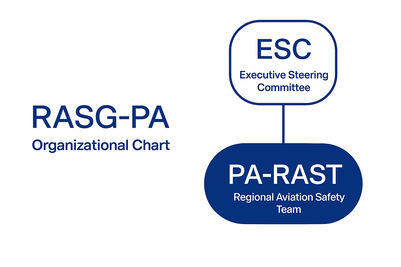
In order to accomplish its mandate, RASG-PA established the following organization:
  Executive Steering Committee (ESC); and 

  1. Pan America — Regional Aviation Safety Team (PA-RAST) 
rags.png 
 RASG-PA Chairmanship
 

RASG-PA Chairmanship is composed of two Co-Chairpersons:

  1. One from ESC member States/Territories; and
  2. One from ESC member International Organizations/Industry.

Currently, the Co-Chairpersons are:

Andrew Larsen (CANADA) – Co-Chairperson representing the States; and
Javier Vanegas (CANSO) – Co-Chairperson representing the Industry and International organizations.

(TBD) - Vice-Co-Chairpersons representing both member States/Territories andt he Industry and International organizations.

Executive Steering Committee (ESC)
 

The Executive Steering Committee is currently made up of the following members:
 

ArubaAirbus
BrazilALTA
CanadaATR
ChileBOEING
ColombiaCANSO
Costa RicaEMBRAER
Dominican RepublicIATA
PanamaIFALPA
United States 
Uruguay
 

For additional information, please contact: RASG-PA [at] icao.int (RASG-PA[at]icao[dot]int)​


Learn more about ICAO
  • Contact ICAO
  • The United Nations
  • Terms & Conditions
  • External Resources
  • web [at] icao.int (Web Support)
  • FAQ
Connect with us :
  • linkedIn
  • Facebook
  • Unitingaviation
  • ICAO-TV
  • Instagram
  • Youtube

© 2025 International Civil Aviation Organization